
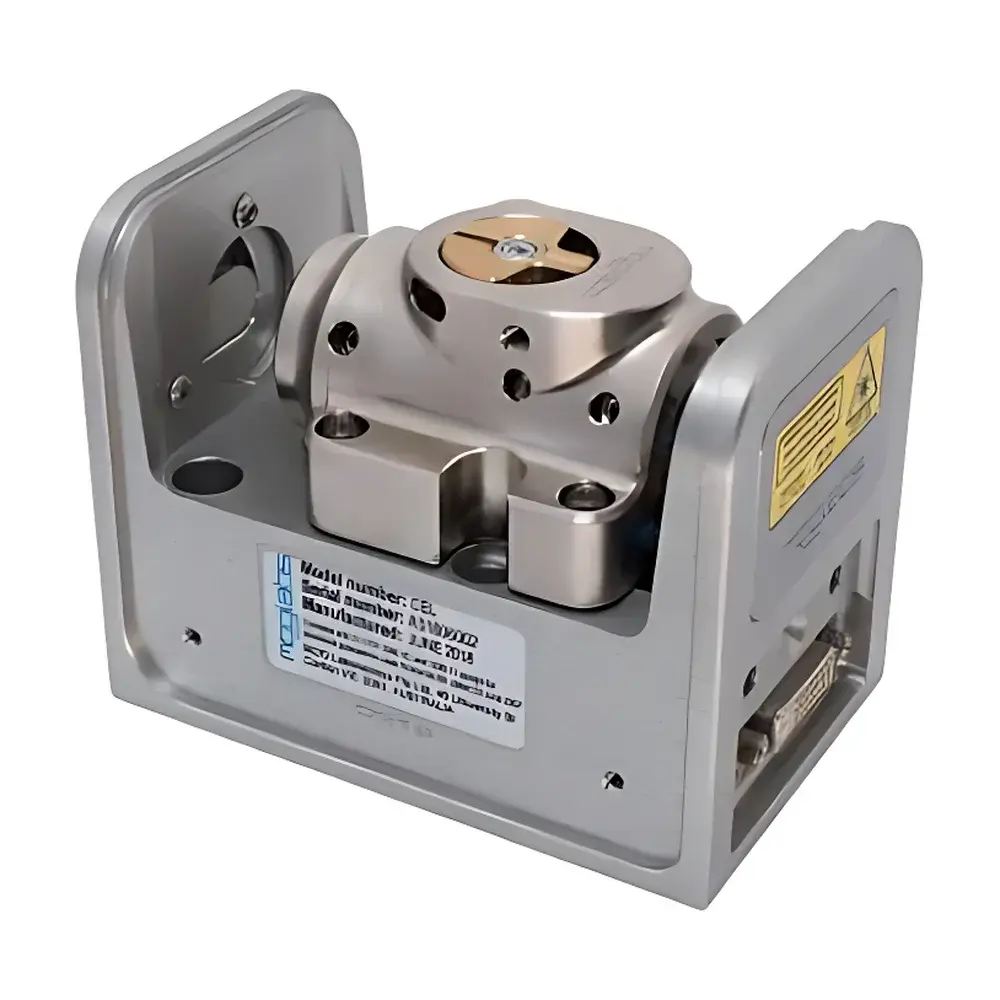
Moglabs CEL Series Ultra-Narrow Linewidth Tunable External-Cavity Semiconductor Laser
| Brand | Moglabs |
|---|---|
| Model | CEL Series |
| Type | External-Cavity Diode Laser (ECDL) |
| Wavelength Range | 450–530 nm & 630–1620 nm |
| Output Power | Up to 250 mW (LD-dependent) |
| Linewidth | <100 kHz (typical), down to 20 kHz (configuration-dependent) |
| Tuning Range | >20 GHz mode-hop-free scan (with MOGLabs controller) |
| Beam Diameter (1/e²) | ~0.6 mm × 0.3 mm |
| Polarization | >100:1 vertical linear |
| Modulation Bandwidth | 20 MHz (AC/DC-coupled, 20 ns delay optional) |
| RF Modulation | >2.5 GHz bandwidth via bias-tee |
| Piezo Feedback | High-bandwidth PZT actuation with user-replaceable Cateye module |
| Thermal Control | TEC (±14.5 V / 3.3 A |
| Cooling | Air-cooled standard |
| Compliance | Designed for GLP/GMP-aligned lab environments |
Overview
The Moglabs CEL Series represents a class of ultra-narrow linewidth tunable external-cavity semiconductor lasers engineered for demanding applications in quantum optics, atomic physics, and high-resolution spectroscopy. Unlike conventional grating-based ECDLs—whose mechanical rotation introduces alignment sensitivity and acoustic susceptibility—the CEL platform employs a patented Cateye retroreflector coupled with interference filters to form a vibration-immune, self-aligning external cavity. This architecture eliminates the need for post-tuning beam realignment and significantly improves long-term frequency stability, passive thermal robustness, and immunity to low-frequency mechanical perturbations. The laser operates on the principle of wavelength-selective feedback into a gain chip via a dispersive filter and phase-stable retroreflection path, enabling sub-100 kHz intrinsic linewidths (down to 20 kHz with optimized configuration) and mode-hop-free tuning over ≥20 GHz under piezoelectric control. Its design prioritizes metrological-grade repeatability, making it suitable for time-frequency standards, optical lattice clocks, and coherent quantum state manipulation where phase coherence duration exceeds milliseconds.
Key Features
- Cateye + interference filter cavity architecture ensures inherent self-alignment and acoustic immunity
- Passively stabilized mechanical structure with minimized thermal drift pathways
- Wide coarse tuning range—tens of nanometers—determined by diode selection (e.g., 776–802 nm or 850–895 nm per single LD)
- Continuous, mode-hop-free fine tuning over ≥20 GHz via high-bandwidth piezoelectric transducer (PZT)
- Direct current modulation up to 20 MHz with AC/DC coupling and selectable 20 ns delay
- RF modulation support via integrated bias-tee with >2.5 GHz bandwidth
- Vertical linear polarization ratio >100:1; beam profile typically 0.6 mm × 0.3 mm (1/e²)
- Integrated diode protection circuitry including relay-based interlock and current limiting
- Low-frequency noise optimization for sub-Hz servo locking and long-coherence applications
- User-replaceable Cateye module enables field maintenance without optical realignment
Sample Compatibility & Compliance
The CEL Series is compatible with standard TO-can and butterfly-packaged laser diodes across visible and near-infrared bands (450–530 nm and 630–1620 nm). Its modular mechanical interface accommodates various gain chips while preserving cavity alignment integrity. All units are manufactured to ISO 9001-certified processes and conform to IEC 61000-6-3 (EMI emission) and IEC 61000-6-2 (immunity) requirements. When operated with MOGLabs’ validated control software and hardware (e.g., Moku:Lab or dedicated PID controllers), the system supports audit-trail-enabled operation compliant with FDA 21 CFR Part 11 for regulated laboratories. The thermal management architecture—including TEC drivers with ±1 mK baseplate stability and optional water-cooling—meets environmental specifications outlined in ISO/IEC 17025 for calibration labs performing traceable frequency measurements.
Software & Data Management
Moglabs provides native LabVIEW and Python APIs for full instrument control, including wavelength setpoint programming, modulation envelope definition, and real-time lock error signal monitoring. The included controller firmware implements dual-loop servo architecture: fast PZT feedback (bandwidth >100 kHz) for intra-cavity phase correction and slower current/TEC loops for coarse stabilization. Data logging supports timestamped spectral scans, lock acquisition history, and thermal drift profiles—with export formats compatible with MATLAB, Origin, and HDF5-based analysis pipelines. For GxP environments, optional validation packages include IQ/OQ documentation, electronic signature support, and configurable audit trails meeting ALCOA+ principles (Attributable, Legible, Contemporaneous, Original, Accurate, Complete, Consistent, Enduring, Available).
Applications
- Laser cooling and trapping of neutral atoms (e.g., Rb, Cs, Sr, Yb)
- Bose-Einstein condensation experiments requiring multi-second coherence times
- Trapped-ion quantum computing platforms demanding sub-kHz laser frequency jitter
- Generation of squeezed and entangled optical states in quantum optics setups
- Electromagnetically induced transparency (EIT) and slow-light experiments
- Primary and secondary optical frequency standards referenced to atomic transitions
- Doppler-free saturated absorption spectroscopy with resolution below 1 MHz
- Interferometric sensing in gravitational wave detector prototype systems
- Undergraduate and graduate-level quantum physics laboratory instruction
FAQ
What distinguishes the CEL Series from traditional grating-based ECDLs?
The CEL uses a Cateye retroreflector and interference filter instead of a rotating diffraction grating—eliminating mechanical misalignment, reducing sensitivity to vibrations, and enabling self-aligning operation during tuning.
Can the CEL laser be locked to an atomic reference such as a rubidium D2 line?
Yes—its narrow intrinsic linewidth, high servo bandwidth, and low-frequency noise make it suitable for direct Pound-Drever-Hall or modulation-transfer locking to atomic vapour cells or high-finesse cavities.
Is water cooling required for continuous-wave operation at maximum output power?
No—air cooling suffices for typical operation up to 250 mW; optional recirculating water cooling is recommended only for extended 24/7 operation in ambient temperatures exceeding 30°C.
Does the system support remote operation over Ethernet or USB?
Yes—full SCPI command set is available over USB 2.0 and Ethernet (TCP/IP), with deterministic latency ≤100 µs for closed-loop control loops.
Are calibration certificates traceable to NIST or other national metrology institutes available?
Traceable wavelength calibration reports (with uncertainty budgets) can be provided upon request, referencing NIST-traceable wavemeters and iodine-stabilized HeNe references.




