Moglabs MSA Series High-Power Master Oscillator Power Amplifier (MOPA) External Cavity Diode Laser
| Brand | Moglabs |
|---|---|
| Origin | Australia |
| Model | MSA Series ECDL-Based MOPA Laser |
| Wavelength Range | 630–1064 nm |
| Output Power | Up to 4 W (wavelength-dependent) |
| Linewidth | <100 kHz |
| ASE Suppression | >45 dB |
| Small-Signal Gain | Up to 23 dB |
| Seed Input Requirement | 10–30 mW |
| Gain Bandwidth | 10–30 nm (wavelength-dependent) |
| Polarization Extinction Ratio | >20 dB |
| Beam Collimation | Integrated, Linearly Aligned Coupling Lenses |
| Amplifier Module Replaceability | User-Serviceable TA Diode Cartridge |
| Optional Configurations | Dual-Stage Isolator (5 mm aperture), Single-Mode Fiber Coupling, Frequency Stabilization Kit, Power Stabilization Module, Astigmatism-Corrected Output, Dual-Beam (Free-Space + Fiber) |
Overview
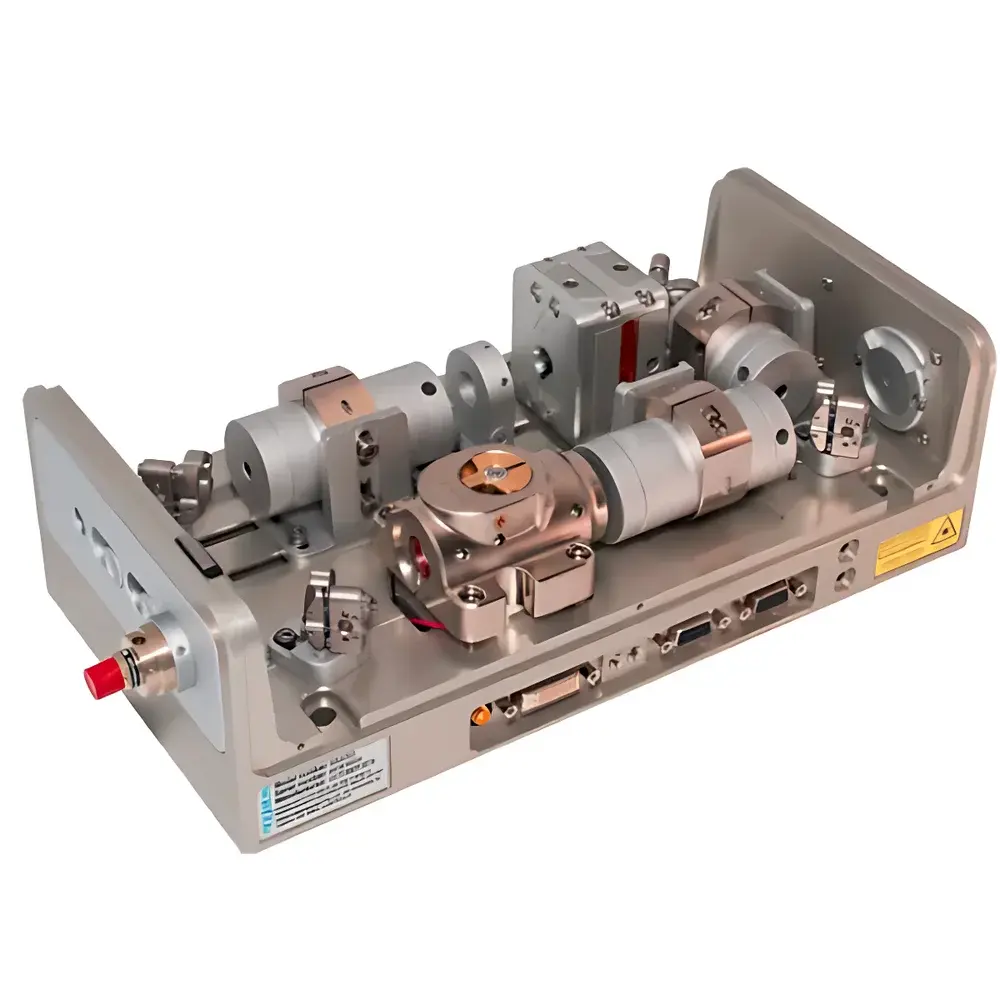
The Moglabs MSA Series is a high-performance master oscillator power amplifier (MOPA) system built around a precision-engineered external cavity diode laser (ECDL) seed source and a robust tapered amplifier (TA) stage. Designed specifically for demanding atomic, molecular, and optical physics applications—including laser cooling, Bose-Einstein condensation (BEC), dipole trapping, and Rydberg excitation—the MSA integrates low-noise frequency stability with high-power, diffraction-limited output in a compact, mechanically rigid platform. Its core architecture employs a linearly aligned, monolithic lens train for both seed injection and amplified beam collimation, minimizing alignment sensitivity and delivering exceptional passive long-term stability. The ECDL seed provides sub-100 kHz intrinsic linewidth and negligible frequency drift, while the TA stage delivers up to 4 W of narrowband, single-spatial-mode output across 630–1064 nm—enabling direct replacement of traditional Ti:sapphire or fiber lasers in many ultra-cold atom laboratories.
Key Features
- Ultra-Stable MOPA Architecture: Combines a low-drift, cateye-type ECDL seed with a high-gain tapered amplifier in a thermally and mechanically decoupled configuration—ensuring minimal coupling of pump noise into the output beam.
- User-Replaceable Amplifier Module: The TA diode is housed in a field-serviceable cartridge, allowing rapid replacement without realignment or vacuum break—critical for maintaining uptime in multi-user or 24/7 experimental setups.
- Passive Beam Stability: Linear optical layout with kinematically mounted, anti-reflection-coated coupling lenses eliminates angular drift and enables long-term pointing stability (<5 µrad/h) without active feedback.
- High ASE Suppression: Optimized internal filtering and TA biasing achieve >45 dB amplified spontaneous emission (ASE) suppression—essential for high-fidelity spectroscopy and coherent manipulation protocols.
- Flexible Output Options: Supports free-space collimated output, single-mode fiber coupling (SMF-28 or polarization-maintaining variants), dual-beam operation (simultaneous fiber + free-space), and integrated astigmatism correction optics.
- Modular Isolation Integration: Compatible with compact 4 mm aperture isolators for space-constrained setups or high-isolation dual-stage isolators (5 mm aperture, >60 dB isolation) for stringent back-reflection rejection requirements.
Sample Compatibility & Compliance
The MSA series is engineered for compatibility with standard ultra-high-vacuum (UHV) optical tables and laser safety enclosures (Class 3B/4 compliant per IEC 60825-1:2014). Its mechanical design conforms to ISO 9001-certified manufacturing practices at Moglabs’ Australian facility, and all optical coatings meet MIL-C-48497A specifications for environmental durability. While not inherently GLP/GMP-certified, the system supports integration into regulated environments via optional frequency and power stabilization modules—each equipped with analog/digital monitoring outputs traceable to NIST-calibrated references. For applications requiring audit-ready control, the MSA can be operated under LabVIEW or Python-based automation frameworks compliant with FDA 21 CFR Part 11 when paired with appropriate electronic loggers and role-based access controls.
Software & Data Management
Moglabs provides the LaserControl software suite (Windows/macOS/Linux) for full instrument orchestration—including wavelength scanning, current/temperature ramping, lock-point management, and real-time diagnostics (e.g., TA voltage, photodiode feedback, interlock status). All operational parameters are logged with timestamped metadata in HDF5 format, supporting reproducible experiment reconstruction. Remote operation via TCP/IP or USB CDC serial interface enables integration into larger control systems (EPICS, Qudi, or custom Python daemons). Optional frequency stabilization kits include Pound-Drever-Hall (PDH) electronics with configurable loop bandwidths (10 Hz–100 kHz), enabling locking to ultra-stable cavities or atomic transitions (e.g., Rb D2, Sr intercombination line) with sub-kHz residual error.
Applications
- Laser cooling and magneto-optical trapping (MOT) of alkali atoms (Rb, Cs, Na), alkaline earths (Sr, Yb), and metastable species (Ca, Mg)
- Bose-Einstein condensation and degenerate Fermi gas production in optical dipole traps
- Rydberg excitation and quantum gate implementation in neutral-atom arrays
- High-resolution Doppler-free spectroscopy and optical frequency metrology
- Pump-probe experiments requiring synchronized, narrow-linewidth, high-peak-power pulses (when combined with AOM/EOM modulation)
- Optical lattice clock interrogation beams and local oscillator sources
FAQ
What is the typical warm-up time to achieve thermal equilibrium and stable output?
The MSA achieves <±50 MHz frequency stability within 30 minutes of power-on; full thermal settling (for sub-10 kHz repeatability) requires ~90 minutes under ambient lab conditions (20–25°C).
Can the MSA be locked to an atomic reference without additional hardware?
No—the base unit does not include integrated locking electronics. However, the optional PDH stabilization kit provides all necessary RF components, servo amplifiers, and reference cavity interfaces.
Is fiber coupling compatible with all available wavelengths?
Yes—single-mode fiber coupling is supported across the entire 630–1064 nm range, though coupling efficiency varies (typically 60–75%) depending on wavelength-specific mode field diameter matching.
How is ASE suppression achieved, and can it be further improved?
ASE suppression relies on optimized TA current density profiling, internal spectral filtering, and spatial mode discrimination. Adding an external bandpass filter (e.g., 1 nm FWHM) before the isolator can improve suppression by an additional 5–10 dB.
Does Moglabs provide calibration certificates traceable to national standards?
Yes—NIST-traceable wavelength calibration reports (±0.5 pm uncertainty) and power meter calibration certificates (±2% at 780 nm) are available as optional deliverables upon request.