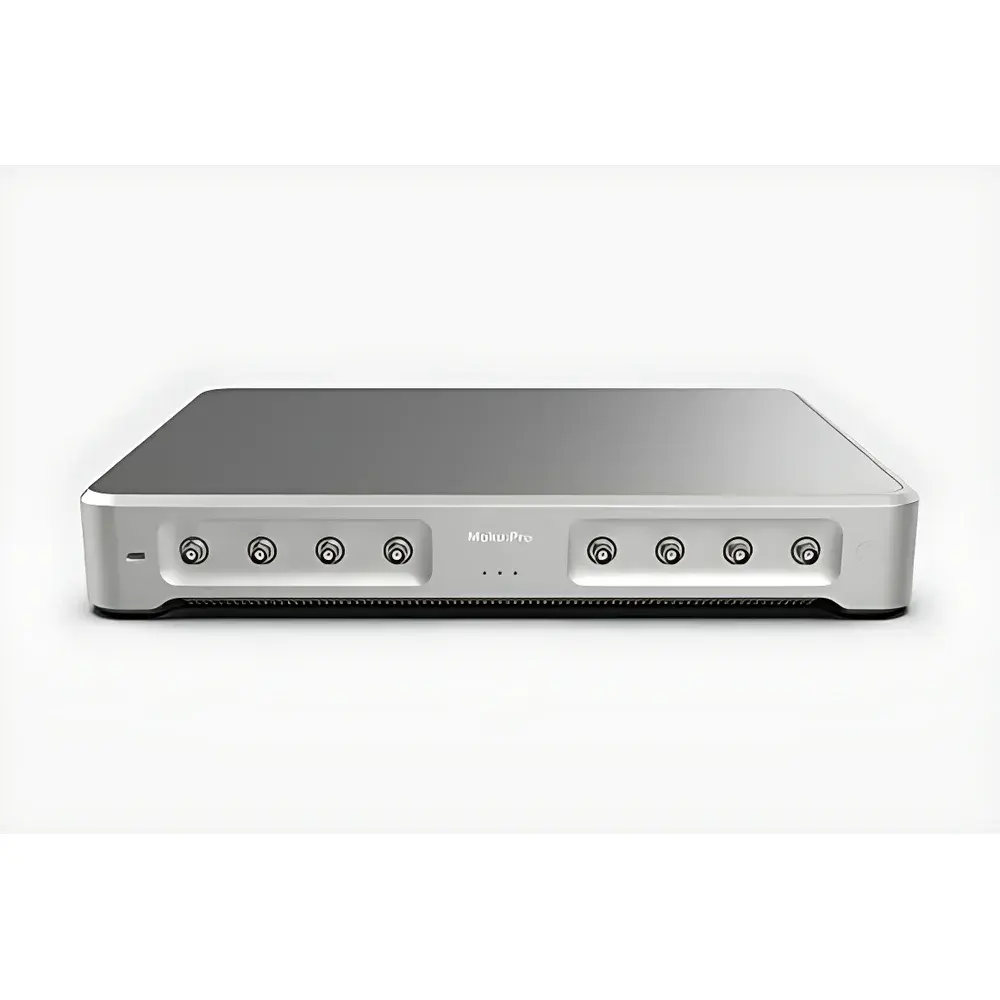
Moku:Pro Multifunctional Scientific Instrument by Liquid Instruments
| Brand | Liquid Instruments (LI) |
|---|---|
| Model | Moku:Pro |
| Type | Software-Defined Lock-in Amplifier & 9-in-1 Test Platform |
| FPGA | Xilinx UltraScale+ |
| Analog Bandwidth | Up to 200 MHz (per channel) |
| Sampling Rate | 1 GSa/s (real-time, dual-channel) |
| Input Voltage Range | ±10 V (50 Ω / 1 MΩ selectable) |
| Dynamic Reserve | >120 dB |
| Phase Resolution | <1 µrad/√Hz |
| Data Storage | Internal 128 GB SSD + Network Streaming (10 GbE) |
| Compliance | CE, FCC Class A, RoHS |
Overview
The Moku:Pro by Liquid Instruments is a high-performance, software-defined multifunctional scientific instrument engineered for precision signal recovery, real-time control, and broadband measurement in advanced research and industrial R&D environments. At its core, the Moku:Pro implements digital lock-in amplification using a fully programmable Xilinx UltraScale+ FPGA, enabling phase-sensitive detection with sub-microradian resolution and dynamic reserve exceeding 120 dB. Unlike traditional analog lock-in amplifiers, Moku:Pro performs all demodulation, filtering, and feedback computations in the digital domain—eliminating drift, component aging, and calibration dependency. Its 200 MHz analog input bandwidth and 1 GSa/s real-time sampling support high-frequency applications including quantum sensing, optical interferometry, scanning probe microscopy, and low-noise cryogenic measurements. The platform operates as a deterministic, low-latency measurement node—capable of closed-loop operation with latency under 100 ns for PID control and adaptive feedback systems.
Key Features
- 9 integrated instruments in one hardware platform: Lock-in amplifier, oscilloscope, spectrum analyzer, arbitrary waveform generator (AWG), data logger, phase meter, PID controller, frequency response analyzer (FRA), and laser lock box—all concurrently accessible via time-division multiplexing on shared analog I/O.
- Ultra-low noise analog front-end: Dual-channel, DC-coupled inputs with switchable 50 Ω / 1 MΩ termination, ±10 V full-scale range, and <1 nV/√Hz input-referred voltage noise (at 1 kHz).
- Real-time FPGA processing: All signal processing—including dual-phase demodulation, IIR/FIR filtering, FFT up to 16 Mpts, and custom logic—is executed deterministically on the UltraScale+ FPGA without CPU bottlenecks or OS jitter.
- High-throughput data infrastructure: 10 Gigabit Ethernet interface enables sustained streaming of raw ADC data (>700 MB/s) to host computers; onboard 128 GB SSD supports autonomous long-duration logging (e.g., multi-day thermal drift studies).
- Lab-grade synchronization: Support for external 10 MHz reference clock input and ultra-stable internal oven-controlled crystal oscillator (OCXO) ensures phase-coherent operation across distributed Moku units in multi-instrument setups.
Sample Compatibility & Compliance
The Moku:Pro interfaces directly with a broad range of transducers and sensors—including photodiodes, piezoelectric actuators, SQUIDs, Hall probes, and RF mixers—without requiring external signal conditioning. Its wide input voltage range and impedance options accommodate both high-impedance electrochemical cells and 50 Ω RF sources. From a regulatory standpoint, the instrument conforms to EN 61326-1:2013 (EMC for laboratory equipment), EN 61000-3-2/-3 (harmonic current and voltage fluctuations), and RoHS Directive 2011/65/EU. It meets CE marking requirements for use in EU-based academic laboratories, metrology institutes, and ISO/IEC 17025-accredited testing facilities. While not FDA-certified as a medical device, its deterministic architecture and audit-ready logging capabilities align with GLP and GMP principles for instrument qualification (IQ/OQ/PQ) documentation workflows.
Software & Data Management
Moku:Pro is operated exclusively through the cross-platform Moku Cloud Compile™ software, which provides browser-based access (Chrome, Edge, Safari) and native macOS/Windows applications. All instrument configurations are saved as human-readable JSON files, enabling version control via Git and reproducible experiment scripting. Raw time-series and spectral data export in HDF5 format ensures compatibility with Python (NumPy, SciPy, h5py), MATLAB, and LabVIEW. The software includes built-in support for SCPI command over TCP/IP, enabling integration into automated test sequences compliant with IEEE 488.2 and IVI-C specifications. Audit trails—including parameter changes, firmware updates, and user login events—are logged with UTC timestamps and stored locally; optional integration with enterprise syslog servers supports centralized compliance monitoring per ISO/IEC 27001 requirements.
Applications
- Quantum technology: Homodyne/heterodyne readout of superconducting qubits, spin resonance detection (ODMR), and cavity optomechanics feedback stabilization.
- Nanoscale metrology: Real-time topographic correction in atomic force microscopy (AFM) using dual-lock-in amplitude/phase tracking at harmonics up to 100 MHz.
- Optical coherence tomography (OCT): Carrier-envelope phase extraction and dispersion compensation via parallel lock-in demodulation across multiple wavelength channels.
- Materials characterization: Low-frequency dielectric spectroscopy (10 mHz–10 MHz) with simultaneous capacitance/resistance measurement using internal FRA and lock-in modes.
- Industrial process control: Embedded PID tuning for laser temperature stabilization, vacuum chamber pressure regulation, and MEMS resonator Q-factor optimization.
FAQ
What is the maximum achievable time resolution in lock-in mode?
Time resolution is governed by the instrument’s 1 GSa/s sampling rate and configurable averaging window; minimum integration time is 1 ns per sample point, with effective time-domain resolution down to 200 ps when using interpolation-enabled demodulation.
Can Moku:Pro operate standalone without a host PC?
Yes—once configured via network, Moku:Pro executes all instruments autonomously using its embedded Linux subsystem and FPGA fabric; no continuous host connection is required for data acquisition or control loop execution.
Is third-party FPGA code deployment supported?
No—Moku:Pro uses a locked, vendor-verified bitstream architecture. Custom logic must be implemented via the provided Lua-based scripting API or compiled instrument firmware extensions approved by Liquid Instruments.
How does Moku:Pro handle ground loops and common-mode noise?
It features fully differential analog inputs with >100 dB CMRR up to 10 MHz, galvanically isolated 10 GbE interface, and optional battery-powered operation to eliminate earth-reference coupling in sensitive low-noise experiments.
Does it support multi-unit phase synchronization?
Yes—via the dedicated 10 MHz reference I/O port and sub-nanosecond timestamp alignment across up to 16 synchronized Moku units using Precision Time Protocol (PTPv2) over a managed Gigabit Ethernet switch.