
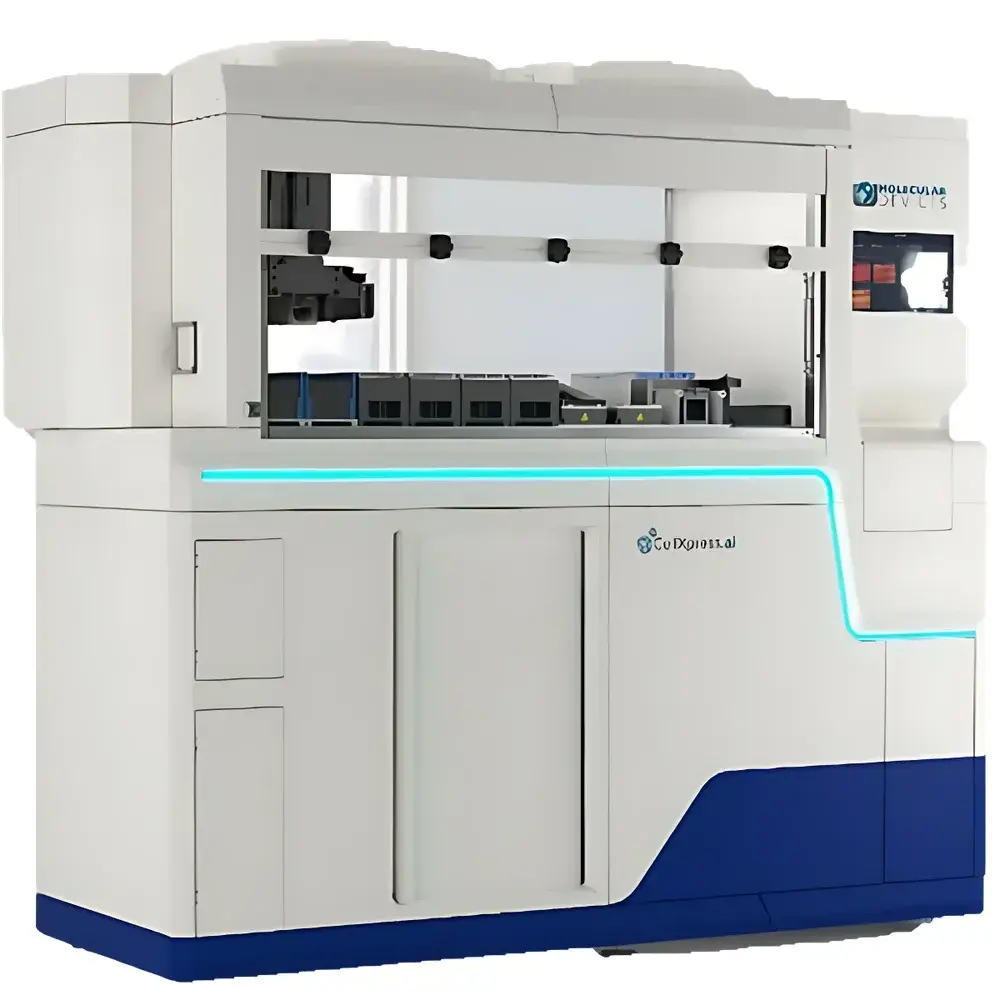
Molecular Devices CellXpress.ai Automated Integrated Organoid Workstation
| Brand | Molecular Devices |
|---|---|
| Origin | USA |
| Manufacturer Type | Manufacturer |
| Origin Category | Imported |
| Model | CellXpress.ai |
| Pricing | Upon Request |
| Temperature Control | Yes |
| Humidity Control | Yes |
| Incubation Capacity | Up to 44 microplates (2 stackers) or 154 microplates (7 stackers) |
| Imaging Speed | 3.5 minutes per 96-well plate (single channel, single field of view) |
| Environmental Control | CO₂, temperature, and humidity regulation |
| Excitation Wavelengths | 7 LED sources, 365–730 nm |
| Camera Resolution | 24 MP |
| Objective Lenses | 2×, 4×, 10×, 20×, 40× |
| Imaging Channels | Brightfield + up to 6 fluorescence channels |
| AI Decision Engine | Rule-based machine learning for real-time morphological assessment |
| Air Filtration | HEPA filtration + integrated UV sterilization |
| Predefined & Custom Protocols | Yes |
Overview
The Molecular Devices CellXpress.ai Automated Integrated Organoid Workstation is a fully integrated, AI-augmented cell culture platform engineered for reproducible, scalable, and traceable 2D, 3D, and organoid model development. Built upon a modular incubator-imager-liquid handler architecture, it applies computer vision–guided decision logic grounded in morphological phenotyping to automate critical culture steps—including seeding, media exchange, passaging, and time-lapse imaging—without requiring programming expertise. Unlike conventional high-content systems that prioritize endpoint imaging, CellXpress.ai embeds process intelligence into the culture lifecycle itself: it continuously monitors structural evolution (e.g., spheroid compaction, lumen formation, neural rosette emergence) using multi-channel brightfield and fluorescence microscopy, then triggers protocol-adjusted interventions based on pre-validated morphometric thresholds. This closed-loop operational paradigm aligns with Good Cell Culture Practice (GCCP) and supports GLP-compliant workflows in regulated environments where auditability, environmental stability, and operator-independent reproducibility are non-negotiable.
Key Features
- Intelligent Process Automation: Eliminates manual intervention through rule-based AI decisions derived from real-time image analysis—no coding required. Users define biological endpoints (e.g., “spheroid diameter ≥ 80 µm + circularity > 0.75”) to trigger media change or harvesting.
- Environmental Fidelity: Dual-sensor CO₂ control (±0.1% accuracy), precision temperature regulation (±0.2°C across 20–40°C range), and active humidity management (30–95% RH, ±3% RH) ensure physiologically relevant conditions for long-term organoid maturation.
- Scalable Incubation Architecture: Modular stacker system accommodates up to 7 independent plate carriers (154 total plates), enabling parallel culture of heterogeneous stem cell lines, patient-derived organoids, or co-culture models under identical environmental parameters.
- High-Fidelity Multimodal Imaging: 24 MP scientific CMOS camera with motorized turret supporting 2×–40× objectives; 7-LED excitation engine (365–730 nm) enables spectral flexibility for GFP/mCherry/CFP/Hoechst/NIR probes without filter wheels.
- Contamination Mitigation: Integrated HEPA filtration (ISO Class 5 airflow) and pulsed UV-C irradiation between runs minimize microbial carryover—critical for low-passage primary organoid expansion.
- Protocol Standardization Engine: Library of validated 2D monolayer, 3D spheroid, and intestinal/liver/cortical organoid protocols; drag-and-drop workflow builder enforces SOP compliance while allowing parameter tuning (e.g., shear stress during media exchange).
Sample Compatibility & Compliance
CellXpress.ai supports diverse biological specimens including human iPSC-derived organoids (gut, brain, kidney), tumor organoids, embryoid bodies, and scaffold-free spheroids (e.g., U87MG, MCF7). Its environmental consistency meets ASTM E1917-22 (Standard Guide for Cell Culture Quality Assurance) requirements for incubator performance validation. The system’s electronic logbook captures timestamped metadata for every imaging event, liquid handling action, and environmental deviation—enabling full 21 CFR Part 11–compliant audit trails when deployed with Molecular Devices’ SoftMax Pro GxP software module. All hardware components comply with IEC 61010-1 safety standards for laboratory equipment.
Software & Data Management
Controlled via CellXpress Software v4.x, the platform delivers unified management of hardware orchestration, image acquisition, and AI-driven analysis. Raw data (TIFF/OME-TIFF) and processed outputs (morphometric CSV, heatmaps, growth curves) are stored in FAIR-compliant format. The software integrates natively with major LIMS platforms (e.g., LabVantage, Thermo Fisher SampleManager) and supports automated export to cloud-based analysis environments (e.g., Python-based scikit-image pipelines or commercial tools like Huygens deconvolution). Audit logs record user identity, action type, timestamp, and outcome status—meeting ISO/IEC 17025 documentation rigor for accredited testing laboratories.
Applications
- Drug Discovery: Longitudinal toxicity profiling in liver organoids (CYP450 induction, bile acid accumulation) with automated endpoint selection to reduce false positives in early screening cascades.
- Disease Modeling: Tracking neurodevelopmental progression in cortical organoids over 60+ days, quantifying synaptic density changes via synaptophysin/GFAP co-staining without manual intervention.
- Regenerative Medicine: Standardizing differentiation efficiency across donor-matched iPSC lines by enforcing identical morphokinetic thresholds for mesenchymal condensation or chondrogenic nodule formation.
- Precision Oncology: Rapid expansion and drug-response phenotyping of patient-derived tumor organoids (PDOs), with AI-guided exclusion of necrotic cores prior to IC₅₀ calculation.
- Toxicology: OECD TG 492–aligned reconstructed human epidermis (RHE) assays, where barrier integrity is assessed via TEER-correlated ZO-1 fluorescence intensity trends.
FAQ
Does CellXpress.ai support live-cell imaging with environmental maintenance during acquisition?
Yes. The system maintains CO₂, temperature, and humidity within specification during all imaging sessions, including extended time-lapse experiments up to 14 days.
Can users import custom deep learning models for morphology classification?
No. The AI engine operates exclusively on rule-based morphometric classifiers trained on Molecular Devices–curated organoid datasets; third-party model injection is not supported to preserve regulatory traceability.
Is remote monitoring and control available outside the local network?
Secure remote access is enabled via TLS-encrypted web interface with role-based permissions, compliant with HIPAA and GDPR data transfer requirements.
What validation documentation is provided for GMP environments?
IQ/OQ/PQ protocols, calibration certificates for environmental sensors, and 21 CFR Part 11 readiness reports are included with purchase and updated annually.
How does the system handle edge cases such as partial well contamination or focus drift?
Automated quality control flags suboptimal fields (e.g., motion blur, out-of-focus stacks, debris occlusion) and excludes them from analysis—retaining only high-confidence data points in final reports.



