
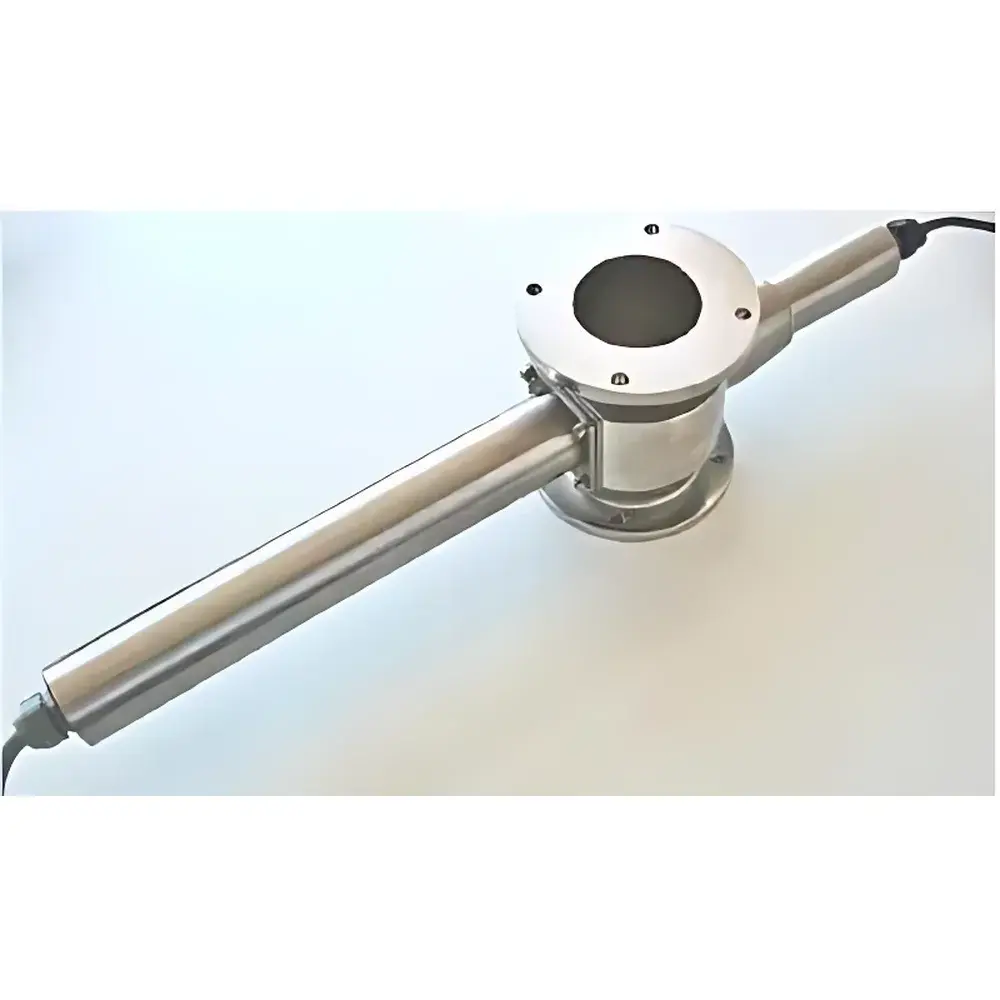
MoniSpec-UV MSUV Online TOC Analyzer (UV Absorption Method)
| Origin | Imported |
|---|---|
| Manufacturer Type | Authorized Distributor |
| Model | UV-140 |
| Measurement Principle | Single-Wavelength UV Absorption (254 nm or 280 nm) |
| Sensor Material | 1.4404 (316L Stainless Steel) |
| Window Material | Sapphire |
| Protection Rating | IP65 / NEMA 4X |
| Process Connections | DIN, ANSI, SMS, NPT, APV, TH |
| Pipe Size Range | DN25–DN125 (½″–5″) |
| Max. Process Pressure | 16 bar (PN16) / 150 psi (ANSI Class 150) |
| Max. Process Temperature | 90°C continuous, 140°C short-term |
| Cable Length | Up to 100 m |
| Detection System | Dual-Diode Photometric (Reference + Measurement at 254 nm or 280 nm) |
| Measurement Range | 0–2 AU (Absorbance Units) |
| Accuracy | ±2% of reading |
| Reproducibility | ±1% |
| Calibration Interval | 12 months |
| Optional Features | CIP-compatible cleaning jet probe, air purge (4 mm), Ex-zone I/II certification available |
| Compatible Transmitter | Messenger Series |
Overview
The MoniSpec-UV MSUV Online TOC Analyzer is a robust, process-integrated ultraviolet absorption sensor engineered for continuous, real-time monitoring of organic carbon content in liquid streams—primarily water, wastewater, and purified process water. Unlike combustion-based TOC analyzers, this instrument operates on the well-established principle of single-wavelength UV absorbance, leveraging the strong correlation between UV absorbance at 254 nm (or optionally 280 nm) and dissolved organic carbon concentration. This correlation is empirically validated across diverse matrices including surface water, drinking water, biopharmaceutical rinse solutions, and effluent from chemical and petrochemical plants. The sensor does not require reagents, high-temperature oxidation, or sample digestion—eliminating consumables, maintenance overhead, and analytical delay. Its optical architecture employs two synchronized silicon photodiodes: one positioned adjacent to the UV lamp as a reference detector, and the other downstream of the flow cell as the measurement detector. This dual-detector configuration enables real-time compensation for lamp intensity drift, window fouling, and thermal drift—ensuring stable baseline performance over extended deployment cycles.
Key Features
- Dual-diode photometric design with active reference compensation for long-term signal stability
- Sapphire optical windows offering exceptional chemical resistance, scratch hardness (Mohs 9), and thermal shock tolerance up to 140°C
- Modular process interface supporting multiple international standards: DIN 11851, ANSI B16.5, SMS 1145, NPT, APV Tri-Clamp, and TH flanges
- CIP-compatible cleaning jet probe option enabling automated, non-intrusive window cleaning without process interruption
- Configurable optical path length (standard and extended variants) to accommodate wide dynamic range—from low-level UV254 monitoring (0–20 Hazen) to high-concentration SAC applications (0–50,000 Hazen)
- IP65/NEMA 4X-rated housing suitable for harsh industrial environments; optional ATEX/IECEx certification available for Zone 1 and Zone 2 hazardous areas
- 12-month calibration interval supported by traceable factory calibration and built-in diagnostic logging
Sample Compatibility & Compliance
The MoniSpec-UV MSUV is validated for use with clear to moderately turbid aqueous streams where UV-absorbing organics dominate the spectral signature. It is widely deployed in GMP-regulated biopharma clean-in-place (CIP) validation, municipal drinking water distribution integrity monitoring, and upstream hydrocarbon processing water loops. While not a direct replacement for ASTM D5903 or ISO 8245-compliant high-temperature catalytic oxidation TOC analyzers, it meets functional equivalence requirements for surrogate TOC trending per USP , EP 2.2.44, and pharmacopeial guidance on UV absorbance-based water quality control. Its output supports 21 CFR Part 11-compliant data integrity when integrated with Messenger transmitters equipped with audit-trail-enabled firmware. No sample filtration is required under normal operating conditions, though particulate load >50 mg/L may necessitate upstream straining or enhanced cleaning frequency.
Software & Data Management
The sensor operates exclusively with the Messenger series transmitter platform, which provides embedded signal conditioning, temperature compensation (via integrated Pt100 RTD), linearization algorithms, and configurable analog/digital outputs (4–20 mA, HART, Modbus RTU/TCP). All calibration parameters, diagnostic events (e.g., lamp output decay, window transmission loss), and maintenance logs are stored locally with time-stamped metadata. When connected to centralized SCADA or MES systems via Ethernet/IP or OPC UA, the system supports automated alarm thresholds, trend export in CSV/Excel format, and integration into electronic batch records (EBR). Firmware updates and configuration changes are performed remotely using the web-based Messenger Configuration Tool—eliminating field service visits for routine parameter adjustments.
Applications
- Real-time UV254 monitoring for disinfection by-product (DBP) precursor tracking in drinking water treatment
- TOC surrogate measurement in pharmaceutical purified water (PW) and water-for-injection (WFI) distribution loops
- Spectral Absorption Coefficient (SAC) determination for wastewater treatment plant influent characterization
- Process water quality assurance in semiconductor fab ultrapure water (UPW) sub-loops
- Leak detection and cross-contamination monitoring in multi-product bioreactor suites
- Effluent compliance verification in chemical manufacturing facilities subject to local TOC discharge limits
FAQ
Does the MoniSpec-UV measure total organic carbon directly?
No—it measures UV absorbance at 254 nm or 280 nm, which serves as a validated surrogate for TOC in matrices where aromatic and unsaturated compounds dominate the organic fraction. Correlation to absolute TOC requires matrix-specific calibration against a reference method (e.g., high-temperature catalytic oxidation).
Can the sensor be installed in pressurized pipelines?
Yes—rated for continuous operation up to 16 bar (PN16) at 90°C, with short-term exposure capability to 140°C, making it suitable for hot water return lines and steam condensate monitoring.
Is sapphire the only window material option?
Sapphire is standard for maximum durability; fused quartz (quartz) is available upon request for specific UV transmission profiles or cost-sensitive deployments.
How often does the cleaning jet probe require maintenance?
Under typical municipal water conditions, the jet probe operates reliably for >12 months between inspections; in high-fouling applications (e.g., activated sludge effluent), quarterly nozzle inspection is recommended.
Can the sensor operate without the Messenger transmitter?
No—the sensor lacks onboard signal processing or power regulation; it is a passive optoelectronic module requiring the Messenger’s regulated UV drive current, synchronous detection circuitry, and environmental compensation algorithms.







