MONITEK TA6-F-S Tri-Beam Laboratory Turbidimeter
| Brand | Galvanic |
|---|---|
| Origin | Imported |
| Manufacturer Type | Authorized Distributor |
| Form Factor | Benchtop/Laboratory |
| Measurement Ranges | 0–250 EBC (90° side scatter), 0–80 EBC (12° forward scatter) |
| Resolution | 0.01 EBC (sensitivity), 0.05 NTU (display resolution) |
| Operating Temperature | 0–30 °C |
| Accuracy | <2% of reading |
| Repeatability | <1% (with standardized cuvettes) |
| Power Supply | 230 V AC (115 V AC optional) |
| Power Consumption | 60 VA |
| Dimensions | 450 × 300 × 300 mm |
| Weight | 9 kg |
| Measurement Time | ~17 s |
| Interface | RS-232 |
| Cuvette Rotation | Motorized, 360° continuous |
| Automatic Surface Defect Compensation | Yes |
| Color Compensation Algorithm | Embedded |
Overview
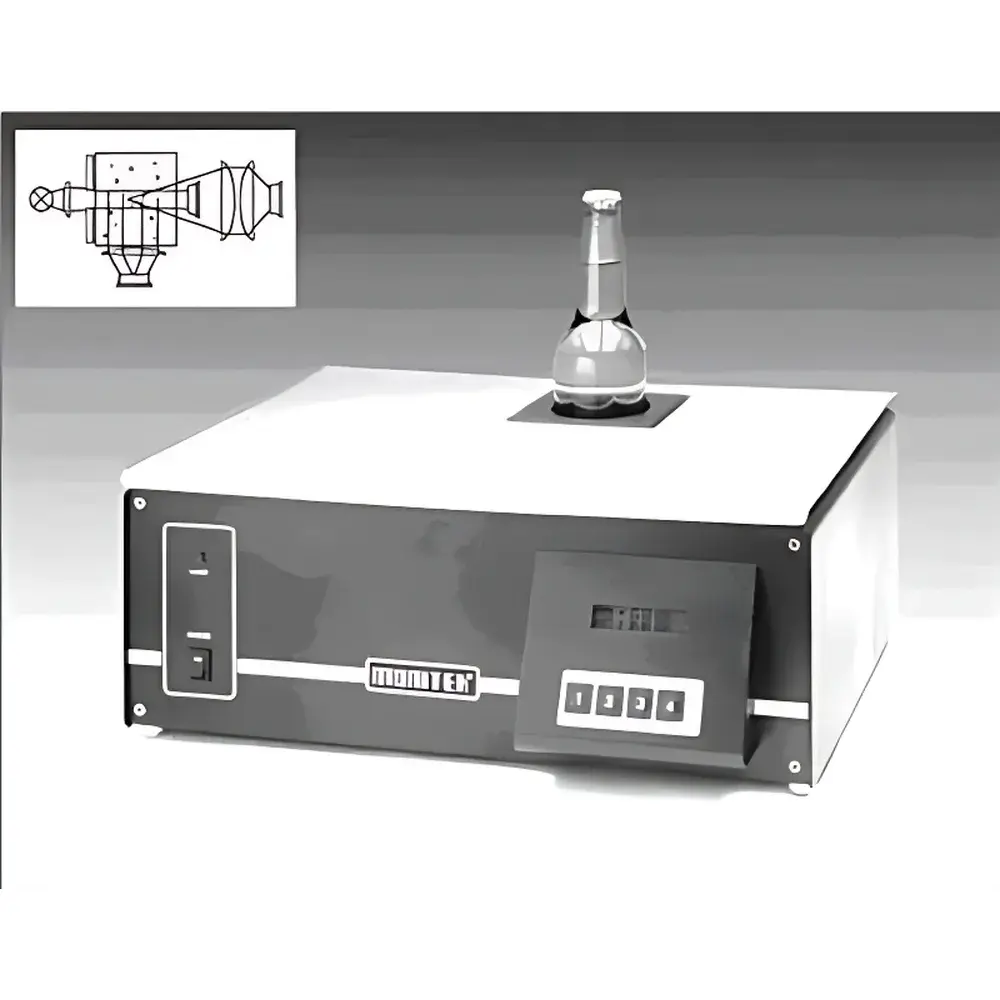
The MONITEK TA6-F-S Tri-Beam Laboratory Turbidimeter is an advanced optical instrument engineered for high-fidelity turbidity quantification in regulated and research-intensive laboratory environments. Unlike conventional single-beam or dual-beam turbidimeters, the TA6-F-S implements a rigorously validated tri-beam measurement architecture based on simultaneous detection of 12° forward-scattered light and 90° side-scattered light—both referenced against the unattenuated incident beam intensity. This dual-angle scattering methodology conforms to the physical principles defined in ISO 7027-1:2016 (optical methods for turbidity measurement) and supports traceable alignment with ASTM D6508 and USP <730> turbidity standards. The instrument’s core function is to quantify suspended particulate concentration and infer particle size distribution characteristics in transparent to semi-opaque liquid matrices—particularly where polydispersity, low-concentration submicron particles, or matrix color interference are critical analytical variables.
Key Features
- Dual-angle optical detection: Independent 12° forward scatter (optimized for linear concentration response across broad particle sizes) and 90° side scatter (enhanced sensitivity to particles <0.3 µm, per ISO 7027-1 Annex B)
- Motorized cuvette rotation system: Continuous 360° rotation during measurement acquires ≥200 discrete optical readings per cycle, enabling statistical rejection of surface artifacts (scratches, fingerprints, coating inconsistencies)
- Embedded color compensation algorithm: Automatically corrects for sample chromaticity (e.g., yellowing in beer or colored process waters) without requiring blank subtraction or manual calibration offsets
- Multi-unit reporting: Direct readout in EBC, NTU, FTU, ppm, TEF, and custom user-defined units—fully switchable via front-panel interface or software command
- Thermostatically stabilized water bath: Maintains cuvette temperature at ambient-equilibrated conditions (0–30 °C operating range); optional Peltier-controlled bath available for temperature-dependent studies
- RS-232 serial interface: Enables bidirectional communication with LIMS, ELN, or custom data acquisition systems; supports ASCII command protocol compliant with ASTM D6508 data export requirements
- Calibration management: Six-month calibration interval recommendation aligned with ISO/IEC 17025 internal quality control guidelines; NIST-traceable calibration kits available (EBC/NTU certified standards)
Sample Compatibility & Compliance
The TA6-F-S is validated for direct measurement of standard 25 mL glass bottles (e.g., DIN 55470 beer bottles), 10–50 mm pathlength quartz or borosilicate cuvettes, and disposable plastic vials (with refractive index correction). It accommodates viscous, mildly colored, or aerated samples common in brewing (wort, finished beer, cold break), pharmaceutical process streams (sterile filtrates, buffer solutions), wastewater effluents, and ultrapure water loops. Instrument design complies with IEC 61000-6-3 (EMC emissions) and IEC 61010-1 (safety for laboratory equipment). Data integrity features—including operator ID logging, timestamped measurement records, and non-editable raw scatter ratio outputs—support adherence to FDA 21 CFR Part 11 requirements when integrated with compliant software platforms.
Software & Data Management
While fully functional as a stand-alone benchtop analyzer, the TA6-F-S integrates with MONITEK’s optional TurbiSoft™ PC application (Windows 10/11 compatible) for advanced data handling. TurbiSoft™ provides audit-trail-enabled measurement history, customizable report generation (PDF/CSV/XLSX), trend analysis across batch sequences, and automated pass/fail evaluation against configurable specification limits (e.g., USP <730> acceptance criteria for injectables). All raw photodetector voltage ratios (I90°/I0, I12°/I0) are stored with metadata (cuvette ID, operator, date/time, ambient temperature), satisfying GLP and GMP documentation requirements. Firmware updates are delivered via secure HTTPS portal with SHA-256 signature verification.
Applications
- Beverage quality control: Real-time monitoring of haze stability in lager, cider, and non-alcoholic beverages per EBC Method 9.26
- Pharmaceutical manufacturing: Quantification of subvisible particles in parenteral solutions and filtration validation per USP <788> and <789>
- Environmental testing: Compliance assessment of wastewater discharge turbidity against EPA Method 180.1 and EU Directive 2000/60/EC
- Membrane process optimization: Detection of breakthrough events in ultrafiltration and nanofiltration systems using differential scatter ratio trends
- Chemical synthesis QC: Monitoring colloidal suspension stability during catalyst preparation or polymer emulsification
- Academic research: Particle sizing correlation studies leveraging the 12°/90° scatter ratio as a proxy for modal diameter shifts in polydisperse systems
FAQ
What regulatory standards does the TA6-F-S comply with?
The instrument adheres to ISO 7027-1:2016 for optical turbidity measurement methodology and supports compliance with ASTM D6508, USP <730>, and EPA Method 180.1 through documented measurement protocols and traceable calibration.
Can the TA6-F-S measure colored samples without interference?
Yes—the embedded color compensation algorithm uses real-time spectral referencing to decouple absorbance effects from true scattering signals, eliminating need for decolorization or dilution in most routine applications.
Is cuvette rotation mandatory for every measurement?
Yes—motorized rotation is integral to the measurement algorithm; it ensures statistical robustness by averaging >200 spatially distributed scatter readings and correcting for localized cuvette defects.
Does the instrument support 21 CFR Part 11 compliance?
When used with TurbiSoft™ v3.2+ and configured with electronic signatures, audit trails, and role-based access control, the system meets technical controls required for Part 11 compliance in regulated environments.
What is the recommended calibration frequency?
Galvanic recommends calibration every six months using NIST-traceable EBC/NTU standards; however, end-user quality procedures may require more frequent verification depending on usage intensity and risk assessment per ISO/IEC 17025 Clause 7.7.