
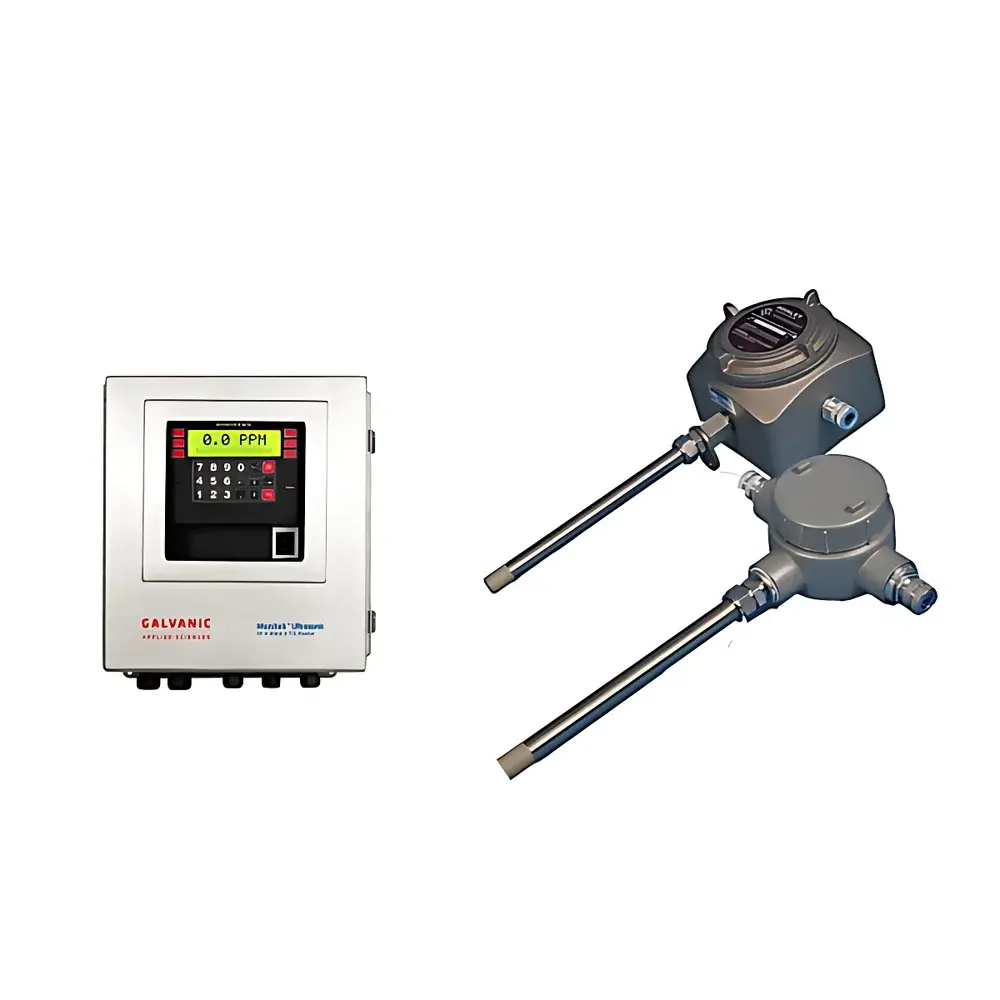
Monitek Ultrasonic Online Turbidity & Suspended Solids Analyzer
| Brand | Galvanic |
|---|---|
| Origin | USA |
| Model | Monitek1 |
| Type | Online Analyzer |
| Application | Real-time turbidity and total suspended solids (TSS) measurement in liquid process streams |
Overview
The Monitek Ultrasonic Online Turbidity & Suspended Solids Analyzer is an industrial-grade, non-invasive process analytical instrument engineered for continuous, real-time quantification of turbidity and total suspended solids (TSS) concentration in opaque, colored, or optically challenging liquids. Unlike optical turbidimeters that rely on light scattering—rendering them ineffective in dark, black, or highly absorbing media—the Monitek system operates on the principle of ultrasonic echo amplitude analysis. A piezoelectric transducer emits high-frequency acoustic pulses (5 MHz or 15 MHz selectable) into the process stream; particles suspended in the liquid reflect portions of the incident ultrasound energy back to the same or adjacent receiver element. The magnitude and temporal profile of the returned echo signal are directly correlated with particle density, size distribution (within practical limits), and concentration. This physical principle ensures immunity to ambient lighting, sample coloration, photodegradation, fouling-induced optical path obstruction, and UV-sensitive chemistry—making it uniquely suited for demanding applications in wastewater treatment, chemical synthesis, petrochemical refining, and pharmaceutical manufacturing where optical methods fail.
Key Features
- Ultrasonic echo-based measurement eliminates dependence on optical transmission or scattering—ideal for black liquor, bitumen emulsions, activated sludge, coal slurries, and other non-transparent process fluids
- Insertion-type probe design enables direct in-line or immersion installation in pressurized vessels, pipelines, open channels, or tanks—no sample extraction or bypass loop required
- Rated for continuous operation up to 20 bar (290 psi); optional configurations available for higher-pressure service
- Quick-insert/quick-remove probe mechanism via 1-inch ball valve—full calibration, cleaning, or replacement achievable without process shutdown
- Configurable output units including ppm, mg/L, % w/w, EBC, NTU-equivalent (calibration-dependent), and custom linearized engineering units
- Transmitter supports up to 16-point multi-point calibration using certified reference suspensions—enabling accurate response across wide dynamic ranges (0–1 ppm to 0–50,000 ppm)
- High linearity and repeatability (< ±1.5% FS typical) over extended operational periods—reducing drift-related recalibration frequency
- Standard 4–20 mA analog output with HART® protocol support; optional Modbus RTU/TCP and Profibus PA interfaces available
Sample Compatibility & Compliance
The Monitek analyzer demonstrates robust performance across heterogeneous, viscous, and chemically aggressive matrices—including caustic alkaline solutions, acidic leachates, hydrocarbon-water emulsions, and thermally unstable biological suspensions. Its stainless steel (316L) wetted materials comply with FDA 21 CFR §177.2400 for incidental food contact where applicable. While not intrinsically rated, explosion-proof enclosures (ATEX II 2G Ex d IIB T4, IECEx) and SIL2-capable configuration options meet functional safety requirements for hazardous area deployment. The system supports GLP/GMP-aligned data integrity practices through audit-trail-enabled firmware (with timestamped calibration logs, parameter changes, and maintenance events), aligning with FDA 21 CFR Part 11 expectations when integrated with compliant SCADA or LIMS platforms.
Software & Data Management
The embedded transmitter firmware provides a browser-accessible web interface (HTTPS-secured) for configuration, diagnostics, and real-time trend visualization. All calibration records—including date/time stamps, operator ID (if authenticated), standard lot numbers, and deviation metrics—are stored locally with 12-month retention. Data export is supported via CSV download or OPC UA server integration. Optional cloud connectivity (via MQTT or REST API) enables remote monitoring, predictive maintenance alerts (e.g., signal attenuation trends indicating probe coating), and centralized fleet management across distributed facilities. Firmware updates are performed via signed package upload with rollback capability—ensuring version control traceability per ISO/IEC 17025 Clause 5.9.
Applications
- Real-time TSS monitoring in primary/secondary clarifiers and membrane bioreactors (MBRs) for optimized sludge wasting and aeration control
- Concentration tracking during polymer flocculation, lime softening, and coagulant dosing processes
- Oil-in-water detection in steam condensate return lines and boiler feedwater systems
- Water-in-naphtha analysis for refinery desalter performance verification
- In-process turbidity validation during sterile filtration of biopharmaceutical intermediates
- Slurry density feedback for automatic dilution control in mineral processing thickeners and tailings management
FAQ
How does ultrasonic turbidity measurement differ from optical methods?
Ultrasonic measurement relies on acoustic reflection rather than light transmission or scattering—making it insensitive to sample color, opacity, or ambient light, and effective where optical sensors fail due to fouling or absorption.
Can the probe be installed in pressurized piping without process interruption?
Yes—the standard 1-inch ball valve insertion assembly allows hot-tap installation and removal under full process pressure up to 20 bar.
What calibration standards are recommended for multi-point setup?
Certified polystyrene latex (PSL) suspensions, ground glass slurries, or site-specific process-representative standards traceable to NIST or equivalent national metrology institutes.
Is the system compatible with existing DCS/SCADA infrastructure?
Yes—via 4–20 mA/HART, Modbus RTU over RS-485, or Ethernet-based protocols including Modbus TCP and OPC UA.
Does the analyzer require periodic re-zeroing in zero-turbidity conditions?
No—ultrasonic baseline stability is maintained by temperature-compensated electronics and self-diagnostic signal integrity checks; zero-point verification is only needed during initial commissioning or after major maintenance.
Related Products







