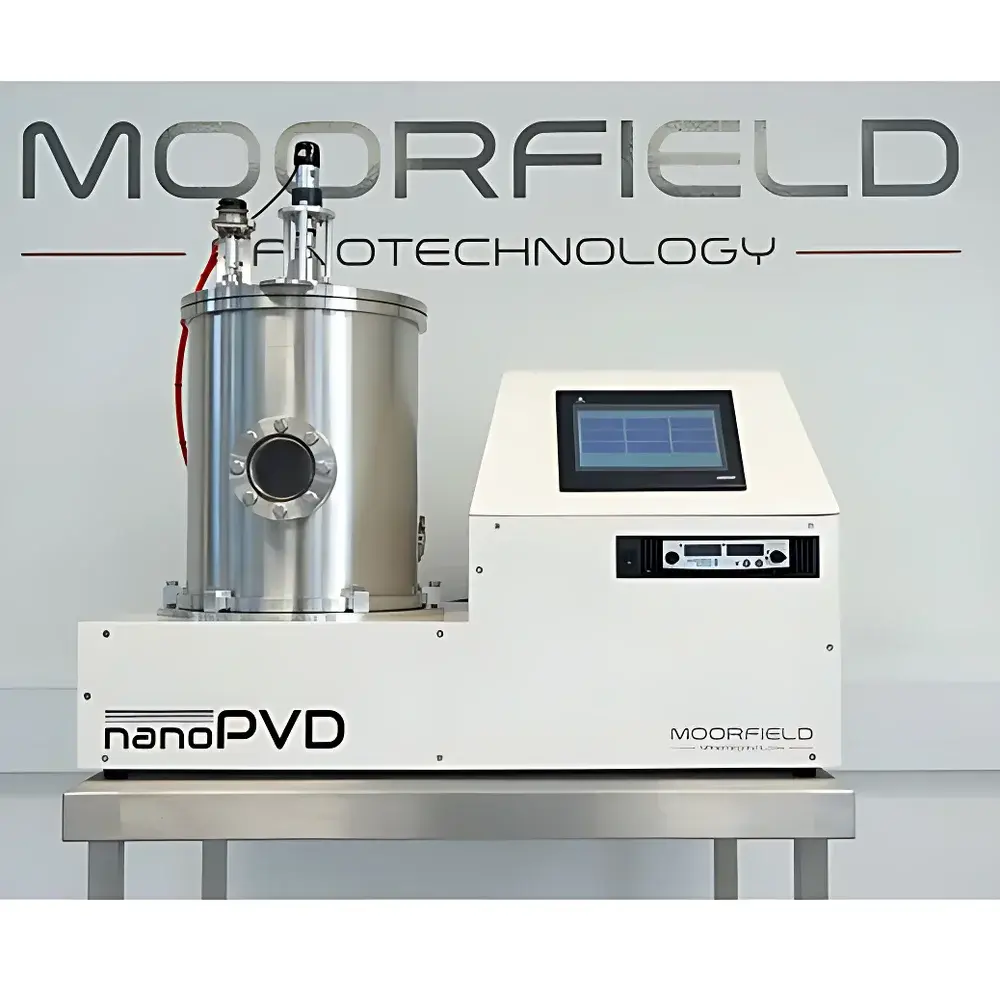
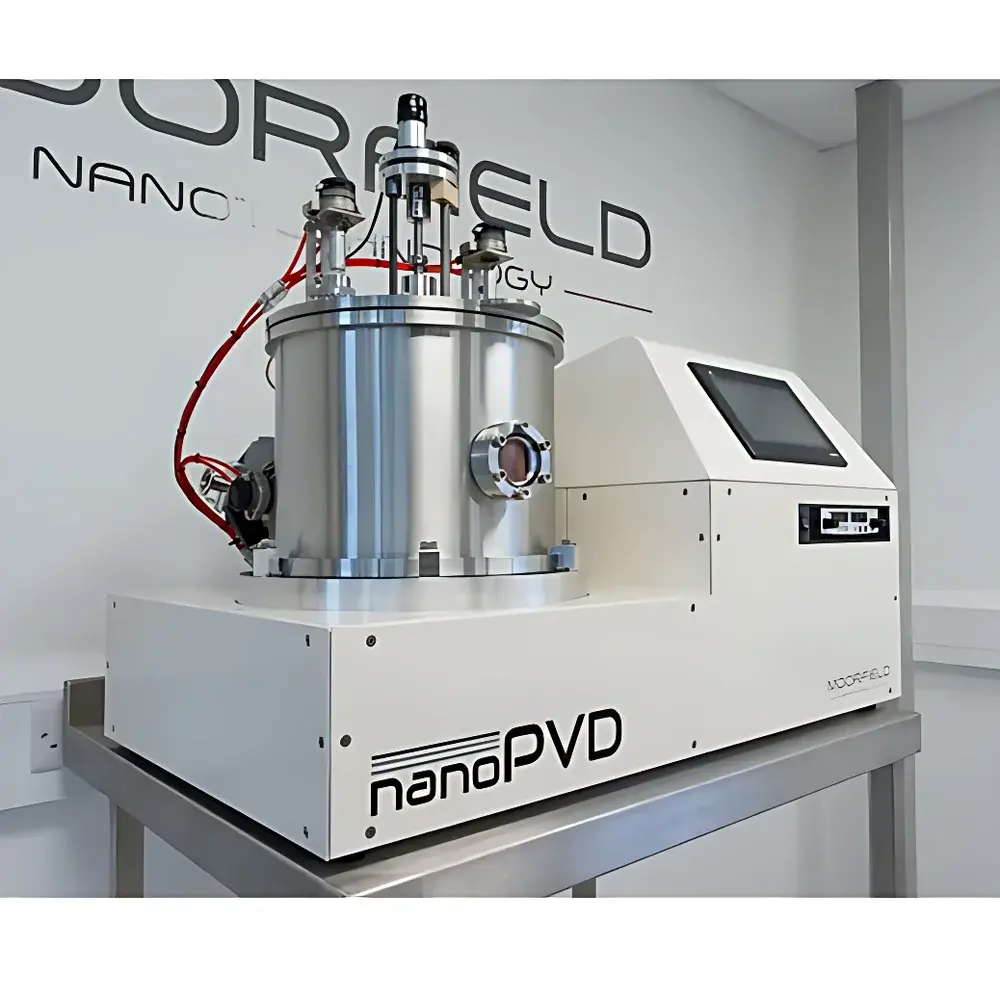
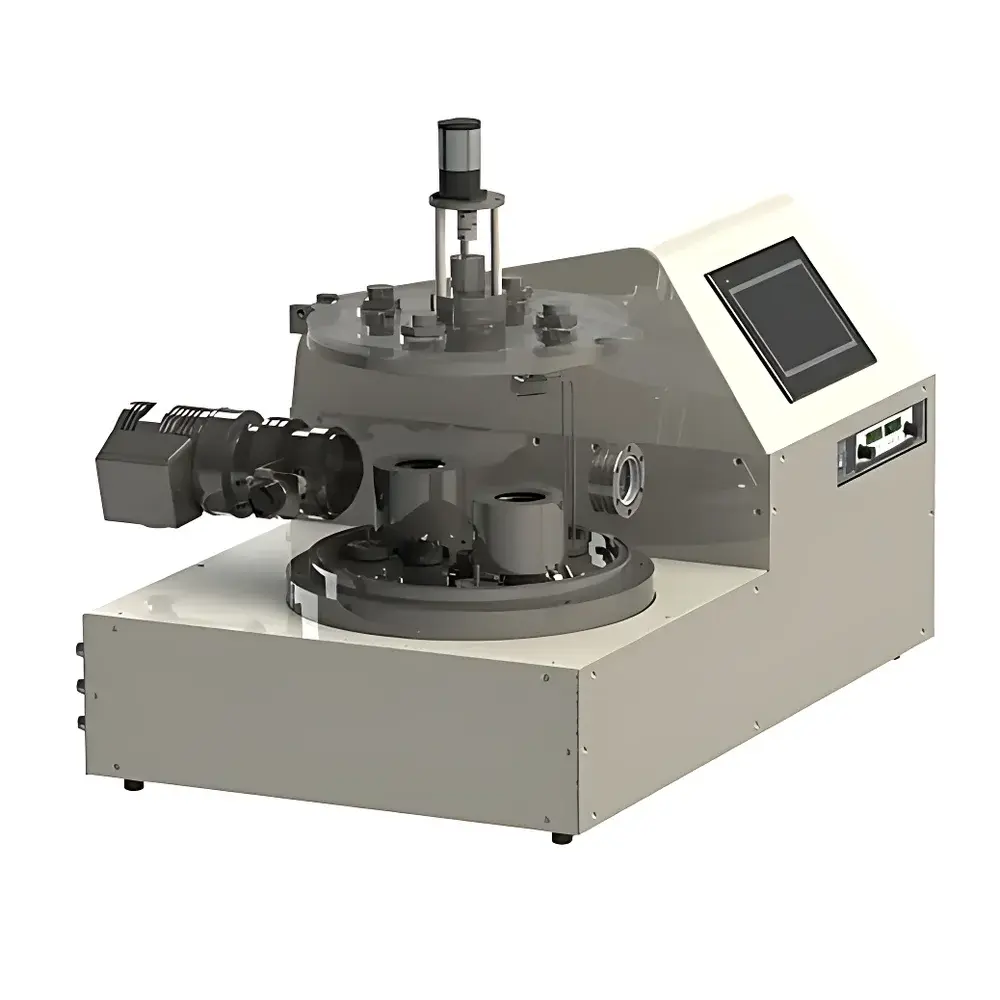
Moorfield nanoPVD Series – oPVD S10A / S10A-WA / T15A Desktop Physical Vapor Deposition Systems
| Brand | Moorfield |
|---|---|
| Origin | UK |
| Model | oPVD S10A, oPVD S10A-WA, oPVD T15A |
| Vacuum Base Pressure | <5×10⁻⁷ mbar |
| Substrate Size | up to 8 inches (S10A-WA), up to 4 inches (S10A & T15A) |
| Substrate Heating | up to 500 °C |
| Target Compatibility | 2-inch water-cooled magnetron sputtering targets (S10A/S10A-WA) |
| Gas Control | up to 3 MFC-controlled process gases (Ar, O₂, N₂) |
| Deposition Modes | DC/RF magnetron sputtering, reactive sputtering, co-sputtering, resistive/low-temperature organic evaporation |
| Film Uniformity | high across full substrate area |
| Cleanroom-Compatible Design | yes |
| Software | integrated touchscreen HMI with programmable recipes, audit-trail-capable control logic |
Overview
The Moorfield nanoPVD Series—comprising the oPVD S10A, oPVD S10A-WA, and oPVD T15A—is a family of compact, research-grade physical vapor deposition (PVD) systems engineered for precision thin-film synthesis in academic and industrial R&D laboratories. Each platform implements fundamental PVD physics—namely magnetron sputtering (based on plasma-driven target erosion in inert or reactive atmospheres) and thermal evaporation (via resistive heating or low-thermal-mass organic sources)—within a rigorously miniaturized, ultra-high-vacuum architecture. Designed in close collaboration with leading UK universities—including the University of Cambridge, Imperial College London, and the University of Exeter—the series bridges the performance gap between benchtop accessibility and large-scale production tool capabilities. All models achieve a base pressure of <5×10⁻⁷ mbar using turbomolecular pumping, enabling low-defect nucleation, minimal residual gas incorporation, and reproducible stoichiometry in oxide, nitride, metallic, and organic thin films. The modular mechanical design supports rapid configuration changes between sputtering and evaporation modes, while maintaining full compliance with ISO 14644-1 Class 5 cleanroom operational standards.
Key Features
- Ultra-high vacuum capability: base pressure <5×10⁻⁷ mbar achieved via integrated turbomolecular pump and optimized chamber geometry
- Water-cooled 2-inch magnetron sputter sources (S10A/S10A-WA): enable stable high-power operation (>300 W per target) without thermal drift
- Multi-source flexibility: up to three independently controlled sputter targets (S10A/S10A-WA) or up to four low-temperature organic evaporation sources (T15A)
- Programmable DC/RF power supply options with automatic source switching logic for multi-material deposition sequences
- Full-featured touchscreen HMI with recipe-based automation: store, recall, and audit up to 99 deposition protocols with timestamped parameter logging
- Substrate stage with Z-axis translation, rotation, and integrated 500 °C heating—compatible with quartz crystal microbalance (QCM) thickness monitoring
- Cleanroom-ready stainless-steel chamber with electropolished interior, double-O-ring seals, and leak-tight pneumatic gate valve
- Comprehensive safety architecture: interlocked access doors, real-time pressure/temperature monitoring, emergency venting, and plasma arc suppression circuitry
Sample Compatibility & Compliance
The nanoPVD platforms accommodate rigid substrates up to 8 inches in diameter (oPVD S10A-WA) or 4 inches (oPVD S10A/T15A), including Si, fused silica, sapphire, ITO-coated glass, and flexible polymer foils (with appropriate stage adaptation). Substrate temperature control spans ambient to 500 °C with ±1 °C stability over 2-hour runs—critical for crystalline phase development in oxides (e.g., ZnO, TiO₂) and interfacial engineering in heterostructures. All systems conform to CE Machinery Directive 2006/42/EC and EMC Directive 2014/30/EU. Vacuum components meet ASTM F2787-10 specifications for ultra-high-vacuum compatibility. Process repeatability is validated per ISO 9001:2015 internal calibration protocols; optional 21 CFR Part 11-compliant software modules support GLP/GMP environments requiring electronic signatures and audit trails.
Software & Data Management
The embedded control system runs a deterministic real-time OS with a 7-inch capacitive touchscreen interface. Users define deposition sequences—including pre-sputter cleaning, multi-step gas flow ramps, power modulation, shutter timing, and QCM-thickness termination—via intuitive drag-and-drop workflow editors. All parameter sets are stored with metadata (user ID, timestamp, chamber history) and exportable as CSV or XML. Optional data acquisition packages integrate with LabVIEW™ or Python-based analysis pipelines via TCP/IP or Modbus TCP. Raw sensor logs (pressure, voltage, current, temperature, film thickness) are retained for ≥30 days onboard and can be archived to network storage with configurable retention policies. System diagnostics include vacuum integrity trending, source lifetime estimation, and predictive maintenance alerts based on cumulative power-on hours and arcing events.
Applications
These systems serve advanced materials research across multiple domains: fabrication of Schottky contact layers (e.g., PtOx/ZnO diodes), transparent conductive oxides (ITO, AZO), ferroelectric perovskites (Pb(Zr,Ti)O₃), spintronic multilayers (CoFeB/MgO), and organic semiconductor stacks for OLED, OPV, and OFET devices. The oPVD T15A’s low-thermal-inertia organic evaporation sources enable sub-monolayer control in small-molecule deposition (e.g., Alq₃, NPB, C₆₀), while the S10A-WA’s large-area uniformity (<±2.5% thickness variation over 8-inch wafers with rotation) supports photovoltaic absorber layer development and MEMS coating validation. Published work using these tools includes peer-reviewed studies in Journal of Physics D: Applied Physics, Advanced Functional Materials, and Nanoscale, demonstrating device-relevant film quality metrics—such as interface state density 10 cm²/V·s in evaporated organic transistors.
FAQ
What vacuum level is achievable, and how long does pump-down take?
Base pressure <5×10⁻⁷ mbar is routinely achieved within 45–60 minutes from atmospheric conditions using the standard turbomolecular pump configuration.
Can the system perform reactive sputtering with oxygen or nitrogen?
Yes—up to three independently MFC-controlled gas lines (Ar, O₂, N₂) support stoichiometric oxide and nitride synthesis, including RF-powered reactive sputtering of insulating targets.
Is substrate heating compatible with organic evaporation processes?
Yes—the 500 °C heated stage operates independently of evaporation sources and is fully shielded to prevent thermal degradation of organic layers during co-deposition.
How is film thickness monitored in real time?
Integrated quartz crystal microbalance (QCM) sensors provide sub-nanometer resolution thickness feedback, with programmable endpoint triggering and rate stabilization algorithms.
Are service and technical support available outside the UK?
Moorfield provides global field service coverage through authorized partners, including remote diagnostics, on-site calibration, and annual preventive maintenance contracts compliant with ISO/IEC 17025 requirements.