
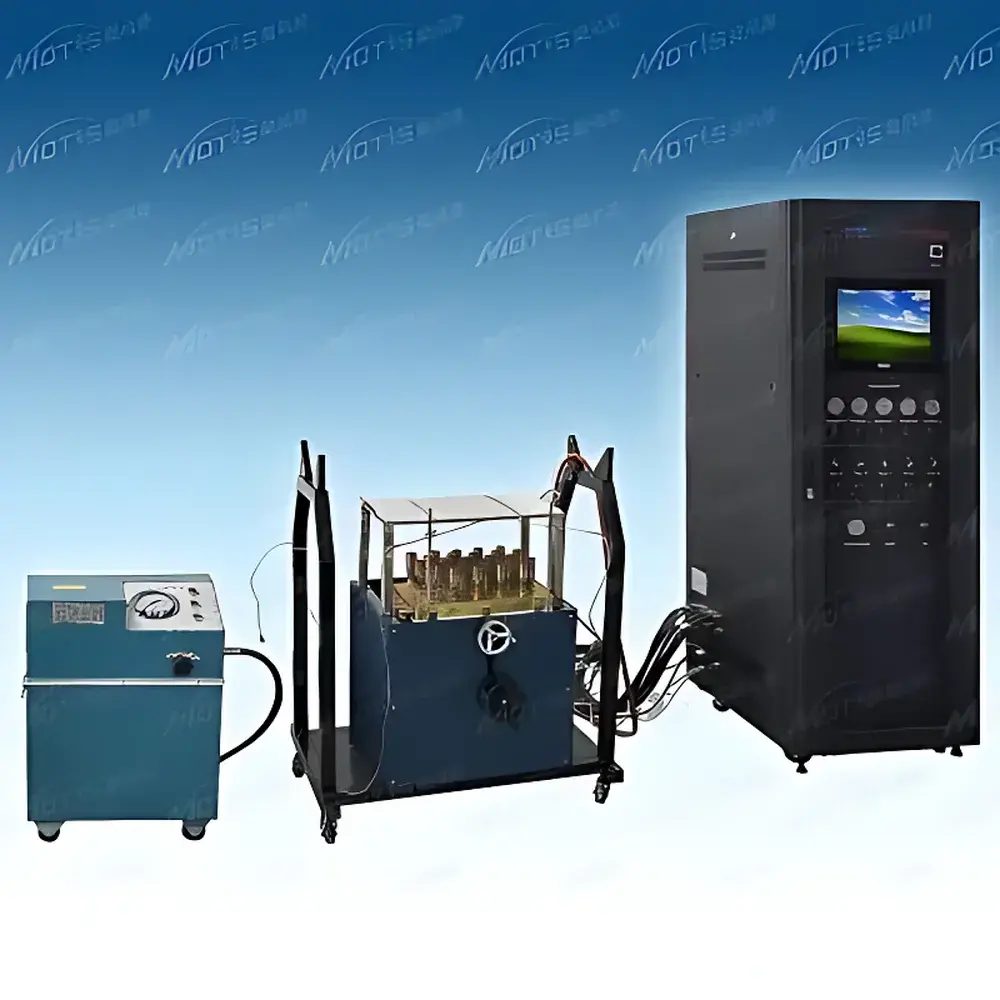
MOTIS PFET Marine Fire-Resistant Pipe Testing Chamber
| Brand | MOTIS |
|---|---|
| Origin | Shanghai, China |
| Model | PFET |
| Compliance | IMO A.753, ISO 19921–1 & 19921–2, ISO 10497, FTP Code Annex 2 (Res. A.753) |
| Test Pressure Range | 0–20 bar |
| Thermal Radiation Sensor | Calibrated heat flux meter (kW/m²) |
| Cooling System | Integrated water-cooled calorimeter mount |
| Temperature Monitoring | Dual K-type thermocouples (0–1200 °C) |
| Sample Positioning | Motorized X-Y-Z adjustable test platform |
| Data Acquisition | PC-based real-time logging software with time-synchronized thermal, pressure, and radiation curves |
Overview
The MOTIS PFET Marine Fire-Resistant Pipe Testing Chamber is a purpose-built combustion test system engineered to evaluate the fire integrity and structural stability of marine-grade piping components—including rigid pipes, flexible hoses, valves, and plastic conduit—under controlled, high-intensity flame exposure while subjected to operational hydraulic pressure. Designed in strict accordance with the International Maritime Organization’s Resolution A.753(18) and harmonized with ISO 19921–1/19921–2 (Fire resistance testing of non-metallic pipes) and ISO 10497 (Fire testing of pipe joints and fittings), the PFET replicates the thermal and mechanical stress conditions encountered during onboard fire scenarios. Its core methodology combines calibrated propane-fueled flame impingement (with defined heat flux profile per IMO Annex 2) with simultaneous pressurization of the test specimen to simulate service-line water pressure up to 20 bar. Failure is objectively defined as leakage exceeding 15 mL/min or visible rupture under sustained flame exposure for prescribed durations (e.g., 15 or 30 minutes), enabling pass/fail determination per FTP Code requirements.
Key Features
- Motorized three-axis sample positioning system (X/Y/Z) enables precise alignment of pipe specimens relative to the standardized burner nozzle—critical for repeatable flame impingement geometry and regulatory compliance.
- ISO-compliant propane combustion burner delivering a stable, reproducible flame with peak heat flux up to 100 kW/m² at the target surface, traceable to NIST-traceable calibration protocols.
- Hydraulic pressure control unit with digital servo-regulation, maintaining setpoint accuracy within ±0.2 bar across the full 0–20 bar range; integrated leak-test function verifies system integrity prior to ignition.
- Water-cooled Schmidt-Boelter type heat flux sensor (±2% full-scale accuracy), actively temperature-stabilized via closed-loop recirculating chiller to ensure long-term radiometric stability during extended tests.
- Dual high-temperature K-type thermocouples (IEC 60584–2 Class 1), mounted at fixed positions upstream and downstream of the flame zone, provide real-time flame temperature profiling with 100 ms sampling resolution.
- Industrial-grade data acquisition system synchronized across pressure, thermal, and radiation channels, timestamped to UTC and compliant with GLP audit trail requirements (including user login, parameter changes, and test start/stop events).
Sample Compatibility & Compliance
The PFET accommodates cylindrical pipe specimens with outer diameters from 12 mm to 150 mm and lengths up to 600 mm, including metallic (copper, stainless steel), thermoplastic (PVC-U, PE, PP), and elastomeric (EPDM, NBR) materials. It supports testing of flanged, threaded, and compression-joint assemblies per IMO A.753 Annex 2 procedures. All test configurations adhere to the dimensional tolerances, flame positioning distances, and environmental conditioning (23 °C ± 2 °C, 50% RH ± 5%) specified in ISO 19921–1. The system meets functional requirements for ISO/IEC 17025 accredited laboratories, with documented uncertainty budgets for pressure (±0.3% FS), heat flux (±2.5% FS), and temperature (±1.5 °C) measurements.
Software & Data Management
The PFET operates with MOTIS FireTest Suite v3.2—a Windows-based application validated under FDA 21 CFR Part 11 for electronic records and signatures. The software provides real-time visualization of pressure decay curves, thermocouple temperature profiles, and heat flux temporal evolution, overlaid against pass/fail thresholds derived directly from IMO A.753 acceptance criteria. All raw data are stored in encrypted .tdms format with embedded metadata (operator ID, calibration certificate IDs, ambient conditions). Export options include PDF test reports (with digital signature and timestamp), CSV for statistical analysis, and XML for LIMS integration. Audit logs record every user action with immutable timestamps and IP address tagging.
Applications
- Qualification testing of marine fire-main system components for class society certification (DNV, LR, ABS, BV).
- Development validation of flame-retardant polymer formulations used in shipboard plumbing.
- Root-cause analysis of field failures involving hose burst or joint leakage during fire incidents.
- Supporting Type Approval submissions to maritime administrations under SOLAS Chapter II-2.
- Research on thermal degradation kinetics of polymeric pipe materials under combined thermal-mechanical load.
FAQ
Does the PFET comply with DNVGL-ST-0345 requirements for fire-resistance testing of non-metallic pipes?
Yes—the system’s flame profile, pressure control fidelity, and data traceability meet all technical clauses of DNVGL-ST-0345 Section 5.2.2 for pipe fire testing.
Can the PFET be configured for cyclic pressure testing during flame exposure?
Yes—custom test sequences can be programmed to modulate pressure in discrete steps or ramps during the burn phase, simulating transient pump conditions.
Is third-party calibration documentation included with delivery?
Each unit ships with a full calibration certificate issued by an ILAC-MRA accredited laboratory, covering pressure transducers, thermocouples, and heat flux sensors.
What maintenance intervals are recommended for the burner assembly?
Burner nozzles and gas regulators require inspection every 50 test cycles; full calibration verification is mandated annually or after any component replacement.
Does the software support automated report generation in multiple languages?
The FireTest Suite generates reports in English, German, French, and Japanese; language selection is configurable per user profile and persists across sessions.



