
MOTIS SBI Single Burning Item Test System
| Brand | MOTIS |
|---|---|
| Origin | Jiangsu, China |
| Manufacturer Type | Authorized Distributor |
| Country of Origin | China |
| Model | SBI |
| Pricing | Upon Request |
| Standards Compliance | EN 13823, GB/T 20284 |
| Measurement Principles | Oxygen depletion calorimetry, optical smoke density analysis, flame spread observation, droplet collection |
| Key Outputs | FIGRA, THR, SMOGRA, TSP, LFS, flaming droplets/particles |
Overview
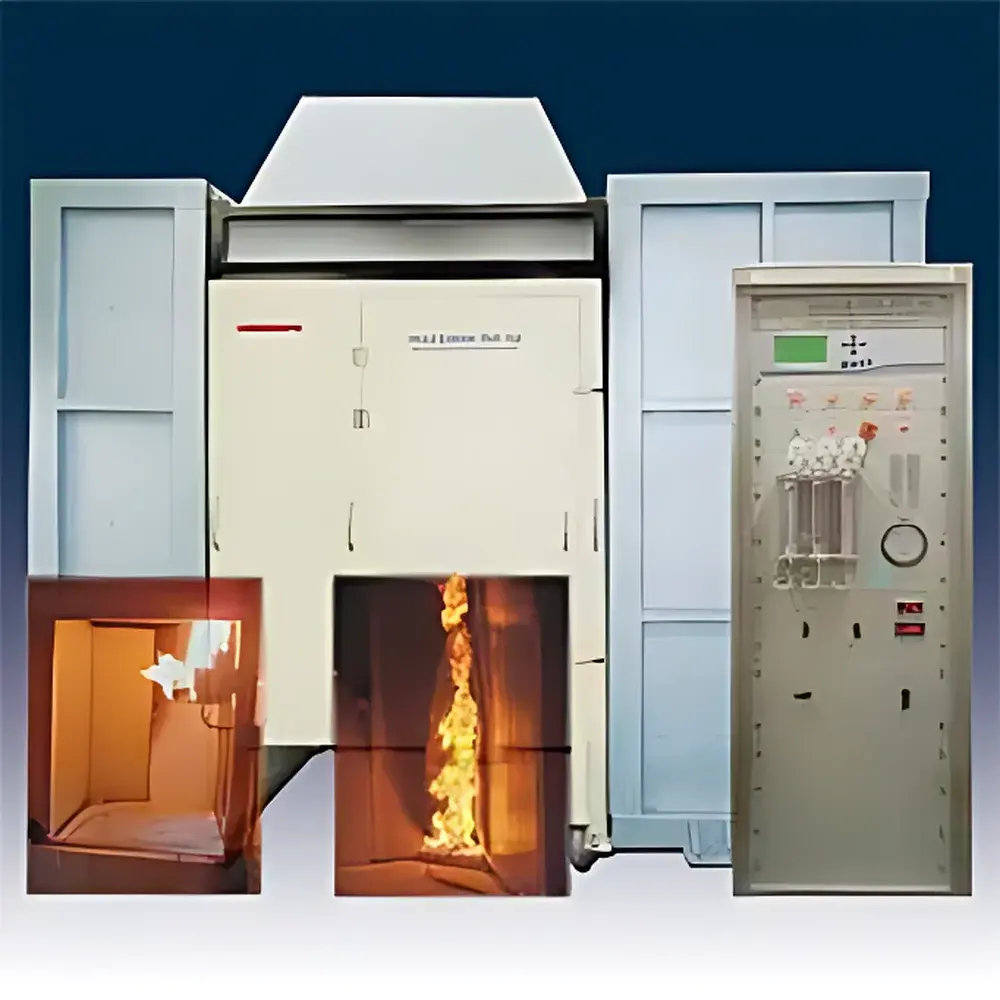
The MOTIS SBI Single Burning Item Test System is a fully integrated, standards-compliant apparatus engineered for the quantitative assessment of fire performance characteristics of building products under controlled, intermediate-scale combustion conditions. Based on the cone calorimeter principle adapted to vertical specimen orientation and localized ignition, the system implements oxygen depletion calorimetry—measuring the molar flow rate of oxygen consumed during combustion to calculate heat release rate (HRR) with high reproducibility. This thermodynamic approach, standardized in EN 13823 and GB/T 20284, provides traceable, physics-based metrics essential for regulatory classification, product development, and fire safety engineering. The test configuration simulates real-world fire exposure where a vertically mounted specimen is subjected to a defined 31 kW propane burner at its base corner, enabling evaluation of both flame propagation dynamics and post-ignition combustion behavior—including heat release, smoke production, lateral flame spread, and molten droplet formation.
Key Features
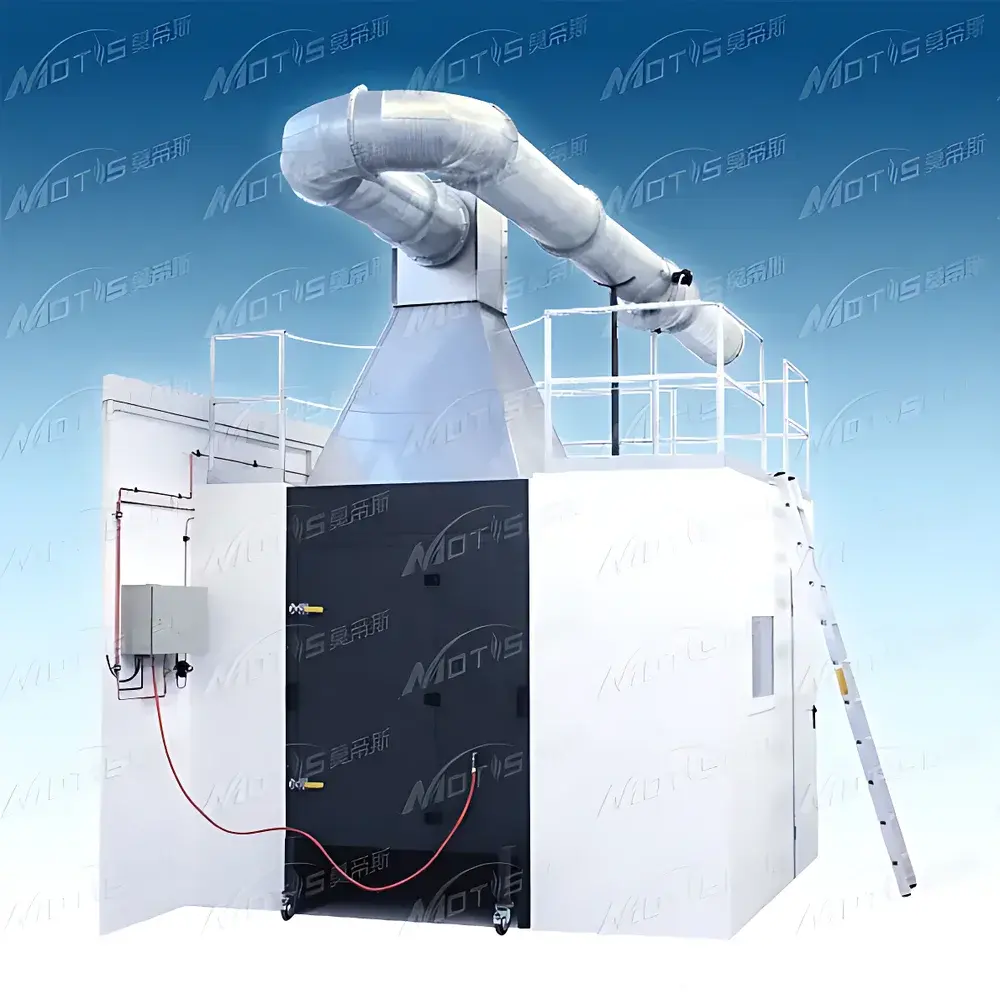
- Modular combustion chamber (3 m × 3 m floor area, 2.4 m height) with refractory-lined walls and integrated ceiling extraction hood connected to a dedicated sampling duct
- Motorized stainless-steel test trolley equipped with dual non-combustible reference panels (vertical and horizontal), precision-mounted burner assembly, and calibrated gas supply control
- 31 kW L-shaped propane burner (250 mm × 250 mm × 80 mm sand-filled box) meeting EN 13823 geometric and thermal specifications
- Dual-path gas sampling zone within the exhaust duct featuring temperature-compensated, corrosion-resistant PTFE probe manifolds for simultaneous multi-parameter acquisition
- Siemens-based 19-inch rack instrumentation suite including OXYMAT 61 paramagnetic oxygen analyzer (0–25% O₂, ±1% FS weekly drift, <3 s response) and U23 NDIR analyzers for CO (0–1%) and CO₂ (0–10%)
- K-type thermocouple array for flue gas temperature profiling, paired with bidirectional stainless-steel Pitot-static probes and differential pressure transducers for volumetric flow quantification
- Integrated data acquisition system with synchronized sampling of thermal, gas, optical, and mechanical signals at ≥10 Hz resolution
- Comprehensive software platform supporting automated calibration routines, real-time parameter derivation (FIGRA, THR, SMOGRA, TSP, LFS), and audit-ready data export in CSV and PDF formats
Sample Compatibility & Compliance
The SBI system accommodates specimens up to 1.5 m in height and 1.0 m in width, mounted on the standardized trolley with defined edge constraints. It supports rigid, semi-rigid, and flexible building materials—including insulation boards, wall claddings, ceiling panels, and flooring composites—as specified in EN 13823 Annex A and GB/T 20284 Clause 6. All measurement subsystems are validated per ISO/IEC 17025 traceability requirements, with analyzer calibrations traceable to NIST-certified gas standards. The system architecture supports GLP-aligned operation: full electronic audit trail, user-access logging, and version-controlled calibration records. While not inherently 21 CFR Part 11 compliant out-of-the-box, the software framework permits integration with third-party electronic signature and record retention modules required for regulated environments.
Software & Data Management
The embedded Windows-based control and analysis software provides real-time visualization of HRR, smoke optical density (OD), mass loss rate, and gas concentrations. Derived fire parameters—including Fire Growth Rate (FIGRA), Total Heat Released (THR), Smoke Growth Rate (SMOGRA), Total Smoke Produced (TSP), and Lateral Flame Spread (LFS)—are computed continuously using standardized algorithms per EN 13823 Section 8. Raw sensor data streams are timestamped and stored in binary format with metadata tagging (operator ID, sample ID, ambient conditions, calibration status). Export functions generate ISO/IEC 17025-compliant reports containing raw traces, summary tables, uncertainty estimates, and graphical overlays. Data integrity safeguards include cyclic redundancy checks (CRC), write-once archival mode, and optional network backup to NAS or cloud storage via secure FTP/SFTP protocols.
Applications
- Regulatory fire classification of construction products for CE marking (EN 13501-1) and Chinese CCC certification
- Comparative evaluation of flame-retardant formulations in polymer composites and mineral wool insulation
- Development testing of intumescent coatings and fire-stopping systems under realistic ignition scenarios
- Validation of computational fire models (e.g., CFD-based FDS simulations) against intermediate-scale experimental benchmarks
- Root-cause analysis of unexpected flaming droplet generation in thermoplastic façade elements
- Technical due diligence for insurance underwriting and building code compliance verification
FAQ
What standards does the MOTIS SBI system fully comply with?
The system is designed and verified to meet all hardware, procedural, and data reporting requirements of EN 13823:2010+A1:2014 and GB/T 20284–2006, including burner geometry, chamber dimensions, sampling duct specifications, and parameter calculation methodologies.
Is the system suitable for testing coated or laminated substrates?
Yes—provided the total specimen thickness does not exceed 200 mm and surface irregularities remain within ±2 mm tolerance across the test face, as stipulated in EN 13823 Annex B.
Can the system be upgraded to support ISO 5660-1 cone calorimetry?
No—the SBI configuration is purpose-built for vertical, corner-ignited exposure; conversion to horizontal cone calorimetry would require complete replacement of the test chamber, trolley, and burner assembly.
What maintenance intervals are recommended for gas analyzers?
Oxygen and infrared analyzers require zero/span calibration every 24 hours of active testing and full sensor verification every 6 months, per Siemens service guidelines and EN 13823 Clause 7.4.
Does the system include exhaust treatment for toxic combustion byproducts?
The base configuration includes ducting and fan interfaces but excludes abatement equipment; users must integrate local exhaust scrubbing or thermal oxidation systems compliant with regional environmental regulations (e.g., EU Directive 2010/75/EU).



