
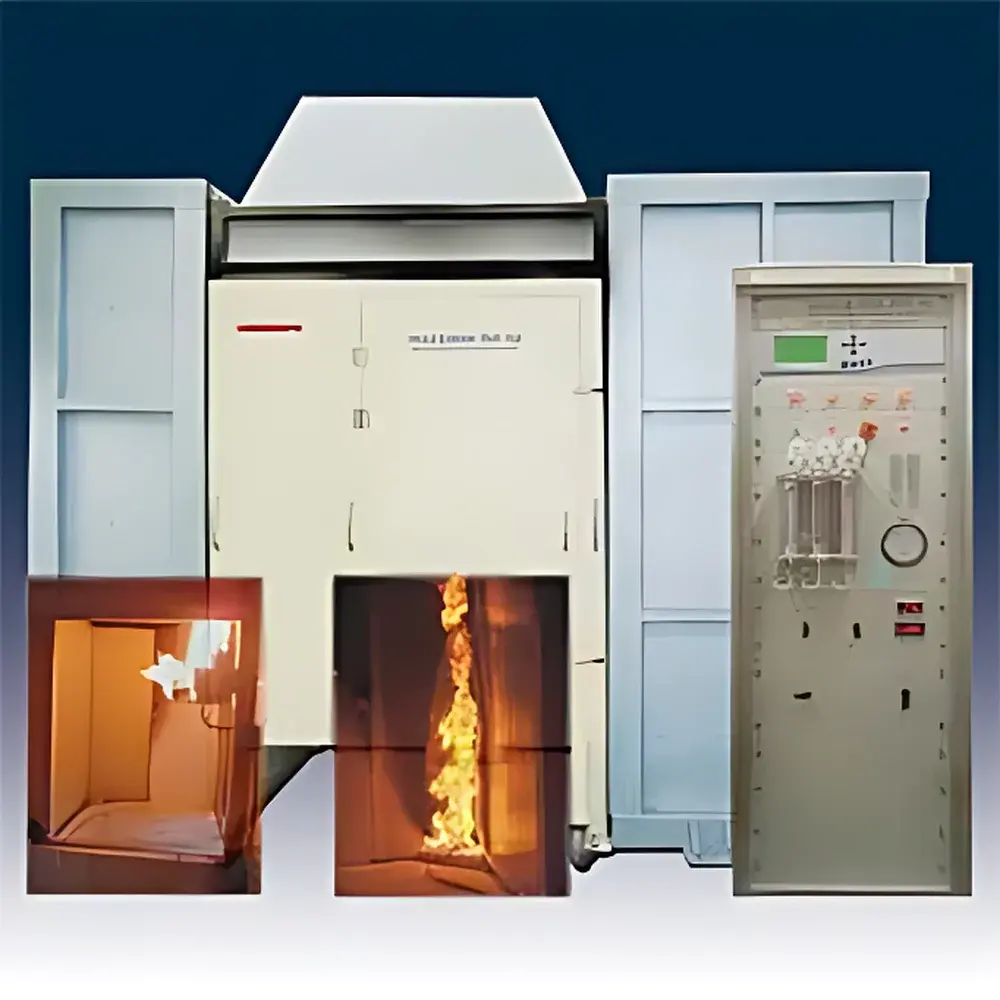
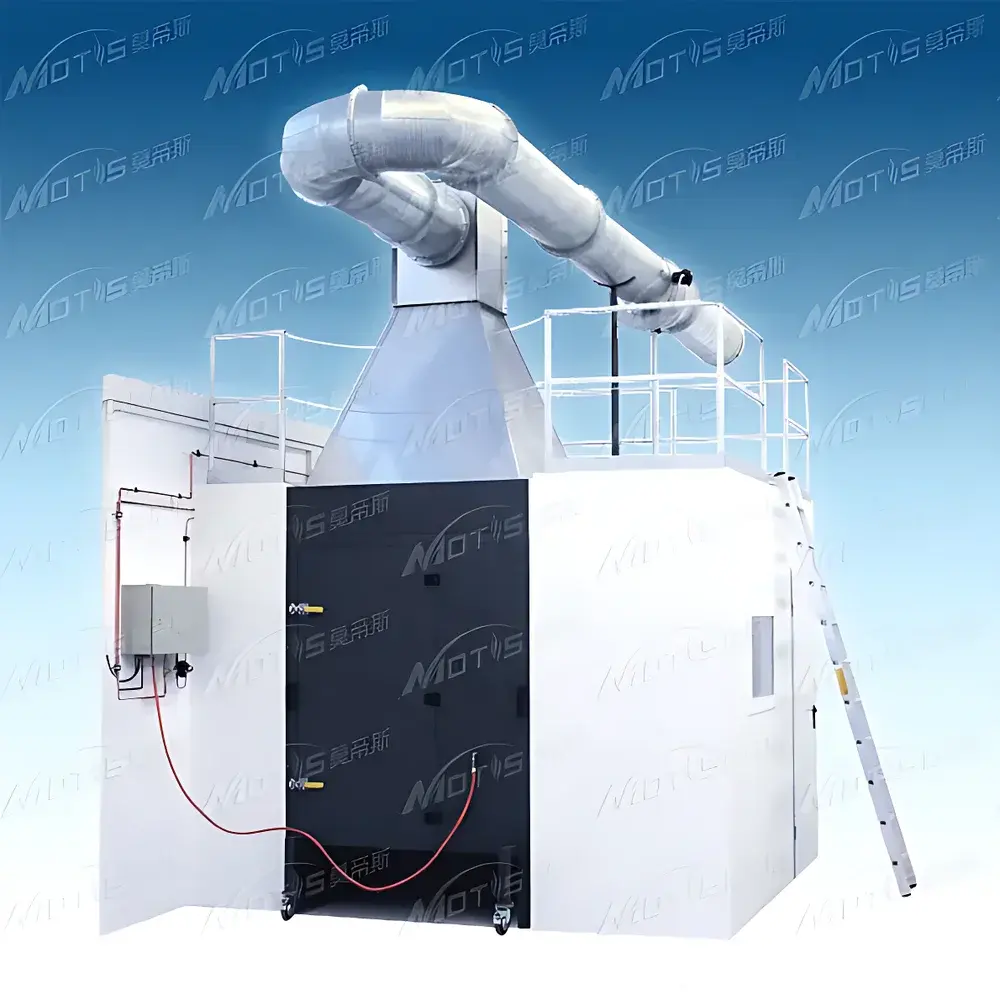
MOTIS SBI Single Burning Item Test System
| Brand | MOTIS |
|---|---|
| Origin | Jiangsu, China |
| Manufacturer Type | Authorized Distributor |
| Country of Origin | China |
| Model | SBI |
| Pricing | Available Upon Request |
| Compliance | EN 13823, GB/T 20284 |
| Core Measurement Principle | Oxygen Consumption Calorimetry & Optical Smoke Density Analysis |
| Key Outputs | FIGRA, THR, SMOGRA, TSP, LFS, Droplet Observation |
Overview
The MOTIS SBI Single Burning Item Test System is a fully integrated, standards-compliant fire testing apparatus engineered for quantitative assessment of the fire reaction performance of building products and construction materials under controlled, bench-scale flaming conditions. Based on oxygen consumption calorimetry—recognized as the most accurate and reproducible method for heat release rate (HRR) determination—the system quantifies combustion behavior by measuring the depletion of oxygen in exhaust gases, enabling precise calculation of heat release rate (HRR), total heat released (THR), and fire growth rate index (FIGRA). Concurrently, optical smoke density analysis via light attenuation in the exhaust duct provides critical smoke production metrics: specific optical density (Ds), smoke growth rate index (SMOGRA), and total smoke produced (TSP). Additional observational parameters—including lateral flame spread (LFS) time to reach the 1.5 m × 1.0 m specimen edge, and qualitative evaluation of flaming droplets or particle formation—are captured per EN 13823 and GB/T 20284 requirements. The test chamber (3 m × 3 m × 2.4 m) features a ceiling-mounted extraction hood, calibrated air inlet plenum beneath the specimen trolley, and a thermally stable, refractory-lined environment designed to minimize convective interference and ensure measurement integrity across repeated cycles.
Key Features
- Full compliance with EN 13823 (Reaction to Fire Tests — Building Products — Fire Testing — Single Burning Item Test) and GB/T 20284 (Fire Performance of Building Materials and Products — Single Burning Item Test)
- Dual-mode combustion source: primary 31 kW propane corner burner (250 mm × 250 mm × 80 mm sand-filled rectangular burner) plus auxiliary burner for ignition consistency
- High-fidelity gas analysis suite: Siemens OXYMAT 61 paramagnetic oxygen analyzer (0–25% O₂, ±1% FS weekly drift, <3 s response) and U23 NDIR analyzers for CO (0–1%) and CO₂ (0–10%), all with 4–20 mA analog outputs and GLP-traceable calibration protocols
- Integrated data acquisition platform supporting synchronized sampling of temperature (K-type thermocouples), differential pressure (micro-differential pressure sensors), volumetric flow (stainless steel bidirectional Pitot probe), and gas composition at 10 Hz minimum resolution
- Corrosion-resistant sampling train: PTFE-lined probe assemblies, condensate removal cold trap, gas conditioning module (flow/pressure stabilization), and chemically inert peristaltic sampling pump
- Modular trolley assembly with two orthogonal non-combustible mineral fiber boards; precision-machined stainless steel frame ensuring repeatable specimen mounting geometry and thermal isolation
- Real-time digital visualization of FIGRA, THR, SMOGRA, and TSP trends during test execution, with automatic endpoint detection per standard-defined thresholds
Sample Compatibility & Compliance
The SBI system accommodates specimens up to 1000 mm (height) × 495 mm (width) × 200 mm (depth), including rigid insulation boards, sandwich panels, cladding systems, and combustible façade components. Specimens are mounted vertically on the trolley with defined edge exposure, simulating real-world installation configurations. All hardware, sensor calibrations, and software algorithms adhere to the metrological traceability requirements of ISO/IEC 17025. Data reporting supports audit-ready export formats compliant with EU Construction Products Regulation (CPR) Annex ZA documentation, and includes full metadata logging (ambient temperature/humidity, calibration certificate IDs, operator credentials, and instrument uptime diagnostics). The system architecture allows integration into laboratory quality management systems (QMS) aligned with ISO 9001 and GLP principles.
Software & Data Management
The embedded Windows-based control and analysis software provides ISO/IEC 17025-aligned test sequencing, automated pre-test system verification (leak check, zero/span validation, flow profile confirmation), and real-time deviation alerts. Raw sensor streams are timestamped with microsecond precision and archived in HDF5 format for long-term integrity and third-party reprocessing. Calibration routines follow ASTM E1354 and ISO 5660-1 guidelines, with electronic logs retaining full version history, user actions, and digital signatures. Audit trails meet FDA 21 CFR Part 11 requirements for electronic records and signatures when configured with optional role-based access control and certificate-based authentication. Export options include PDF test reports (EN 13823 Annex B–compliant), CSV time-series datasets, and XML schema for LIMS integration.
Applications
This system serves laboratories engaged in fire safety certification, regulatory submission (e.g., CE marking under CPR, Chinese CCC fire classification), and R&D of low-flammability construction materials. It is routinely employed for comparative flame retardancy screening of polymer composites, validation of intumescent coatings, fire performance benchmarking of bio-based insulation, and technical due diligence in façade engineering reviews. The quantitative output set (FIGRA ≤ 120 kW·s/m², THR ≤ 15 MJ/m², LFS < 1.5 m within 1200 s) directly informs Euroclass B-s1,d0 or C-s2,d1 classifications. Academic institutions use the platform for fundamental combustion kinetics studies involving char-forming mechanisms, soot oxidation pathways, and ventilation-controlled fire dynamics under intermediate-scale boundary conditions.
FAQ
What standards does the MOTIS SBI system fully support?
EN 13823 and GB/T 20284 are natively implemented, including all mandatory procedural checks, acceptance criteria, and reporting templates.
Is the system suitable for testing composite façade systems?
Yes—specimen mounting fixtures and trolley geometry accommodate multi-layer assemblies up to 200 mm depth, with optional edge-sealing kits to replicate field-installed joint conditions.
How is measurement traceability ensured?
All gas analyzers carry factory calibration certificates traceable to NIST or NPL standards; temperature and flow sensors are validated annually against accredited reference standards per ISO/IEC 17025.
Can the system be integrated into an existing laboratory LIMS?
Yes—API-enabled data export supports HL7, ASTM E2500, and custom RESTful endpoints; configuration assistance is provided for common LIMS platforms including LabWare, STARLIMS, and Thermo Fisher SampleManager.
What maintenance intervals are recommended?
Quarterly verification of burner output and gas flow profiles; semi-annual recalibration of O₂/CO/CO₂ analyzers; annual full system performance validation using certified reference materials per ISO 5660-1 Annex D.



