
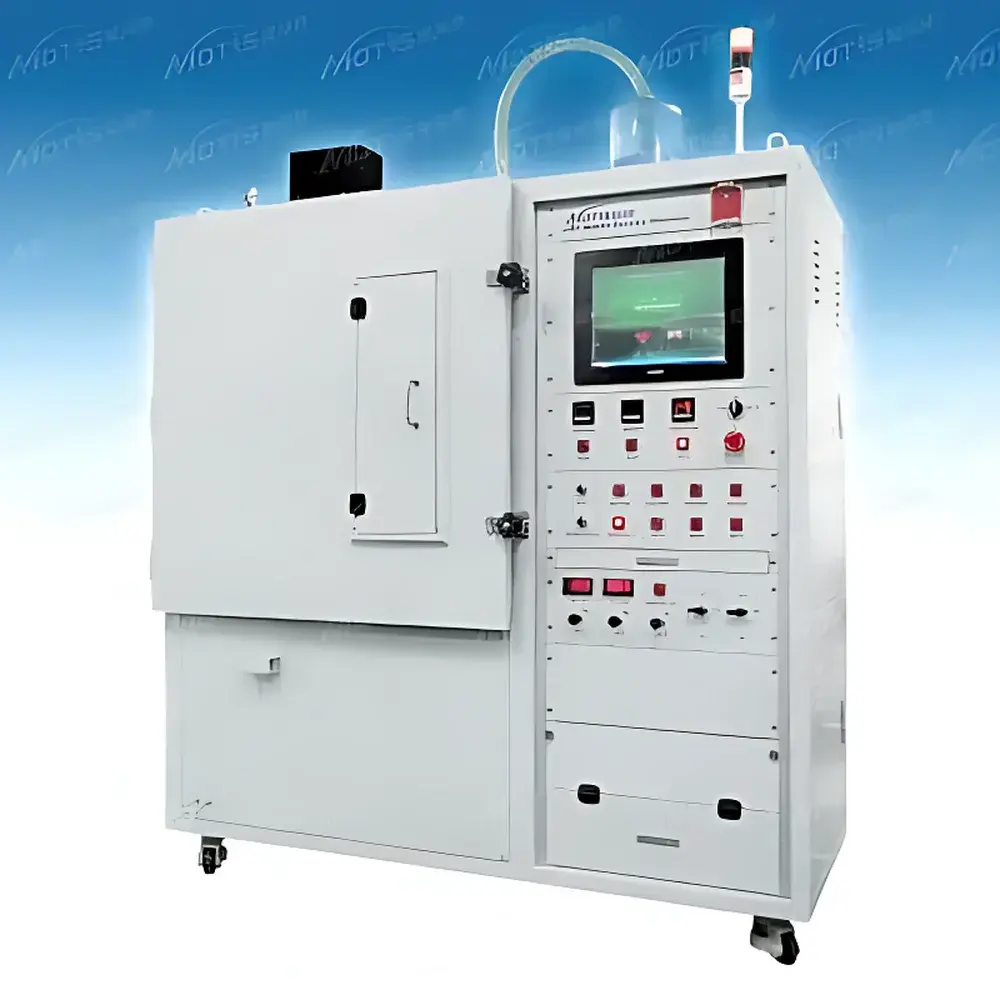
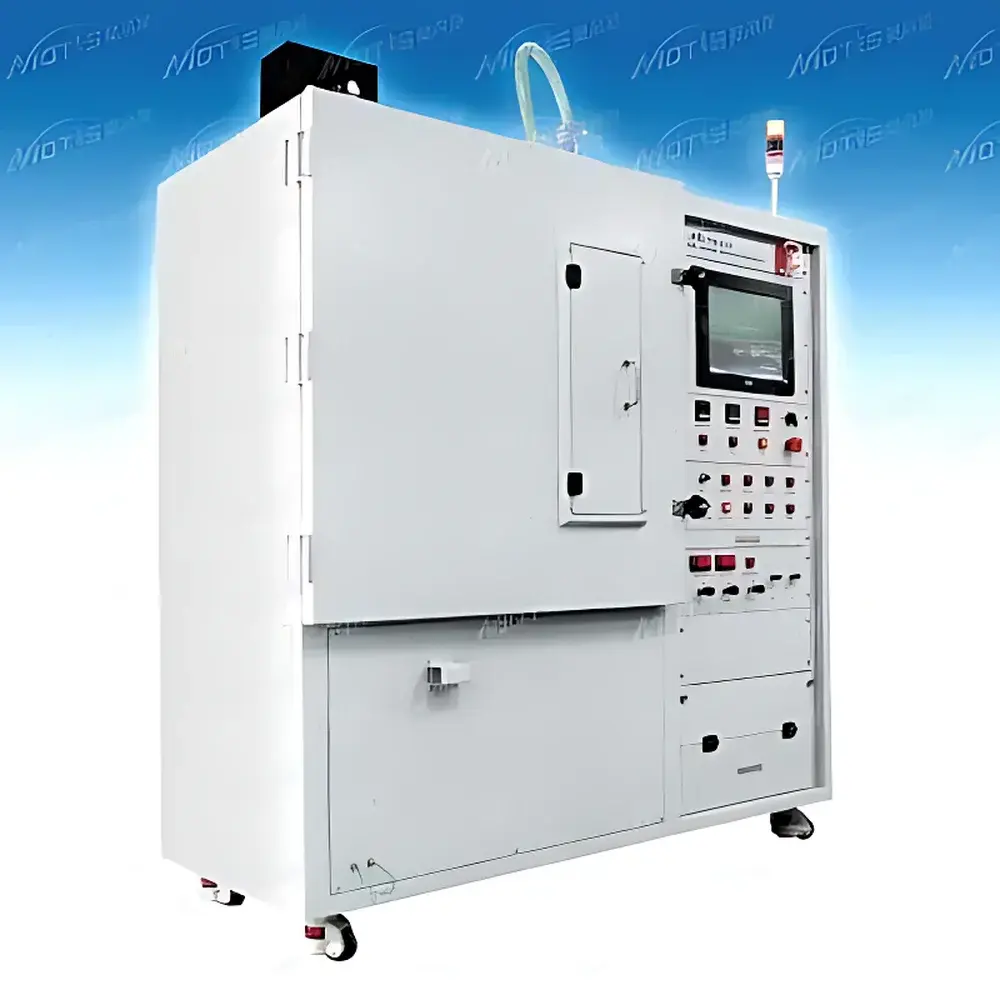
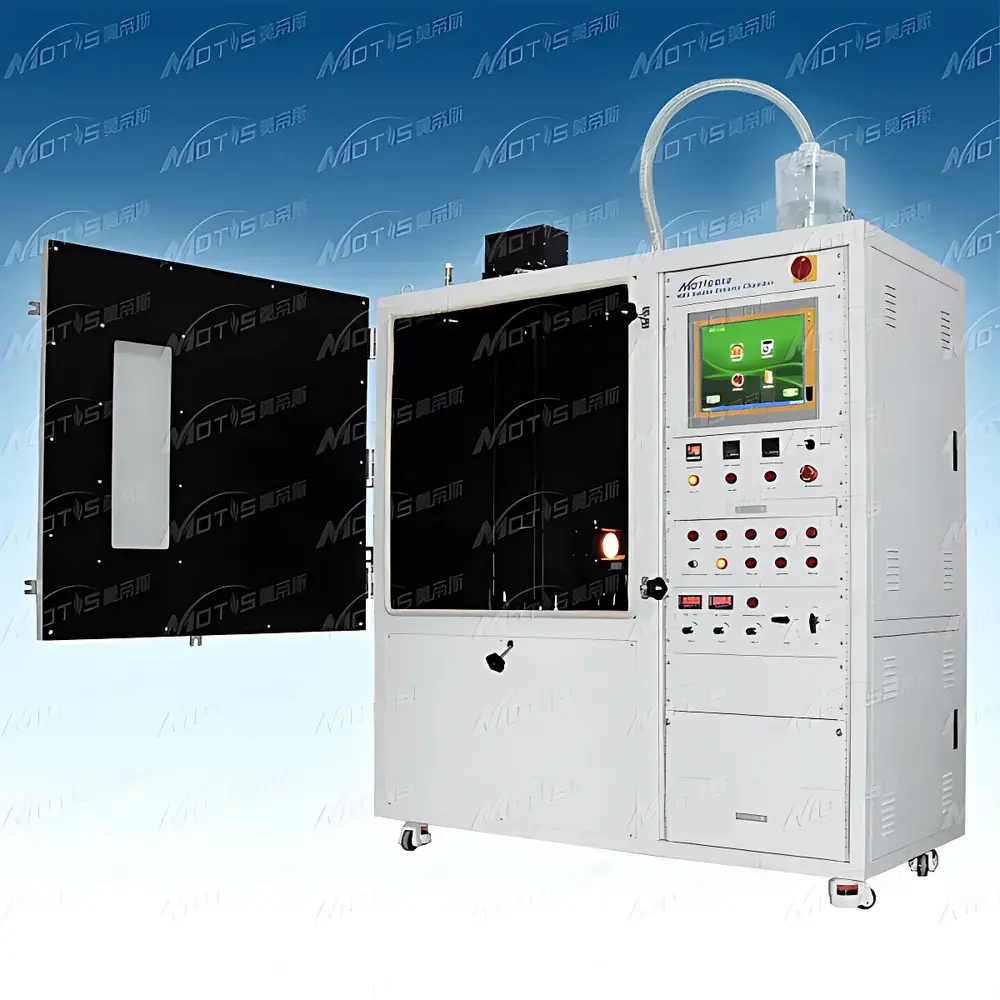
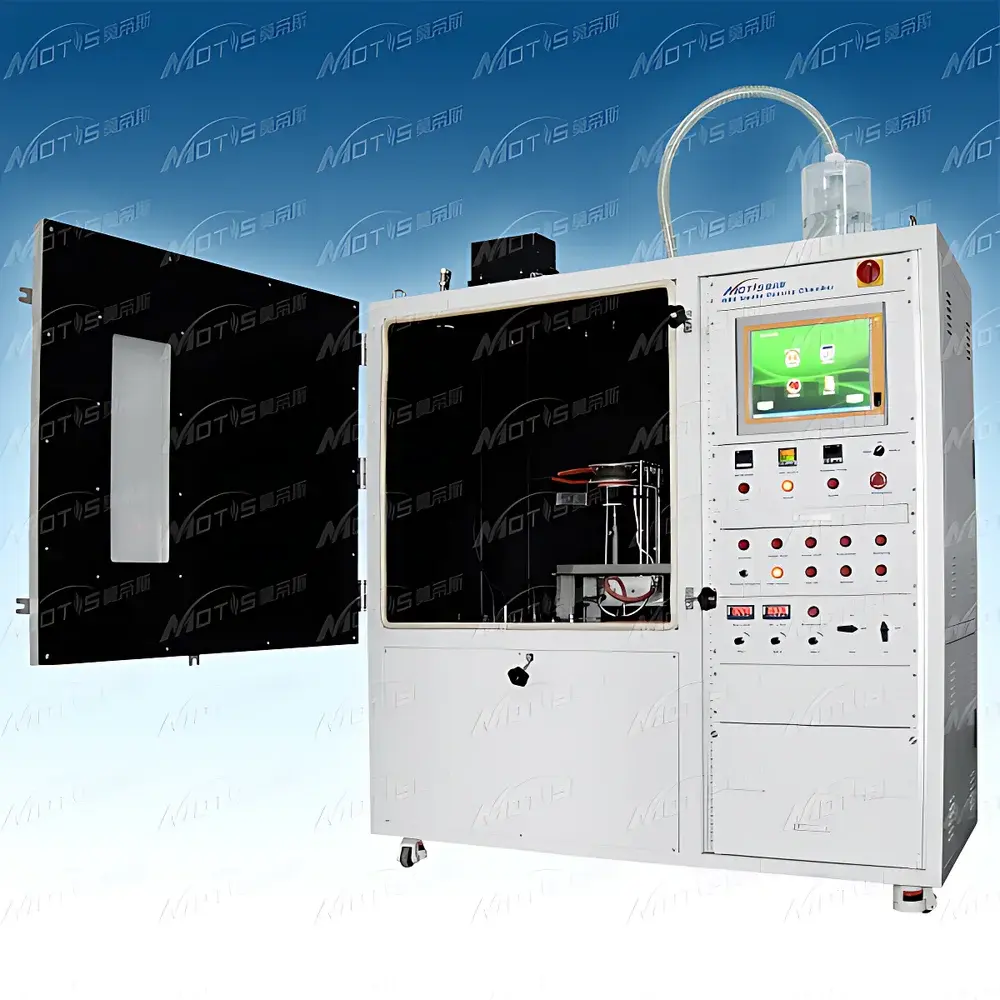
MOTIS SDB Smoke Density Chamber
| Brand | MOTIS |
|---|---|
| Model | SDB |
| Origin | Shanghai, China |
| Chamber Internal Dimensions | 914 × 914 × 610 mm |
| Optical Detection System | Side-window Photomultiplier Tube (PMT), S-4 spectral response, transmittance resolution ≤ 0.0001% |
| Radiation Sources | ASTM E662 Radiant Panel (25 kW/m²) and ISO 5659-2 Radiant Cone (50 kW/m²) |
| Ignition Sources | ASTM E662 Flame Burner, ISO 5659-2 Flame Burner, NES 711 Flame Burner with Mixing Fan |
| Temperature Control | External Auxiliary Heating Jacket |
| Pressure Regulation | Automatic Pressure Relief Valve with Calibrated Volume Bottle |
| Safety Features | Explosion-Proof Aluminum Foil Liner, Top/Bot Pneumatic Cylinders, Full-Access Front Door |
| Cooling Options | Air-Cooled Copper Heat Flux Meter, Water-Cooled MEDTHERM Heat Flux Meter (NIST-traceable), Self-contained Recirculating Chiller |
| Mass Loss Measurement | Integrated Balance (0–5000 g, ±0.01 g) |
| Compliance Standards | ASTM E662, ISO 5659-2, NES 711, GB/T 8323 |
| Software | Integrated Touchscreen PC with Real-time Transmittance Logging, Report Generation, and Calibration Workflow |
| Optional Add-ons | Dräger Gas Detection Tubes, FTIR Coupling Interface for Smoke Toxicity & Speciation Analysis |
Overview
The MOTIS SDB Smoke Density Chamber is a fully integrated, standards-compliant optical smoke measurement system engineered for precise quantification of specific optical density (Ds) during combustion of polymeric and non-metallic materials. It operates on the fundamental principle of the Beer–Lambert Law, wherein attenuation of collimated visible light (550 nm nominal wavelength) through smoke-laden air within a defined test volume is directly related to particulate concentration and particle size distribution. The chamber’s 914 × 914 × 610 mm internal cavity—internally coated with corrosion-resistant PTFE—ensures long-term stability against acidic and halogenated decomposition products generated during thermal degradation of plastics, cables, rail composites, and marine interior materials. Its modular radiant and flame ignition architecture supports multi-standard evaluation under ASTM E662 (for aerospace and building materials), ISO 5659-2 (widely adopted in transport and regulatory testing), and NES 711 (Naval Engineering Standard). Unlike legacy smoke chambers relying on photodiodes or silicon detectors, the SDB employs a side-window photomultiplier tube (S-4 spectral response) with sub-0.0001% transmittance resolution, enabling high-fidelity capture of early-stage smoke nucleation and low-density plume development.
Key Features
- PTFE-lined stainless-steel chamber with full-front access door for rapid specimen loading, optical window cleaning, and accessory exchange
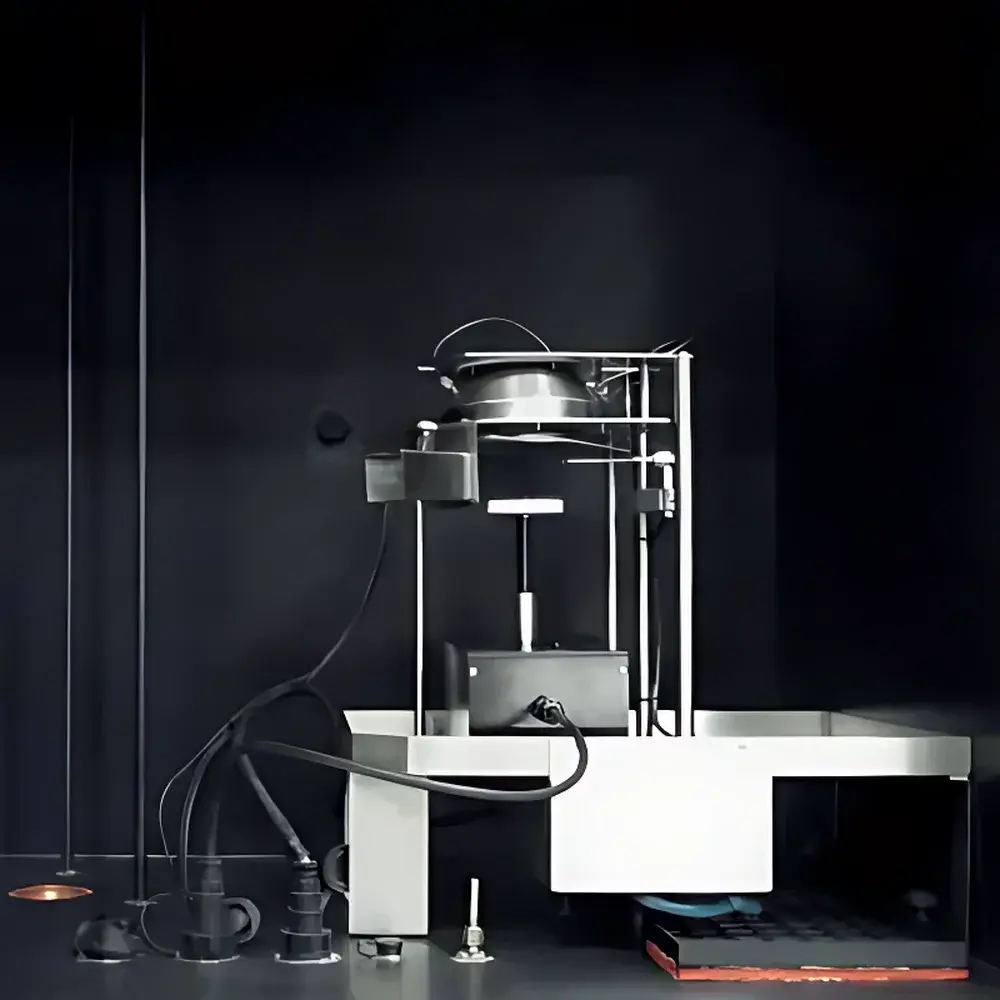
- Dual-certified radiant sources: ASTM E662 radiant panel (25 kW/m²) and ISO 5659-2 conical heater (50 kW/m²), interchangeable via aviation-grade quick-connect interface
- Multi-standard flame burners: ASTM E662 burner, ISO 5659-2 burner, and NES 711 burner with integrated mixing fan for uniform turbulence control
- Automated optical dark box housing three-position rotating filter wheel (Clear / ND2 Neutral Density / Dark) for dynamic range extension and in-situ calibration
- NIST-traceable water-cooled MEDTHERM heat flux meter (supplied with calibration certificate) and optional air-cooled copper calorimeter for simultaneous heat release rate correlation
- Integrated precision balance (0–5000 g, ±0.01 g) supporting mass loss monitoring per ASTM E662 Annex A3 and MOD smoke density protocols
- Pressure-regulated environment via top-mounted relief valve linked to calibrated volume bottle; auxiliary external heating jacket for accelerated thermal equilibration
- Explosion-proof aluminum foil lining and dual pneumatic actuators (top/bottom) for safe, repeatable mechanical operation
Sample Compatibility & Compliance
The SDB accommodates flat, rigid specimens up to 100 mm × 100 mm × 25 mm (ASTM E662) or 75 mm × 75 mm × 12 mm (ISO 5659-2), including thermoplastics (e.g., PVC, PE, PP), thermosets (epoxies, phenolics), elastomers, cable jackets, seat foams, and composite laminates. It meets all mechanical, optical, and environmental requirements specified in ASTM E662–23, ISO 5659-2:2017, NES 711 (Issue 4), and GB/T 8323.2–2018. The system supports GLP-aligned operation: audit trails, user access levels, electronic signatures, and 21 CFR Part 11–compliant data archiving are available via optional software modules. All radiant and flame configurations undergo factory verification against reference smoke generators and NIST-traceable radiometers prior to shipment.
Software & Data Management
The SDB is controlled via an embedded industrial touchscreen PC running dedicated firmware compliant with IEC 62443-3-3 security guidelines. The interface provides real-time plotting of transmittance (%T), specific optical density (Ds = –log10(%T/100)), and mass loss curves synchronized with thermal input profiles. Raw data files are stored in CSV and XML formats with metadata tags (operator ID, standard selected, ignition mode, chamber temperature, ambient humidity). Built-in calibration routines include zero-dark, full-light, and ND2 reference checks. Reports conform to ASTM/ISO formatting templates and may be exported with embedded digital signatures, timestamps, and instrument certification status. Optional integration with LIMS platforms is supported via OPC UA and RESTful API endpoints.
Applications
This chamber serves as a primary tool in fire safety R&D laboratories, third-party certification bodies (e.g., UL, TÜV, SGS), and OEM material qualification teams across aerospace, rail transit, marine, and building product sectors. Typical use cases include comparative smoke toxicity screening (when coupled with Dräger tubes or FTIR), regulatory compliance testing for EN 45545-2 (rail), IMO FTP Code (marine), FAA AC 20-135 (aviation), and Chinese GB 8624 classification. It also supports academic research into soot formation kinetics, halogenated flame inhibition mechanisms, and nano-additive effects on smoke suppression efficiency.
FAQ
What standards does the SDB chamber support out-of-the-box?
ASTM E662, ISO 5659-2, NES 711, and GB/T 8323.2—all verified at time of commissioning.
Is NIST traceability provided for all calibrated components?
Yes: the MEDTHERM heat flux meter includes a valid NIST-traceable calibration certificate; PMT gain and transmittance linearity are validated using certified neutral density filters.
Can the system perform simultaneous smoke density and toxic gas analysis?
Yes—via optional Dräger tube holders (for CO, HCN, HCl, HF) or FTIR gas cell integration (requires external spectrometer and purge gas manifold).
What maintenance intervals are recommended for optical components?
Front and rear quartz windows should be cleaned after every 10 tests using spectroscopic-grade methanol; PMT sensitivity verification is recommended quarterly or after 100 test cycles.
Does the system meet cybersecurity requirements for networked lab environments?
The base configuration operates in standalone mode; optional firmware upgrades provide TLS 1.2 encryption, role-based authentication, and secure remote diagnostics compliant with ISO/IEC 27001-aligned policies.



