
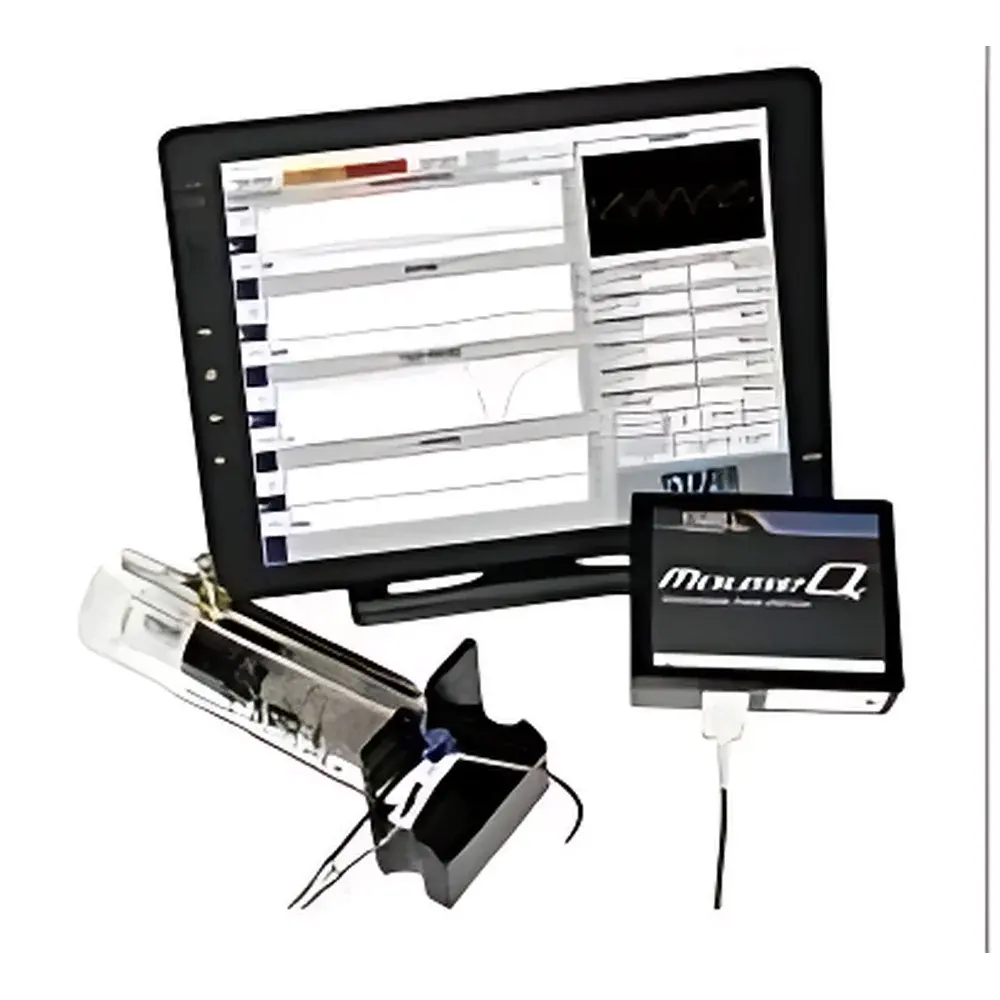
MouseOx Advanced Non-Invasive Pulse Oximeter for Small Rodents and Lagomorphs
| Origin | USA |
|---|---|
| Manufacturer Type | Authorized Distributor |
| Origin Category | Imported |
| Model | MouseOx |
| Pricing | Available Upon Request |
Overview
The MouseOx Advanced Non-Invasive Pulse Oximeter is a purpose-engineered physiological monitoring system designed specifically for unrestrained or lightly restrained small laboratory animals—including neonatal and adult mice, rats, guinea pigs, and rabbits. It operates on the principle of dual-wavelength photoplethysmography (PPG), utilizing red (660 nm) and infrared (940 nm) light absorption to quantify arterial oxygen saturation (SpO₂) in real time without surgical intervention or arterial cannulation. The device simultaneously extracts hemodynamic and respiratory parameters from a single, lightweight, clip-style sensor placed on the animal’s paw, tail, or ear—minimizing stress artifacts and preserving natural physiology during longitudinal studies, surgical anesthesia management, pharmacological challenge assays, and preclinical safety pharmacology evaluations.
Key Features
- Simultaneous acquisition of five core physiological parameters: SpO₂ (%), pulse rate (BPM), respiratory rate (breaths/min), pulse amplitude (µm-scale vascular distension), and respiratory amplitude (excursion magnitude)
- Real-time signal processing with sub-second latency: SpO₂ and pulse amplitude updated every 0.72 seconds post-detection of each cardiac cycle
- Respiratory rate calculated as a moving average over 10 consecutive breaths, reported every 1.7 seconds to suppress transient motion-induced noise
- Clinically validated accuracy: SpO₂ measurement error < ±1.5% across 0–100% range; pulse amplitude error < ±2.4% across 0–800 µm dynamic range
- Modular architecture comprising the main MouseOx unit, StarrLink analog output interface (0–5 V or 4–20 mA configurable), and species-specific restraint tubes optimized for stable sensor positioning and thermal regulation
- No calibration required for routine use; sensor auto-zeroing and ambient light rejection algorithms ensure robustness across variable lighting and ambient temperature conditions
Sample Compatibility & Compliance
The MouseOx system supports consistent signal acquisition across a broad weight range (5 g to 5 kg), with validated performance in C57BL/6, BALB/c, Sprague-Dawley, and New Zealand White strains under both conscious and anesthetized states. Sensor geometry and optical path length are optimized for low-perfusion tissues common in rodent extremities. All hardware components comply with IEC 61000-6-3 (EMC emission standards) and IEC 61000-6-2 (immunity requirements). While not classified as a medical device per FDA 21 CFR Part 820, the system is routinely deployed in GLP-compliant toxicology studies and aligns with NIH Office of Laboratory Animal Welfare (OLAW) guidelines for minimally invasive monitoring. Data traceability supports audit readiness for AAALAC-accredited facilities.
Software & Data Management
Data output is delivered via analog voltage signals (StarrLink module) compatible with third-party data acquisition systems (e.g., PowerLab, DI-158U, or custom LabVIEW environments). Optional digital integration enables timestamp-synchronized streaming to CSV or HDF5 formats. All acquired waveforms retain native sampling resolution (100 Hz nominal), preserving spectral integrity for post-hoc HRV (heart rate variability) or respiratory sinus arrhythmia (RSA) analysis. Audit-trail functionality logs operator ID, session start/end timestamps, sensor placement notes, and firmware revision—supporting documentation requirements under ISO/IEC 17025 and OECD GLP Principles.
Applications
- Intraoperative monitoring during survival surgery to maintain target SpO₂ >92% and detect early hypoxemia prior to hemodynamic decompensation
- Anesthesia depth assessment through trending of pulse amplitude attenuation and respiratory rate depression
- Chronic disease modeling (e.g., COPD, heart failure, sepsis) requiring longitudinal, non-stressful SpO₂ and respiratory kinetics
- Drug-induced respiratory depression screening in CNS pharmacology programs (e.g., opioid receptor agonists)
- Validation of genetic models exhibiting impaired oxygen transport or ventilatory control
- Environmental stress testing (hypoxia, hypercapnia, thermoregulatory challenges) with concurrent cardiorespiratory endpoint correlation
FAQ
Is MouseOx suitable for neonatal mice less than 7 days old?
Yes—sensor variants with reduced clamping force and miniaturized optical footprints have been validated for P7 pups using tail-base placement; signal stability requires thermal stabilization at 34–36°C.
Can the system distinguish between apnea and bradypnea?
Yes—the algorithm applies adaptive thresholding to respiratory waveform morphology and integrates inter-breath interval variance to classify apneic episodes (>3× baseline IBI) versus sustained bradypnea.
Does MouseOx support synchronization with EEG or EMG recordings?
Yes—TTL pulse outputs from the StarrLink module provide hardware-triggered alignment with electrophysiological acquisition systems at millisecond precision.
What is the recommended recalibration interval?
No routine recalibration is required; however, annual verification against NIST-traceable optical phantoms is advised for regulatory submissions.
How does ambient light affect measurement fidelity?
The sensor incorporates optical bandpass filtering and synchronous demodulation to reject >99.8% of ambient 50/60 Hz and broadband illumination interference, enabling reliable operation under standard vivarium lighting.




