
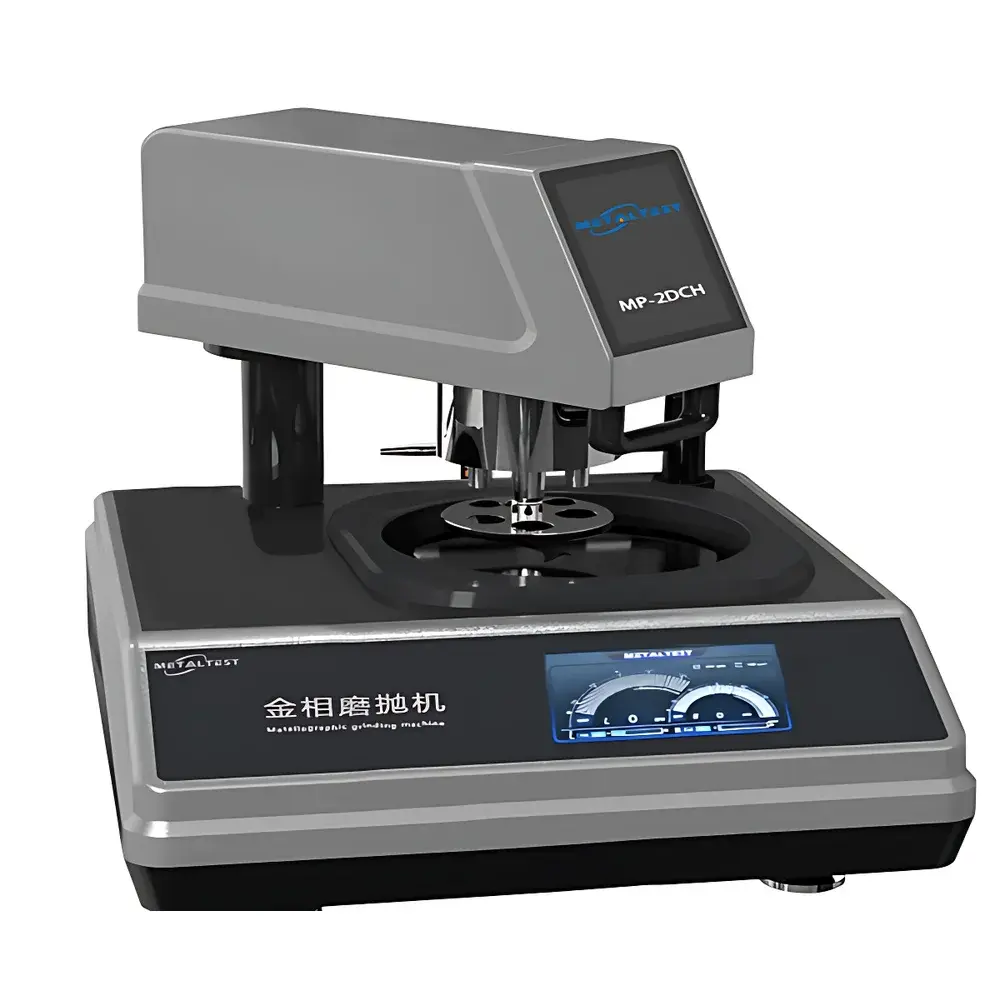
MP-1DCH Single-Station Touchscreen Semi-Automatic Grinding and Polishing Machine
| Brand | WEIYEE |
|---|---|
| Origin | Guangdong, China |
| Model | MP-1DCH |
| Grinding Disc Diameter | 200 mm (8") |
| Number of Grinding Discs | 1 |
| Speed Range (Disc) | 50–1500 rpm, infinitely variable |
| Rotation Direction | Forward/Reverse selectable |
| Polishing Head Speed | 20–120 rpm, infinitely variable |
| Sample Capacity | Up to 4 specimens simultaneously |
| Power Supply | AC 220 V |
| Housing Material | Reinforced plastic-steel composite |
Overview
The MP-1DCH Single-Station Touchscreen Semi-Automatic Grinding and Polishing Machine is a precision sample preparation instrument engineered for consistent, repeatable material surface conditioning in metallurgical, ceramic, geological, and advanced materials laboratories. Designed around Couette-flow-based mechanical abrasion principles, the system employs a single 200 mm (8″) grinding/polishing disc rotating at precisely controlled speeds (50–1500 rpm) to deliver uniform shear stress across mounted specimens. Its semi-automatic architecture integrates programmable pressure application with independent control of disc rotation and polishing head motion (20–120 rpm), enabling stepwise execution of standardized metallographic preparation protocols—including coarse grinding, fine grinding, and final polishing—while minimizing operator-induced variability. The reinforced plastic-steel housing ensures structural stability during extended operation and provides electromagnetic shielding compliant with IEC 61000-6-3 emission limits.
Key Features
- Intuitive 7-inch capacitive touchscreen interface with multilingual UI (English, German, Spanish, Chinese), supporting recipe-based workflow programming and real-time parameter monitoring.
- Infinitely variable disc speed control (50–1500 rpm) with ±0.5% speed stability under load, ensuring reproducible material removal rates across abrasive stages.
- Dual-direction rotation (forward/reverse) mitigates asymmetric wear on consumables and improves planarity retention during multi-step preparation.
- Independent polishing head drive (20–120 rpm) enables synchronized or decoupled motion relative to the main disc—critical for achieving low-scratch, deformation-free surfaces in soft alloys and brittle ceramics.
- Adjustable mechanical loading mechanism (0–50 N range, calibrated via integrated load cell feedback) delivers traceable, repeatable force application per specimen—essential for ASTM E3, ISO 14577, and GB/T 13298-compliant microstructural analysis.
- Four-specimen holder configuration with concentric alignment pins ensures radial symmetry and eliminates eccentric loading errors during high-speed operation.
Sample Compatibility & Compliance
The MP-1DCH accommodates standard metallographic mounts (25 mm, 30 mm, and 32 mm diameter) as well as custom rectangular specimens up to 40 × 30 mm. It supports all common abrasive media—including silicon carbide papers (P80–P2500), diamond suspensions (1–6 µm), and colloidal silica (0.02–0.06 µm)—via compatible backing plates and adhesive systems. The machine meets CE marking requirements under Machinery Directive 2006/42/EC and EMC Directive 2014/30/EU. Its operational parameters align with ISO 13005:2013 (metallographic specimen preparation), ASTM E3-22 (standard guide for preparation of metallographic specimens), and GLP-compliant documentation workflows when paired with optional audit-trail-enabled software modules.
Software & Data Management
The embedded firmware logs all process parameters—including time-stamped speed profiles, applied load values, rotation direction events, and total runtime—into non-volatile memory with automatic timestamping (RTC-backed). Optional PC connectivity via USB-C enables export of CSV-formatted logs for LIMS integration or statistical process control (SPC) analysis. When deployed in regulated environments (e.g., ISO 17025-accredited labs), the system supports 21 CFR Part 11-compliant user authentication and electronic signature workflows through the optional WEIYEE LabSuite™ v3.2 software platform, which includes role-based access control, change history tracking, and encrypted data storage.
Applications
- Preparation of cross-sectional samples for SEM-EDS, EBSD, and TEM analysis in failure analysis and R&D labs.
- Routine quality control of sintered tungsten carbide, stainless steel, aluminum alloys, and composite laminates per ASTM B657 and ISO 4527.
- Surface conditioning of geological thin sections (e.g., quartzite, basalt) prior to optical petrographic examination.
- Standardized polishing of battery electrode coatings (NMC, LFP) for porosity and particle distribution assessment via image analysis.
- Preparation of additively manufactured Ti-6Al-4V and Inconel 718 specimens for residual stress evaluation using X-ray diffraction.
FAQ
What standards does the MP-1DCH support for metallographic preparation?
It complies with ASTM E3-22, ISO 13005:2013, and GB/T 13298, and its force and speed control capabilities enable adherence to method-specific requirements in ISO 6506 (Brinell hardness) and ISO 6507 (Vickers hardness) specimen prep.
Can the MP-1DCH be integrated into an automated lab workflow?
Yes—via Modbus RTU over RS-485 (optional module), it supports external PLC coordination for batch processing and upstream/downstream integration with mounting presses and ultrasonic cleaning stations.
Is calibration documentation available for metrological traceability?
Factory calibration certificates (traceable to NIM China and NIST SRMs) are provided for rotational speed and applied load sensors, with annual recalibration intervals recommended per ISO/IEC 17025 Clause 6.5.
Does the machine support wet or dry grinding modes?
Both—integrated coolant delivery ports (M6 thread) and splash guard design accommodate continuous aqueous or oil-based lubricant flow; dry grinding is supported with dust extraction via optional 50 mm duct interface.
Related Products



