
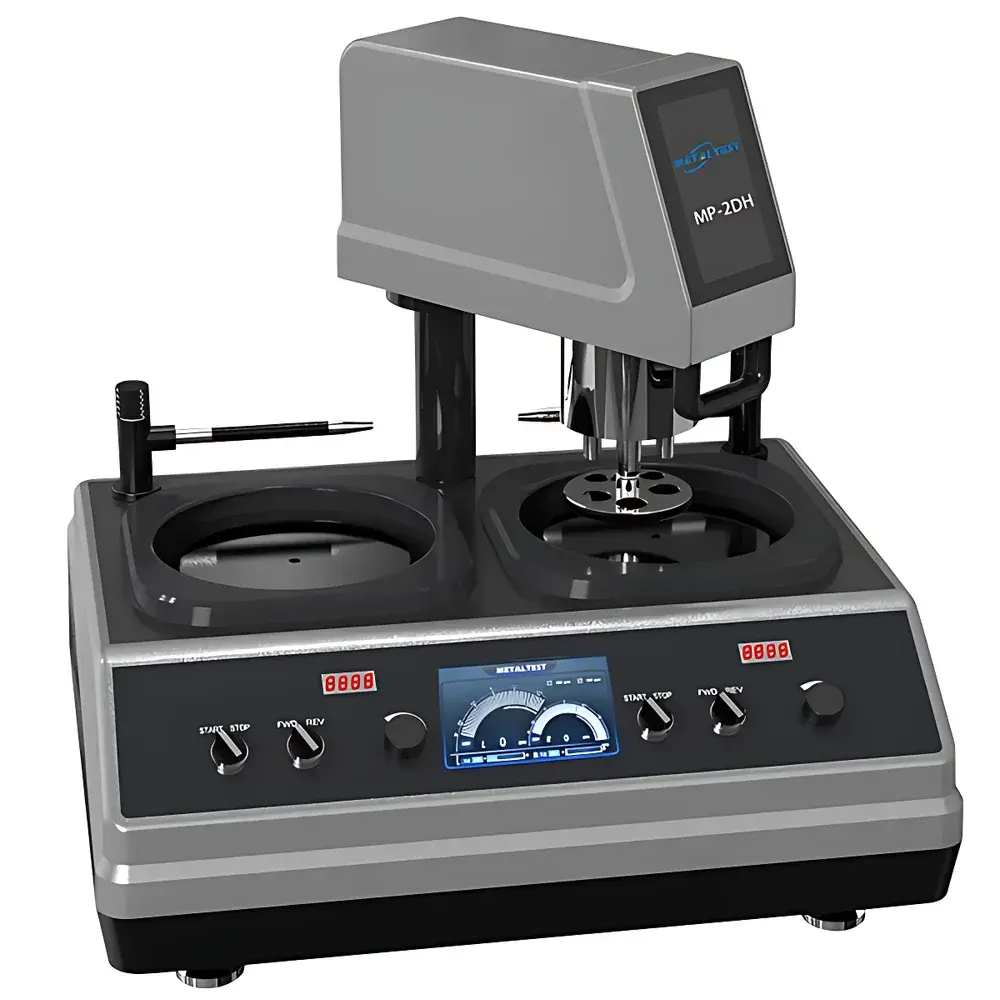
MP-2DCH Dual-Disk Semi-Automatic Grinding and Polishing Machine
| Brand | WEIYEE |
|---|---|
| Origin | Guangdong, China |
| Model | MP-2DCH |
| Disk Diameter | 200 mm (8") |
| Number of Disks | 2 |
| Speed Range (Disk) | 50–1500 rpm, infinitely variable |
| Rotation Direction | Forward/Reverse selectable |
| Polishing Head Speed | 20–120 rpm, infinitely variable |
| Power Supply | 220 V AC |
| Sample Capacity | Up to 4 specimens simultaneously |
| Pressure Control | Adjustable mechanical load system |
| Housing Material | Reinforced plastic-steel composite |
Overview
The MP-2DCH Dual-Disk Semi-Automatic Grinding and Polishing Machine is an engineered solution for standardized metallographic and geological sample preparation in quality control laboratories, academic research facilities, and materials testing centers. Designed around the principles of controlled abrasive removal and surface planarization, the system employs two independently driven 200 mm diameter grinding/polishing disks operating under adjustable mechanical pressure and precisely regulated rotational dynamics. Its semi-automatic architecture balances operator intervention with repeatable process execution—enabling consistent material removal rates, minimized edge rounding, and reproducible surface finish across diverse specimen types including ferrous alloys, non-ferrous metals, ceramics, and composite laminates. The dual-disk configuration supports parallel processing of up to four specimens (two per disk), significantly improving throughput without compromising inter-sample uniformity.
Key Features
- Dual independent 200 mm grinding/polishing disks with fully decoupled speed control (50–1500 rpm, infinitely variable) and forward/reverse rotation selection—essential for optimizing abrasive action during coarse grinding, fine grinding, and final polishing stages.
- Adjustable mechanical loading mechanism enabling precise pressure application (typically 10–50 N per specimen, depending on carrier design and abrasive type), critical for maintaining consistent material removal kinetics and minimizing subsurface deformation.
- Separately controllable polishing head rotation (20–120 rpm, infinitely variable), facilitating synchronized or differential motion between specimen carrier and disk surface to enhance flatness and reduce artifact formation.
- Reinforced plastic-steel housing provides structural rigidity while resisting corrosion from water-based slurries and common polishing lubricants—ensuring long-term dimensional stability and operator safety.
- Integrated 220 V AC power interface compliant with IEC 61000-3-2 harmonic emission standards and equipped with thermal overload protection and emergency stop circuitry meeting EN 60204-1 requirements.
Sample Compatibility & Compliance
The MP-2DCH accommodates standard metallographic specimen mounts (25 mm, 30 mm, and 40 mm diameters) as well as custom carriers compatible with ASTM E3, ISO 14976, and GB/T 13298 specimen preparation guidelines. Its mechanical pressure control and rotational flexibility support standardized protocols for both silicon carbide paper grinding (P80–P2500) and diamond/alumina suspension polishing (15 µm to 0.02 µm). The system is suitable for laboratories operating under GLP and ISO/IEC 17025 frameworks; though not inherently FDA 21 CFR Part 11-compliant (as it lacks electronic audit trail functionality), its operational parameters are fully documentable via external logbooks or LIMS-integrated process records.
Software & Data Management
As a semi-automatic mechanical platform, the MP-2DCH does not incorporate embedded firmware or digital control software. All operational parameters—including disk speed, direction, polishing head speed, and applied pressure—are set manually using calibrated dials and mechanical levers. This analog architecture ensures electromagnetic immunity, eliminates firmware update dependencies, and simplifies validation in regulated environments where deterministic mechanical behavior is preferred over programmable logic. Process parameters are recorded externally using laboratory notebooks or integrated into digital workflows via barcode-scanned SOPs and time-stamped procedural logs.
Applications
- Routine metallographic preparation for optical and electron microscopy (SEM/TEM) analysis in metallurgical QA/QC labs.
- Geological thin-section preparation for petrographic analysis, including brittle rock matrices and mineral aggregates.
- Preparation of sintered ceramic and powder metallurgy compacts for porosity and grain size evaluation per ASTM E112 and ISO 643.
- Surface conditioning of coated substrates prior to adhesion testing (e.g., ASTM D4541) or cross-hatch evaluation (ASTM D3359).
- Standardized sample flattening for hardness testing (ISO 6507, ASTM E384) where specimen geometry directly impacts indentation repeatability.
FAQ
What types of abrasive media are compatible with the MP-2DCH?
The machine supports all standard rigid-backed grinding papers (SiC, Al₂O₃), cloth-backed diamond pads, and slurry-fed polishing cloths—provided they conform to 200 mm disk mounting specifications and operate within recommended pressure and speed envelopes.
Is the MP-2DCH suitable for automated process documentation?
No—the system lacks built-in data logging or connectivity. However, its manual controls are designed for straightforward transcription into ELN or LIMS platforms using predefined parameter templates.
Can the unit be used for wet or dry grinding?
It is engineered for wet grinding and polishing only; integrated splash guards and drain channels facilitate continuous coolant or slurry flow, preventing overheating and abrasive clogging.
Does the MP-2DCH meet international electrical safety standards?
Yes—it complies with EN 60204-1 (Safety of Machinery – Electrical Equipment) and IEC 61000-3-2 for harmonic current emissions when operated at rated voltage and load.
What maintenance intervals are recommended for sustained performance?
Bearing lubrication every 500 operational hours, disk mounting bolt torque verification quarterly, and periodic inspection of pressure actuator springs and belt tension—per the manufacturer’s maintenance schedule included in the technical manual.



