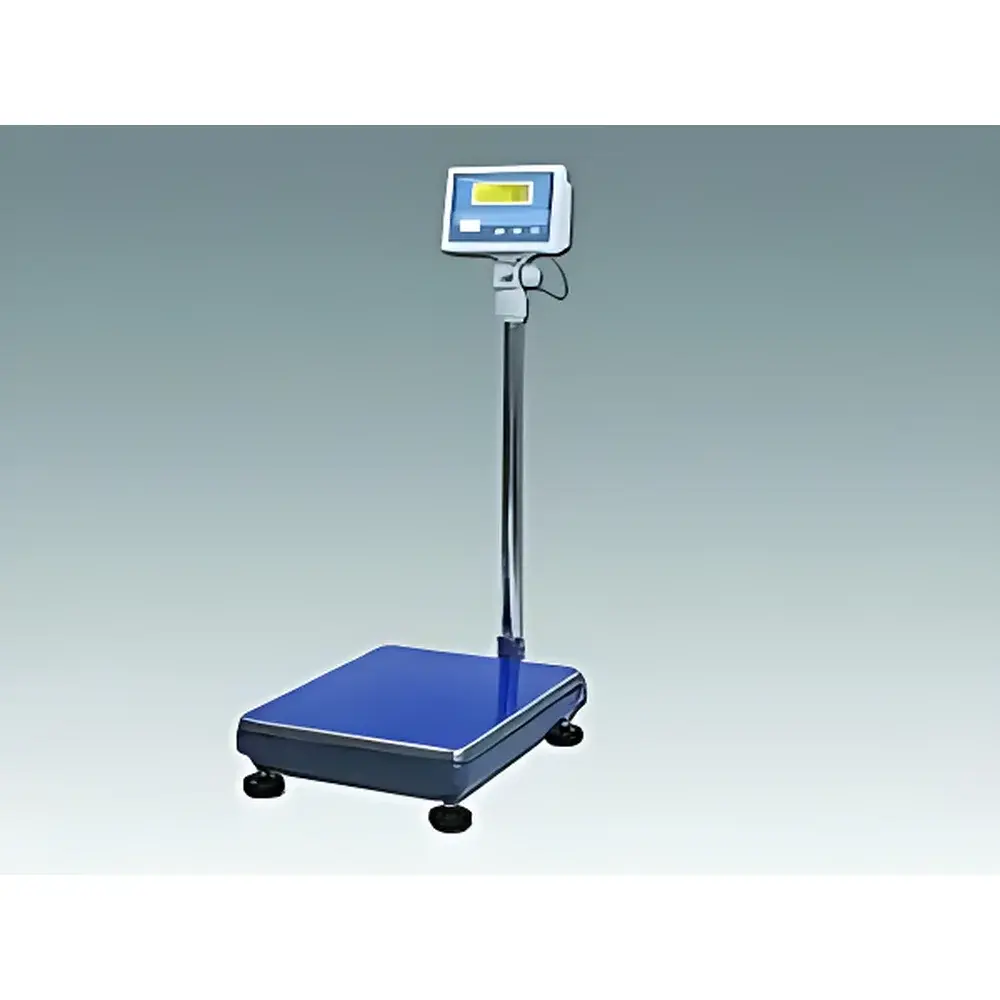
MP100K Heavy-Duty Electronic Balance
| Origin | Shanghai, China |
|---|---|
| Manufacturer Type | Authorized Distributor |
| Origin Category | Domestic (China) |
| Model | MP100K |
| Price | USD 440 (FOB Shanghai) |
| Capacity | 100 kg |
| Readability | 5 g |
| Repeatability | ±5 g |
| Linearity | ±10 g |
| Pan Dimensions | 420 × 520 mm |
| Display | Backlit LCD |
| Power Options | AC Adapter (100–240 VAC) or Internal Rechargeable Battery (9 V equivalent) |
| Interface | RS-232 Serial Port |
| Construction | Hybrid Metal-Plastic Housing with Stainless Steel Weighing Pan |
| Core Technology | High-Stability Strain-Gauge Load Cell Integrated with Embedded Microcontroller for Digital Signal Processing |
Overview
The MP100K Heavy-Duty Electronic Balance is an industrial-grade weighing instrument engineered for precision, durability, and operational reliability in non-laboratory environments where high-capacity measurement is required without sacrificing repeatability. Built upon a robust strain-gauge load cell architecture—optimized to minimize creep and thermal drift—the MP100K employs embedded microcontroller-based signal conditioning to deliver stable, noise-resistant weight readings. Unlike conventional analog-output scales, this balance digitizes sensor output at the source, enabling real-time compensation for environmental fluctuations such as minor temperature gradients and mechanical vibration. Its 100 kg maximum capacity and 5 g readability make it suitable for applications demanding coarse-to-moderate resolution mass determination, including raw material batching, package verification, inventory reconciliation, and educational demonstration protocols. The device complies with general-purpose metrological requirements outlined in OIML R76-1 (2021) for Class III non-automatic weighing instruments and meets electromagnetic compatibility standards per IEC 61326-1:2023.
Key Features
- Backlit LCD display with large, high-contrast digits for legibility under variable ambient lighting conditions
- Dual-power operation: supports continuous use via universal AC adapter (100–240 VAC, 50/60 Hz) or portable operation via internal rechargeable battery system (equivalent to 9 V DC, >8 hours runtime on full charge)
- Integrated RS-232 serial interface compliant with EIA/TIA-232-F specifications, enabling direct connection to PCs, printers, or PLCs for automated data logging and SPC integration
- Onboard functionality includes tare, auto-calibration (internal reference mass), zero-tracking, piece counting (with user-defined unit weight), and overload/fault diagnostics with alphanumeric error codes
- Stainless steel weighing pan (420 × 520 mm) mounted on a rigid hybrid housing combining structural aluminum alloy framing and impact-resistant ABS polymer casing
- Microprocessor-controlled digital filtering algorithms ensure rapid stabilization (<3 seconds typical response time) and suppress transient oscillations from operator-induced mechanical disturbance
Sample Compatibility & Compliance
The MP100K accommodates bulk solids, packaged goods, containers, and irregularly shaped objects up to 100 kg. Its wide, low-profile pan geometry supports stable placement of drums, crates, trays, and tote bins. While not certified for pharmaceutical or legal-for-trade applications requiring NTEP or EC Type Approval, the balance satisfies functional accuracy expectations for internal process control in ISO 9001-certified manufacturing facilities, vocational training labs, agricultural cooperatives, and municipal quality assurance departments. It conforms to basic safety requirements under IEC 61010-1:2010 for electrical equipment used in measurement, control, and laboratory applications. Calibration traceability is maintained through documented internal adjustment using factory-certified test weights (Class M2, per ISO 9001 clause 7.1.5.2).
Software & Data Management
No proprietary software is bundled; however, the RS-232 interface permits seamless integration with third-party data acquisition platforms—including LabVIEW, MATLAB, Excel via ActiveX controls, or custom MES/ERP modules—using standard ASCII protocol (e.g., “S” command for stable weight transmission). All transmitted values include carriage return/line feed termination and optional prefix/suffix identifiers. The balance supports configurable baud rates (1200–9600 bps), parity (none/even/odd), and data bits (7 or 8). Audit trail functionality is implemented externally via host-system logging; no onboard storage or FDA 21 CFR Part 11-compliant electronic signatures are provided. For GLP/GMP-aligned environments, users are advised to implement external timestamped capture and secure archival per organizational SOPs.
Applications
- Raw material intake verification in food processing and chemical blending operations
- Finished goods packaging weight checks prior to palletization and shipment
- Inventory management in warehouse distribution centers (e.g., case-counting mode for uniform SKU items)
- Field-deployable mass calibration support for lower-capacity analytical balances in mobile QA labs
- Physics and materials science instruction in technical colleges—demonstrating load-cell principles, uncertainty propagation, and statistical process analysis
- Construction site material estimation (e.g., cement, aggregate, insulation rolls) where portability and battery operation are critical
FAQ
What is the recommended calibration frequency for routine use?
For daily operational environments with moderate temperature variation and mechanical stress, perform internal calibration before first use each shift and after any significant relocation or impact event.
Can the MP100K be used in humid or dusty industrial settings?
The unit carries an IP42 ingress protection rating—suitable for dry indoor locations only; it is not rated for washdown, high-humidity, or explosive atmospheres.
Does the balance support external calibration with certified weights?
Yes; external calibration mode accepts user-provided Class M1 or M2 reference masses per ISO/IEC 17025 guidelines, though no built-in calibration certificate generation is available.
Is firmware upgrade capability supported?
Firmware updates are performed exclusively by authorized service centers using dedicated diagnostic hardware; end-user field upgrades are not enabled.
How is repeatability verified during installation qualification?
Repeatability testing follows ASTM E898-22 Section 7.3: three consecutive weighings of a stable test load (≥50% of capacity) at identical location on pan, calculating standard deviation of results—must be ≤ ±5 g.