
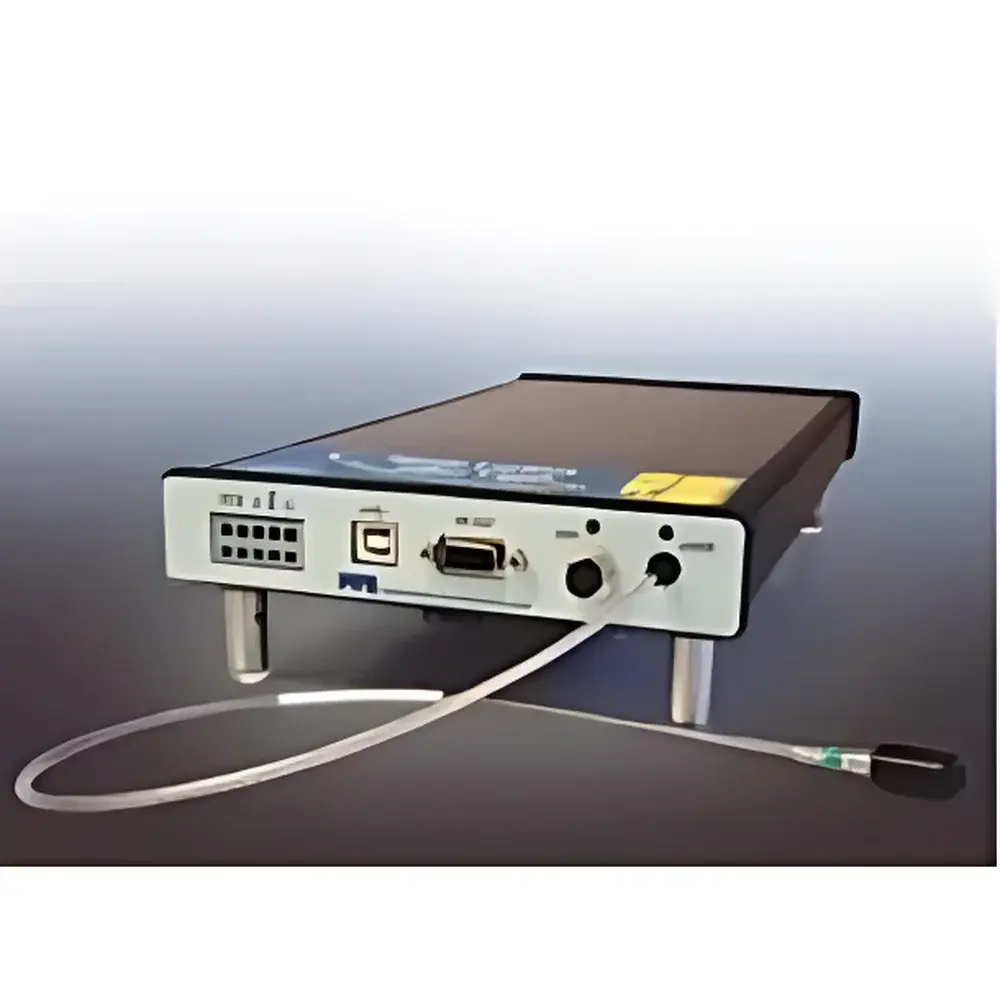
MPB MLFL Mode-Locked Fiber Laser
| Brand | MPB |
|---|---|
| Origin | Canada |
| Model | MLFL |
| Wavelength Range | 1020–1100 nm |
| Pulse Duration | 2–50 ps |
| Average Output Power | 10–20 mW (oscillator only), 150 mW (with PM preamplifier), 3000 mW (with PM booster amplifier) |
| Repetition Rate | 30–100 MHz |
| Polarization | Linear |
| Design | All-fiber, polarization-maintaining (PM) architecture |
| MTBF | ≥10,000 hours |
| Compliance | Designed for ISO/IEC 17025-aligned optical labs and GLP-compliant environments |
Overview
The MPB MLFL Mode-Locked Fiber Laser is an all-fiber, polarization-maintaining ultrafast laser source engineered for high-stability, turnkey operation in demanding scientific and industrial applications. Based on passive mode-locking in a fully monolithic fiber cavity, the MLFL generates transform-limited picosecond pulses with intrinsic amplitude noise suppression and self-starting capability—eliminating the need for external triggering or manual alignment. Its core architecture leverages stress-induced birefringence in PM fiber components to preserve linear polarization state across the entire optical path, ensuring consistent beam quality and polarization extinction ratio (>20 dB) over extended operational lifetimes. Designed and assembled in Canada, the system complies with IEC 60825-1 (laser safety) and meets electromagnetic compatibility requirements per CISPR 11 Class B. It serves as a primary oscillator in multi-stage amplification chains and functions reliably as a seed source for optical parametric amplifiers (OPAs), frequency-doubled outputs via SHG crystals, and THz generation platforms.
Key Features
- All-fiber, monolithic design with no free-space optics—ensures long-term alignment stability and immunity to environmental vibration
- Self-starting passive mode-locking mechanism with low timing jitter (<100 fs RMS, integrated over 10 kHz–10 MHz)
- Transform-limited pulse duration tunable from 2 ps to 50 ps via dispersion management within the cavity
- Linearly polarized output with >20 dB polarization extinction ratio, maintained across full power and repetition rate tuning range
- Compact OEM-ready chassis (2U rack-mountable or benchtop configuration) with integrated thermal stabilization and air-cooled operation
- Low power consumption (<30 W typical for oscillator-only configuration), suitable for integration into portable or embedded systems
Sample Compatibility & Compliance
The MLFL is compatible with standard PM fiber-pigtailed nonlinear crystals (e.g., BBO, LBO, PPLN) for second-harmonic generation and optical parametric conversion. Its stable carrier-envelope phase (CEP)-unlocked output supports time-resolved pump-probe spectroscopy, asynchronous optical sampling (ASOPS), and time-of-flight metrology. The system conforms to ISO/IEC 17025 calibration traceability frameworks when used with NIST-traceable photodetectors and autocorrelators. For regulated environments—including pharmaceutical QC labs and semiconductor fab metrology suites—the MLFL supports optional audit-trail logging and user-access control via RS232/USB-C interfaces, aligning with FDA 21 CFR Part 11 data integrity principles when integrated into validated software workflows.
Software & Data Management
The MLFL includes a vendor-provided Windows-based control application supporting real-time monitoring of output power, repetition rate, and internal temperature sensors. All operational parameters are accessible via SCPI command set over USB or RS232, enabling seamless integration into LabVIEW, Python (PyVISA), or MATLAB automation environments. Firmware updates are performed via signed binary packages with SHA-256 verification. Internal non-volatile memory logs operational uptime, thermal history, and fault events—exportable as CSV for GLP/GMP documentation. No cloud connectivity or remote telemetry is enabled by default; local data retention complies with GDPR and CCPA requirements for on-premise instrument data sovereignty.
Applications
- Multiphoton microscopy: Provides stable, low-noise excitation at 1040–1080 nm for deep-tissue imaging with reduced phototoxicity
- Ultrafast spectroscopy: Enables transient absorption and fluorescence upconversion measurements with sub-ps temporal resolution
- Semiconductor inspection: Used in time-resolved terahertz emission spectroscopy (TRES) for mapping carrier dynamics in GaN, SiC, and 2D materials
- Precision micromachining: Drives high-aspect-ratio ablation in transparent dielectrics (fused silica, sapphire) with minimal heat-affected zones
- Optical frequency comb seeding: Serves as a robust, low-phase-noise reference for f–2f interferometers in optical clock development
- THz generation: Paired with photoconductive antennas or organic crystals (e.g., DAST) for coherent broadband THz pulses in non-destructive testing
FAQ
Is the MLFL compliant with FDA 21 CFR Part 11 for use in regulated biopharma labs?
Yes—when operated with validated software interfaces and audit-trail logging enabled, the MLFL meets electronic record and signature requirements for GxP environments.
Can the repetition rate be externally synchronized to a master clock?
Yes—via the built-in RF sync input (SMA), the laser supports phase-locked operation to external sources with ±500 fs RMS jitter at 10 MHz offset.
What is the maximum average power achievable with the PM booster amplifier option?
Up to 3 W (3000 mW) average power is specified at 1030 nm with M² < 1.1 and power stability < ±0.5% RMS over 8 hours.
Does the system include factory calibration data for pulse duration and spectrum?
Yes—each unit ships with a NIST-traceable calibration certificate including autocorrelation FWHM, spectral bandwidth (FWHM), and polarization extinction ratio measurements.
Is remote firmware update supported over network connection?
No—firmware updates require local USB connection and digital signature verification to prevent unauthorized modification.





