
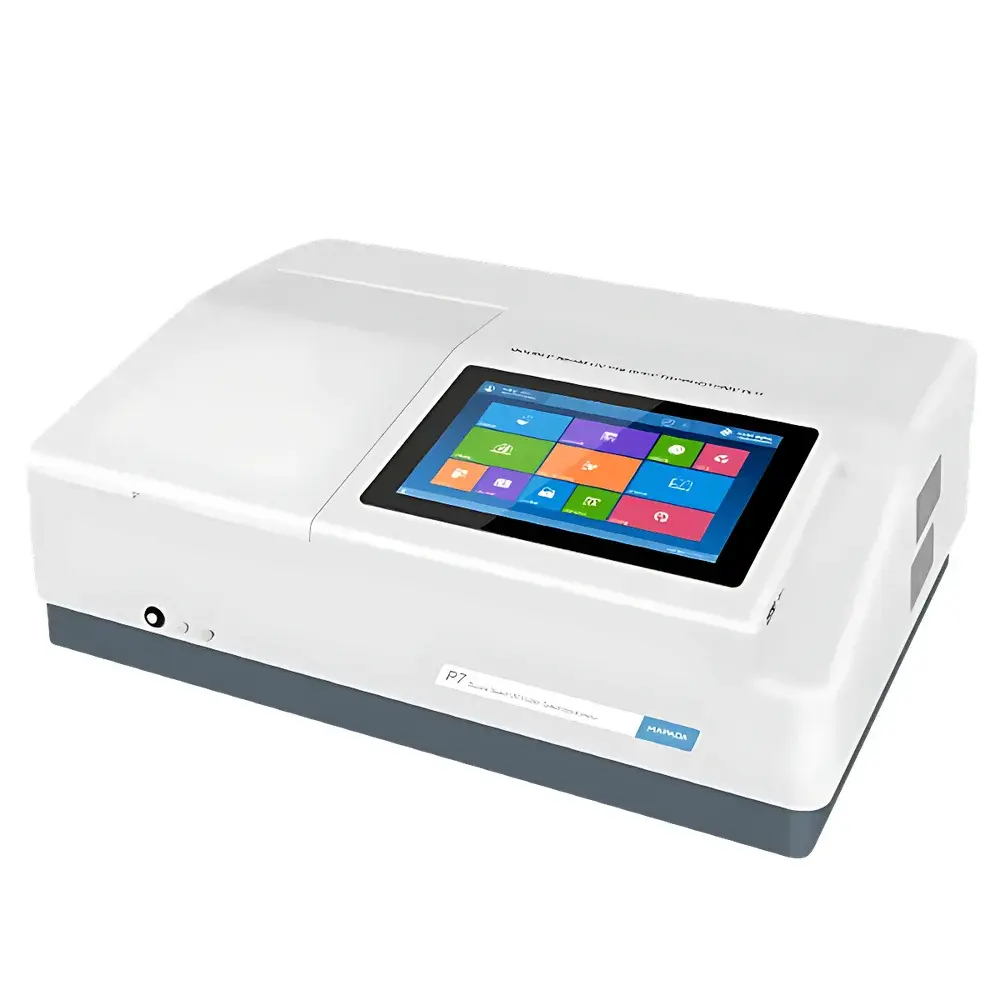
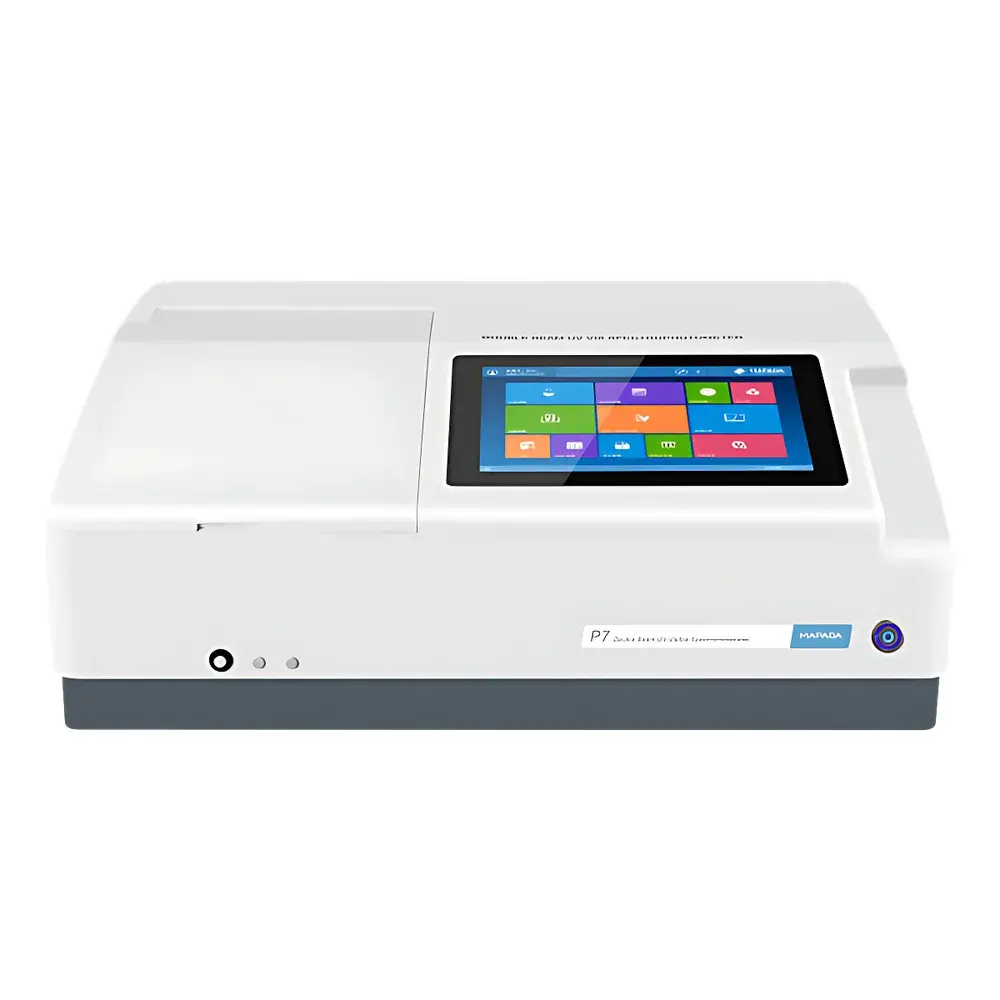
MPM P7 Dual-Beam Ultraviolet-Visible Spectrophotometer
| Brand | MPM |
|---|---|
| Origin | Shanghai, China |
| Manufacturer Type | Original Equipment Manufacturer (OEM) |
| Product Origin | Domestic (China) |
| Model | P7 |
| Instrument Architecture | Dual-Beam |
| Wavelength Range | 190–1100 nm |
| Wavelength Automation | Motorized Auto-Search |
| Spectral Bandwidth | 1.8 nm |
| Wavelength Accuracy | ±0.3 nm |
Overview
The MPM P7 Dual-Beam Ultraviolet-Visible Spectrophotometer is a precision optical instrument engineered for high-reproducibility absorbance, transmittance, and energy (A/T/E) measurements across the full UV-Vis spectral range (190–1100 nm). Based on the dual-beam optical architecture, it simultaneously directs light through both sample and reference paths using a high-stability tungsten-halogen and deuterium lamp source, enabling real-time background correction and minimizing drift from source intensity fluctuations or environmental temperature variation. This design ensures superior photometric stability and long-term measurement fidelity—critical for quantitative analysis in regulated environments such as pharmaceutical QC labs, academic research facilities, and industrial quality control departments. The instrument complies with fundamental performance requirements outlined in ISO 6425:2022 (spectrophotometer verification) and supports traceable calibration protocols aligned with NIST-traceable standards.
Key Features
- Dual-beam optical path with automatic beam balancing and real-time reference compensation
- Motorized wavelength drive with auto-search capability and ±0.3 nm certified accuracy
- Fixed 1.8 nm spectral bandwidth optimized for resolution–sensitivity trade-off in routine analysis
- Integrated A/T/E mode switching with one-touch conversion and configurable display units
- Single-point concentration calculation via user-defined K-factor (one-point calibration)
- Flexible formula editor supporting custom mathematical expressions applicable across all measurement modules
- Multi-wavelength acquisition: up to 20 user-defined wavelengths per run, with configurable averaging (1–50 scans per point)
- Quantitative analysis modes: single-wavelength, dual-wavelength (difference/ratio), triple-wavelength, and fully customizable methods
- Standard curve construction using 2–20 calibrants; four regression options (linear through zero, linear, quadratic, cubic)
- Full kinetic and time-scan functionality: unlimited duration, programmable delay/intervals, automated rate calculation, and event-triggered data capture
- Spectral scanning with adjustable speed (low/medium/high), variable step intervals (0.1–10 nm), peak detection, and interactive point labeling
Sample Compatibility & Compliance
The P7 accommodates standard 10 mm square cuvettes (glass, quartz, or plastic) and supports optional accessories including micro-volume holders, thermostatted cells, and fiber-optic probes. Its optical design minimizes stray light (<0.05% at 220 nm), ensuring reliable quantitation even for highly absorbing samples. The instrument meets essential performance criteria referenced in ASTM E275–22 (standard practices for UV-Vis spectrophotometry) and supports documentation workflows compliant with GLP and GMP principles. Audit trail functionality—including operator ID, timestamp, method version, and parameter history—is embedded within the software architecture to facilitate FDA 21 CFR Part 11 readiness when deployed with appropriate system controls.
Software & Data Management
The proprietary MPM SpectraSuite software provides an intuitive Windows-based interface with role-based access control, method validation templates, and comprehensive data governance tools. All measurement results—including spectra, kinetic traces, multi-wavelength tables, and calibration curves—are stored in a structured internal database with metadata tagging (sample ID, batch, analyst, instrument ID, date/time). Export options include native .spc files plus industry-standard formats: Excel (.xlsx), Word (.docx), PDF (.pdf), CSV, and image formats (PNG, TIFF). Users may define custom report layouts with institutional headers, logos, and regulatory footers. Data integrity safeguards include electronic signatures, immutable audit logs, and password-protected method locking.
Applications
The P7 serves as a foundational analytical platform in diverse settings: pharmaceutical dissolution testing and excipient qualification per USP and ; nucleic acid/protein quantification (A260/A280 ratios); enzyme kinetics (e.g., LDH, ALP assays); colorimetric endpoint assays (e.g., BCA, Bradford); water quality monitoring (nitrate, phosphate, COD); and thin-film thickness estimation via interference fringe analysis. Its robustness and repeatability make it suitable for routine QC release testing, method transfer studies, and teaching laboratories requiring ISO/IEC 17025-aligned instrumentation.
FAQ
What wavelength calibration standards are recommended for routine verification?
NIST-traceable holmium oxide and didymium filters are recommended for wavelength verification at 241.1, 279.4, 287.5, 333.7, 360.9, 418.5, 460.0, 484.5, 536.2, and 637.5 nm.
Is the instrument compatible with third-party LIMS systems?
Yes—via ASCII text export, ODBC connectivity, and configurable XML schema output, enabling integration with major LIMS platforms including LabWare, STARLIMS, and Thermo Fisher SampleManager.
Can the P7 perform spectral derivative analysis?
Yes—first- and second-order derivatives are supported in spectral scan mode, with smoothing options (Savitzky-Golay, moving average) and exportable derivative datasets.
What is the maximum data point density achievable in spectral scanning mode?
At 0.1 nm step interval across 190–1100 nm, the instrument acquires up to 9,101 data points per scan.
Does the software support multi-user method libraries with version control?
Yes—methods are stored with revision history, creation/modification timestamps, and user attribution; older versions remain accessible for reprocessing or audit review.




