
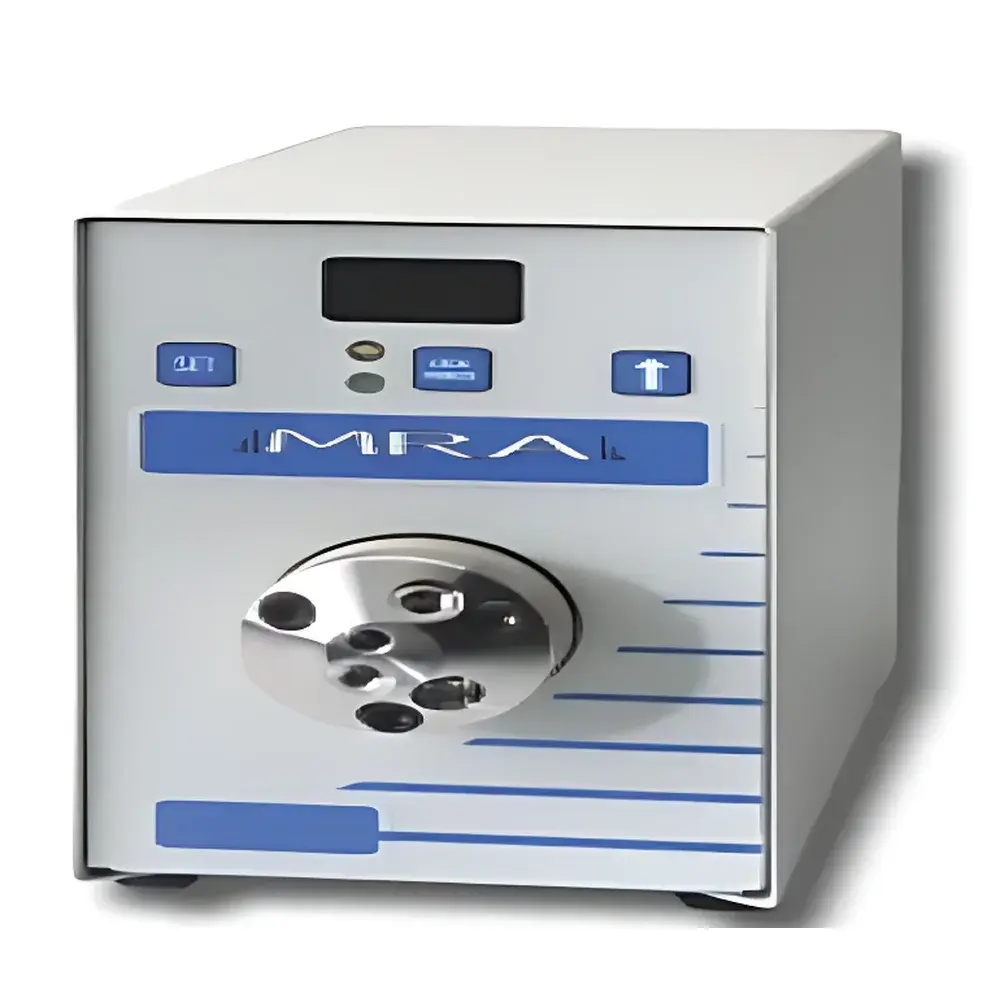
MRA-100 Active Flow Splitter for Mass Spectrometry
| Origin | USA |
|---|---|
| Manufacturer Type | Distributor |
| Origin Category | Imported |
| Model | MRA-100 |
| Pricing | Upon Request |
| Wetted Materials | Stainless Steel and RPC-8™ |
| Connection | 10-32 External Thread Fittings |
| Flow Path Diameter (Stator Assembly) | 0.71 mm (0.028″) and 0.38 mm (0.015″) |
| Flow Path Volume (Per Port) | Port 1 – 2.96 µL, Port 2 – 3.76 µL, Port 3 – 0.77 µL, Port 4 – 0.46 µL |
| Max Operating Pressure | 6.9 MPa (69 bar, 1000 psi) |
| Dimensions | 19.1 cm × 14.1 cm × 7.8 cm (7.5 in × 5.6 in × 3.1 in) |
| Weight | 2.1 kg (4.6 lb) |
| Control Interface | Digital TTL Signal and RS-232 |
Overview
The MRA-100 Active Flow Splitter is a precision-engineered fluidic component designed specifically for integration into high-performance liquid chromatography–mass spectrometry (HPLC-MS) workflows. It enables controlled, reproducible diversion of a small, representative fraction of the HPLC eluent stream directly to the mass spectrometer ion source—while routing the majority of flow to waste or a secondary detector. Unlike passive splitters, the MRA-100 employs an electromechanically actuated stator-rotor architecture to achieve discrete, stable flow division across 59 predefined split ratios ranging from 100:1 to 100,000:1 (main flow : MS flow). Its design eliminates dependency on mobile phase composition, viscosity, temperature, or backpressure fluctuations—ensuring ratio fidelity under gradient elution, varying solvent strengths (e.g., water/acetonitrile), and elevated column temperatures common in UHPLC applications.
Key Features
- 59 fixed, factory-calibrated split ratios (100:1 to 100,000:1), each verified via gravimetric flow validation under ISO/IEC 17025-aligned procedures
- Pressure-stable operation up to 6.9 MPa (1000 psi), compatible with modern UHPLC systems and microbore/column-integrated configurations
- Chemically inert wetted path constructed from electropolished 316 stainless steel and RPC-8™ polymer—a fluorinated thermoplastic engineered for low extractables and compatibility with aggressive solvents (e.g., TFA, formic acid, DMSO)
- Digital TTL and RS-232 interfaces enable bidirectional communication with third-party LC control software (e.g., Thermo Chromeleon, Waters Empower, Agilent OpenLab) for synchronized method-triggered ratio switching
- Compact footprint (19.1 × 14.1 × 7.8 cm) and modular 10-32 threaded ports facilitate drop-in replacement in existing LC-MS interconnect manifolds without re-plumbing
- No moving parts subject to wear during static operation; stator-rotor alignment maintained via hardened ceramic bearings for long-term repeatability (>10⁶ actuation cycles)
Sample Compatibility & Compliance
The MRA-100 supports aqueous, organic, and mixed-phase mobile phases used in reversed-phase, HILIC, and ion-pairing chromatography. Its RPC-8™ surface minimizes analyte adsorption—critical for trace-level quantitation of peptides, polar metabolites, and labile pharmaceuticals. The device complies with USP <661.2> for plastic components in pharmaceutical analysis and meets material safety requirements per FDA 21 CFR Part 11 for electronic record integrity when integrated into validated GxP environments. While not a standalone analytical instrument, it contributes to system-level compliance with ISO 17025 clause 5.4.2 (equipment suitability) and ASTM E2655 (standard guide for LC-MS interface performance evaluation).
Software & Data Management
The MRA-100 accepts ASCII-based command sets over RS-232 (9600 baud, 8N1) and responds with status acknowledgments and real-time position feedback. OEM integration kits include Python and LabVIEW drivers supporting automated ratio selection within sequence methods. Audit trails—including timestamped commands, firmware version, and actuation count—are accessible via serial query for GLP/GMP documentation. No proprietary software installation is required; configuration persists through power cycles via non-volatile memory.
Applications
- Optimization of electrospray ionization (ESI) sensitivity in nanoLC-MS/MS by delivering sub-µL/min flow rates to nanospray sources while maintaining column backpressure
- Parallel detection setups where one fraction feeds MS and another feeds UV/fluorescence detectors for orthogonal confirmation
- Method development for bioanalysis (e.g., PK/PD studies), where consistent split ratios ensure inter-batch comparability of calibration curves
- Reduction of matrix effects in complex biological matrices (plasma, tissue homogenates) by limiting MS inlet load without altering chromatographic resolution
- Extension of column lifetime in high-salt or particulate-laden samples by diverting >99.99% of flow away from the MS interface
FAQ
Does the MRA-100 require recalibration after installation?
No—each unit ships with NIST-traceable calibration certificates for all 59 ratios, verified at 0.5 mL/min and 1.0 mL/min using certified flow meters. Field recalibration is not supported or necessary under normal operating conditions.
Can it be used with supercritical fluid chromatography (SFC) systems?
Not recommended. The stator geometry and RPC-8™ compatibility are optimized for liquid-phase viscosities (0.2–2.5 cP); CO₂-based mobile phases introduce compressibility and phase-transition dynamics outside its validated operational envelope.
Is firmware upgrade capability available?
Yes—firmware updates are delivered via RS-232 using a secure signed binary protocol. Updates retain all user-configured parameters and are logged in the internal audit trail.
What is the minimum detectable flow rate at the MS port when using a 100,000:1 split?
At a typical HPLC flow rate of 0.3 mL/min, the MS port receives 3 nL/min—within the optimal range for chip-based nanoESI sources and compatible with commercial microfluidic interface modules.
How does the MRA-100 handle gradient delays caused by internal volume?
Total internal volume across all four ports is ≤8 µL. When placed immediately upstream of the MS interface (≤5 cm tubing length), gradient delay is <0.2 s—negligible relative to typical MS duty cycles and chromatographic peak widths (>2 s FWHM).
Related Products




