
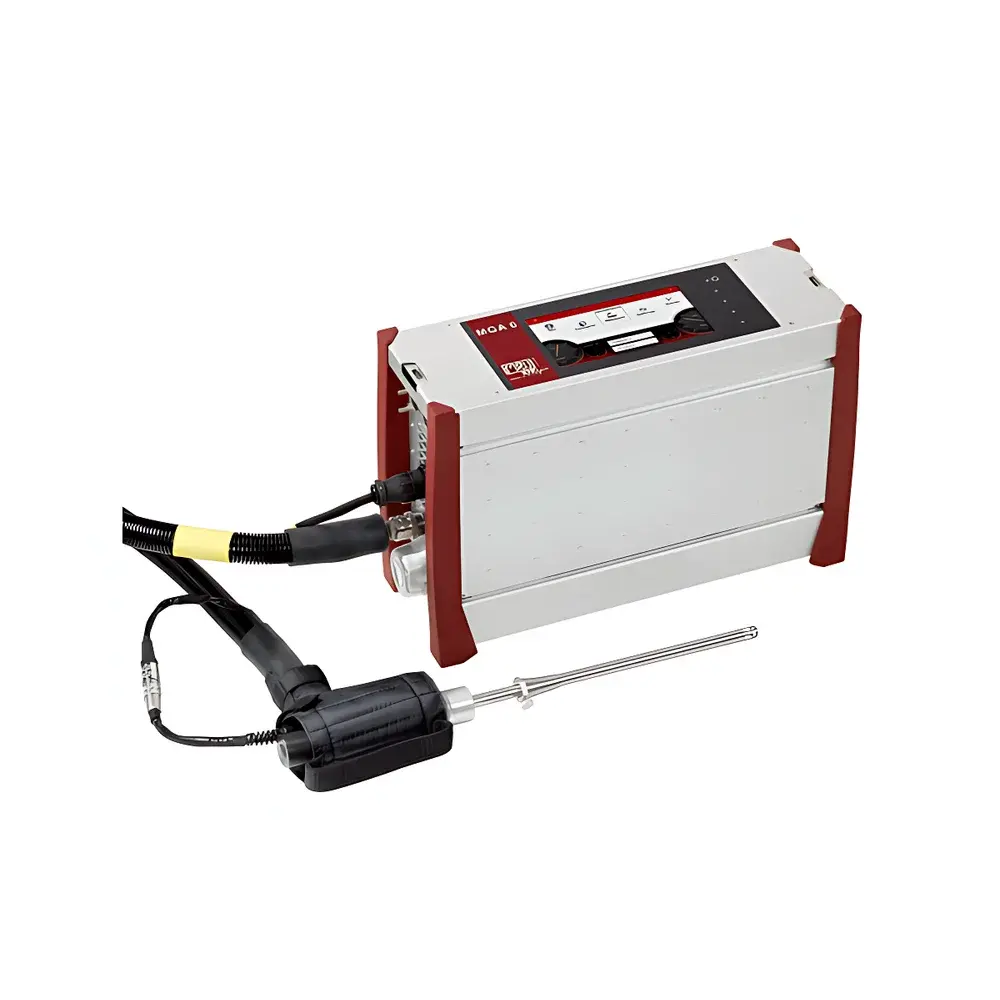
MRU MGA6 Portable Infrared Flue Gas Analyzer
| Brand | MRU (Germany) |
|---|---|
| Origin | Germany |
| Model | MGA6 |
| Instrument Type | Portable Flue Gas Analyzer |
| Measurement Principle | NDIR (Non-Dispersive Infrared) + Electrochemical Sensors |
| Measured Gases | O₂, CO, CO₂, HC (Hydrocarbons), SO₂, NO, NO₂ |
| Accuracy | ≤ ±2% FS |
| Repeatability | ≤ 2% FS |
| Response Time (T₉₀) | ≤ 20 s |
| Drift Stability | ≤ 2% FS over 24 h |
| Display | 7″ TFT Color Touchscreen (800 × 480) |
| Operating System | Embedded Linux |
| Connectivity | Bluetooth 5.0, WLAN (IEEE 802.11 b/g/n), RS485, 8-channel analog output, 4-channel analog input |
| Data Storage | Internal database with timestamped measurement logs |
| Output Formats | CSV, PDF reports |
| Compliance | EN 15267-3, EN 14181 (QAL1/QAL2), ISO 12039, ISO 10849, ASTM D6522, EPA Method 6C / 7E / 10 |
Overview
The MRU MGA6 Portable Infrared Flue Gas Analyzer is an engineered solution for real-time, field-deployable emission monitoring in compliance-critical industrial environments. Built on a dual-sensor architecture—integrating non-dispersive infrared (NDIR) detection for CO, CO₂, HC, SO₂, NO, and NO₂ with electrochemical or paramagnetic sensing for O₂—the MGA6 delivers trace-level gas quantification under dynamic flue conditions. Its design adheres to the physical and metrological constraints defined in EN 15267-3 for automated measuring systems and supports QAL1 (Quality Assurance Level 1) validation per EN 14181. The analyzer operates across combustion sources including utility-scale boilers, gas turbines, internal combustion engines, cement kilns, and ceramic furnaces—where precise stoichiometric evaluation, thermal efficiency calculation, and regulatory reporting demand simultaneous multi-parameter acquisition and traceable data lineage.
Key Features
- Integrated NDIR optical modules with temperature-stabilized detectors and interference-filtered broadband sources ensure long-term spectral fidelity and minimal cross-sensitivity between overlapping absorption bands (e.g., NO/NO₂, CO/SO₂).
- Selectable O₂ sensing: electrochemical cells rated for ≥2 years service life or high-stability paramagnetic sensors with 5-year calibration interval capability—both compliant with ISO 12039 Annex B requirements.
- Embedded Linux OS enables deterministic real-time processing, secure firmware updates, and deterministic I/O scheduling—critical for synchronized sampling of gas concentration, flue temperature (−20 to +650 °C), ambient temperature, barometric pressure (80–110 kPa), and volumetric flow (via Pitot tube integration).
- Ruggedized aluminum chassis with elastomeric overmolding meets IP65 ingress protection and MIL-STD-810G shock/vibration specifications—validated for continuous operation in ambient temperatures from −10 °C to +50 °C.
- Advanced compensation algorithms correct for pressure-induced signal attenuation, water vapor quenching effects, and thermal drift across sensor arrays—reducing post-acquisition correction workload.
Sample Compatibility & Compliance
The MGA6 accepts conditioned sample gas streams with particulate loading ≤1 mg/m³ and dew point ≤5 °C (achieved via integrated heated probe and condensate trap). It complies with EN 14181 QAL2 functional testing protocols and supports automatic zero/span verification using certified reference gases traceable to NIST or PTB standards. All measurement records include embedded audit trails—capturing operator ID, calibration timestamps, sensor diagnostics, and environmental metadata—to satisfy FDA 21 CFR Part 11 electronic record requirements when deployed in GMP-regulated energy-from-waste facilities. Full documentation packages include EU Declaration of Conformity (CE), RoHS 2011/65/EU certification, and WEEE compliance statements.
Software & Data Management
MRU4U mobile application (iOS/Android) provides full remote instrument control—including real-time waveform visualization, alarm threshold configuration, and live parameter logging—via encrypted Bluetooth or TLS-secured WLAN. Local storage retains ≥100,000 measurement events with millisecond-resolution timestamps. Export options include ISO-compliant CSV (UTF-8 encoded with header metadata), printable PDF reports with digital signature fields, and direct database ingestion via OPC UA server interface. RS485 Modbus RTU support enables integration into SCADA systems for centralized emissions dashboards aligned with ISO 50001 energy management frameworks.
Applications
- Combustion optimization: Calculation of excess air ratio (λ), flue gas heat loss (%), combustion efficiency (%), and dew point temperature—based on measured O₂, CO, CO₂, and flue temperature profiles.
- Regulatory compliance monitoring: Continuous stack testing per EPA Methods 6C (SO₂), 7E (NOₓ), and 10 (O₂); adherence to EU IED (2010/75/EU) LCP BREF emission limit values.
- Preventive maintenance diagnostics: Trend analysis of CO spikes and O₂ depletion patterns to identify burner misalignment, refractory degradation, or air leakage in ductwork.
- Commissioning & acceptance testing: Field validation of CEMS performance prior to handover, with automated QAL3 uncertainty budgeting per EN 15267-3 Annex F.
FAQ
Does the MGA6 support automatic calibration verification?
Yes—through optional built-in zero/span valves and certified gas cylinders, enabling automated QAL2 checks per EN 14181.
Can the device measure gas velocity without external hardware?
No—velocity requires Pitot tube or thermal anemometer integration; the MGA6 provides analog input channels and calculation routines for derived flow parameters.
Is raw sensor data accessible for third-party modeling?
Yes—CSV exports include uncorrected detector voltages, thermistor readings, and raw ADC counts alongside compensated concentrations.
What cybersecurity protocols are implemented for WLAN communication?
WPA2-Enterprise authentication, TLS 1.2 encryption for cloud uploads, and configurable firewall rules within the embedded Linux kernel.
How is traceability maintained during firmware updates?
Each firmware version carries a SHA-256 hash certificate signed by MRU’s PKI infrastructure; update logs are immutably appended to the audit trail database.







