
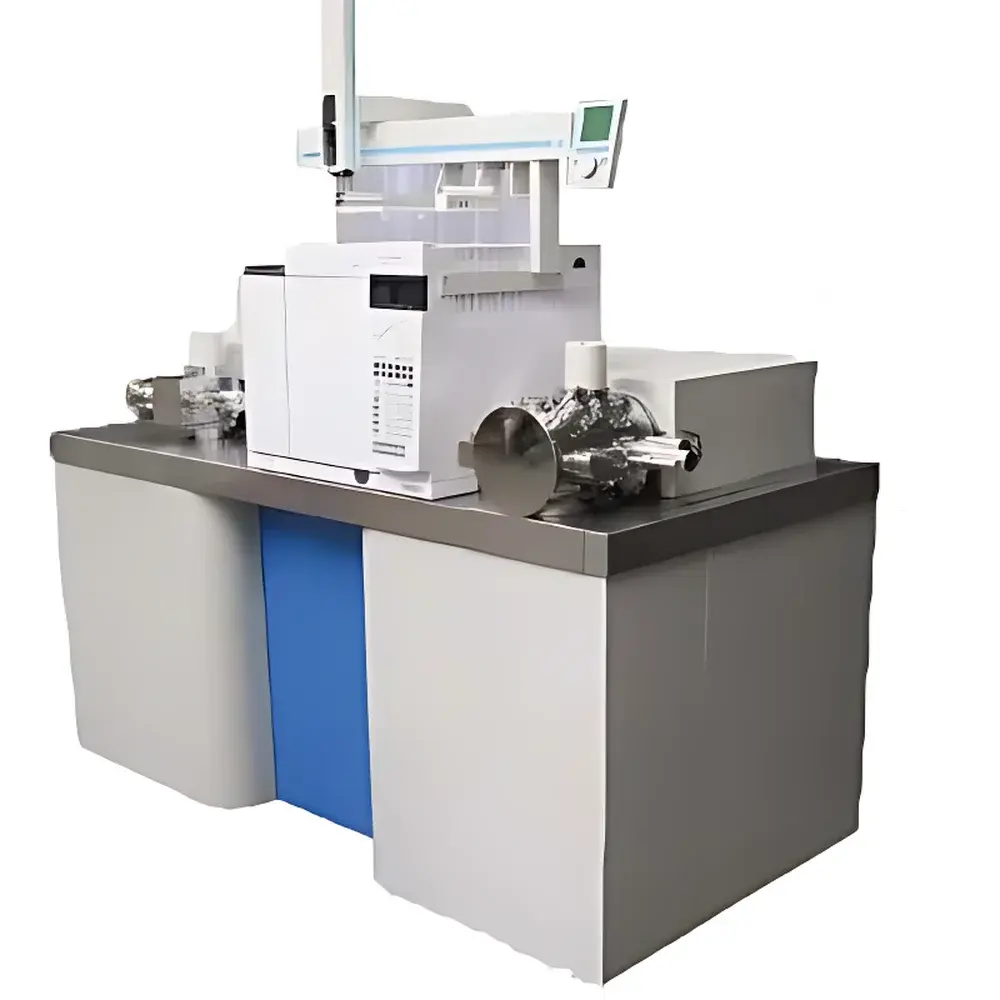
MSI AUTOCONCEPT GC-MS Dual-Focusing Magnetic Sector Mass Spectrometer
| Brand | MSI |
|---|---|
| Origin | United Kingdom |
| Manufacturer Type | Authorized Distributor |
| Instrument Type | Magnetic Sector Mass Spectrometer |
| GC Configuration | Conventional Gas Chromatography Coupling |
| Mass Range | 1–2000 u and 1–10000 u (switchable) |
| Resolution | 80,000 (10% valley definition) |
| Sensitivity | 5 × 10⁻⁷ C/µg (at m/z 69, using perfluorotributylamine, PFTBA) |
| Scan Speed | 0.1–1000 s/decade |
| Ion Optics | Fully bakeable, all-metal ion path with integrated thermal desorption capability |
Overview
The MSI AUTOCONCEPT GC-MS is a high-performance dual-focusing magnetic sector mass spectrometer engineered for trace-level quantitative analysis of organic contaminants in complex environmental matrices—including soil, sediment, water, air particulates, and biological tissues. Unlike quadrupole or time-of-flight (TOF) systems, the AUTOCONCEPT employs reversed Nier-Johnson geometry with electrostatic and magnetic sectors operating in tandem to achieve mass-resolving power exceeding 80,000 (10% valley definition), enabling unambiguous separation of isobaric interferences and accurate isotopic ratio measurement. Its design prioritizes long-term signal stability, low baseline noise, and reproducible quantitation under regulated laboratory conditions—making it suitable for compliance-driven workflows aligned with EPA Method 8270, ISO 18587, and EU Directive 2013/39/EU monitoring requirements.
Key Features
- Fully bakeable all-metal ion optical pathway: Integrated resistive heating across the entire flight tube (ion source → energy analyzer → magnet → detector) enables in situ thermal desorption of hydrocarbons and siloxanes, minimizing downtime associated with manual cleaning and restoring baseline sensitivity without hardware disassembly.
- Modular multi-GC inlet architecture: Supports simultaneous connection of up to three independent gas chromatographs via dedicated, electrically isolated ion source ports—each configurable with distinct column chemistries, temperature programs, and carrier gas flows—enabling rapid method switching without venting or re-tuning.
- Enhanced detection system: Features a dual-mode Faraday cup / electron multiplier hybrid detector with active gain stabilization, delivering sub-femtogram detection limits without reliance on ion counting or post-acquisition signal averaging.
- Compact footprint engineering: Occupies ≤0.85 m² floor space (including integrated vacuum manifold and cooling circuitry), eliminating need for dedicated high-bay laboratories or external chillers—ideal for retrofitting into existing QC/QA labs with spatial constraints.
- High dynamic range acquisition: Capable of linear response over six orders of magnitude (10⁶) without detector saturation, validated per ASTM E2624-19 for quantitative isotope dilution mass spectrometry (IDMS) applications.
Sample Compatibility & Compliance
The AUTOCONCEPT GC-MS accommodates standard GC-compatible sample introduction methods—including split/splitless injectors, PTV inlets, and cryo-trapping modules—as well as optional accessories such as direct insertion probe (DIP), solid probe (SP), and calibrated reference gas inlet for real-time instrument response normalization. All hardware and firmware comply with IEC 61000-4 electromagnetic compatibility standards and meet CE marking requirements for laboratory instrumentation. Data acquisition and processing adhere to 21 CFR Part 11-compliant audit trail functionality when operated with MSI’s certified MassLynx™-compatible software suite, supporting GLP/GMP-regulated environments and FDA inspection readiness.
Software & Data Management
Control and data reduction are performed using MSI’s AutoQuant™ v5.2 platform—a Windows-based application validated for ISO/IEC 17025:2017 Annex A.2 traceability. The software provides automated calibration verification (ACV), peak deconvolution using spectral library matching (NIST MS Search + in-house environmental contaminant libraries), and built-in uncertainty propagation models compliant with EURACHEM/CITAC Guide CG4. Raw data files (.raw) are stored in open-format mzML 1.1.0, ensuring interoperability with third-party tools including OpenMS, MZmine, and Skyline. Audit trails record user actions, parameter changes, and calibration events with timestamped digital signatures—fully exportable for regulatory submission.
Applications
- Regulatory environmental testing: Quantification of PAHs, PCBs, dioxins/furans (PCDD/Fs), organochlorine pesticides (OCPs), and brominated flame retardants (BFRs) at sub-ppt levels in wastewater effluents and biota samples.
- Forensic toxicology: High-resolution identification and confirmation of novel psychoactive substances (NPS) and metabolites in human urine and blood matrices.
- Food safety surveillance: Detection of mycotoxins, veterinary drug residues, and process-induced contaminants (e.g., furan, acrylamide) in compliance with EU Commission Regulation (EU) No 2023/915.
- Isotopic fingerprinting: Stable carbon (¹³C/¹²C) and chlorine (³⁷Cl/³⁵Cl) isotope ratio analysis for source apportionment of chlorinated hydrocarbons in contaminated sites.
FAQ
What vacuum system configuration does the AUTOCONCEPT GC-MS use?
It employs a hybrid turbomolecular pumping station (≥300 L/s at N₂) backed by a dry scroll pump, achieving base pressure <5 × 10⁻⁹ mbar in the analyzer region after bakeout.
Is the instrument compatible with GC×GC modulation?
Yes—via optional cryogenic modulator interface and synchronized timing control through AutoQuant™’s pulse-triggered acquisition mode.
Can the resolution be adjusted during acquisition?
Yes—resolution settings (R = 10,000 to 80,000) are programmable on-the-fly without interrupting data collection or requiring magnet recalibration.
Does the system support quantitative analysis using isotope dilution?
Yes—fully validated for IDMS workflows with up to four labeled internal standards per run, including correction for natural abundance and mass bias effects.
What maintenance intervals are recommended for routine operation?
Ion source cleaning is typically required every 6–12 months depending on sample load; bakeout cycles are scheduled automatically every 72 hours during idle periods to maintain optimal sensitivity.






