
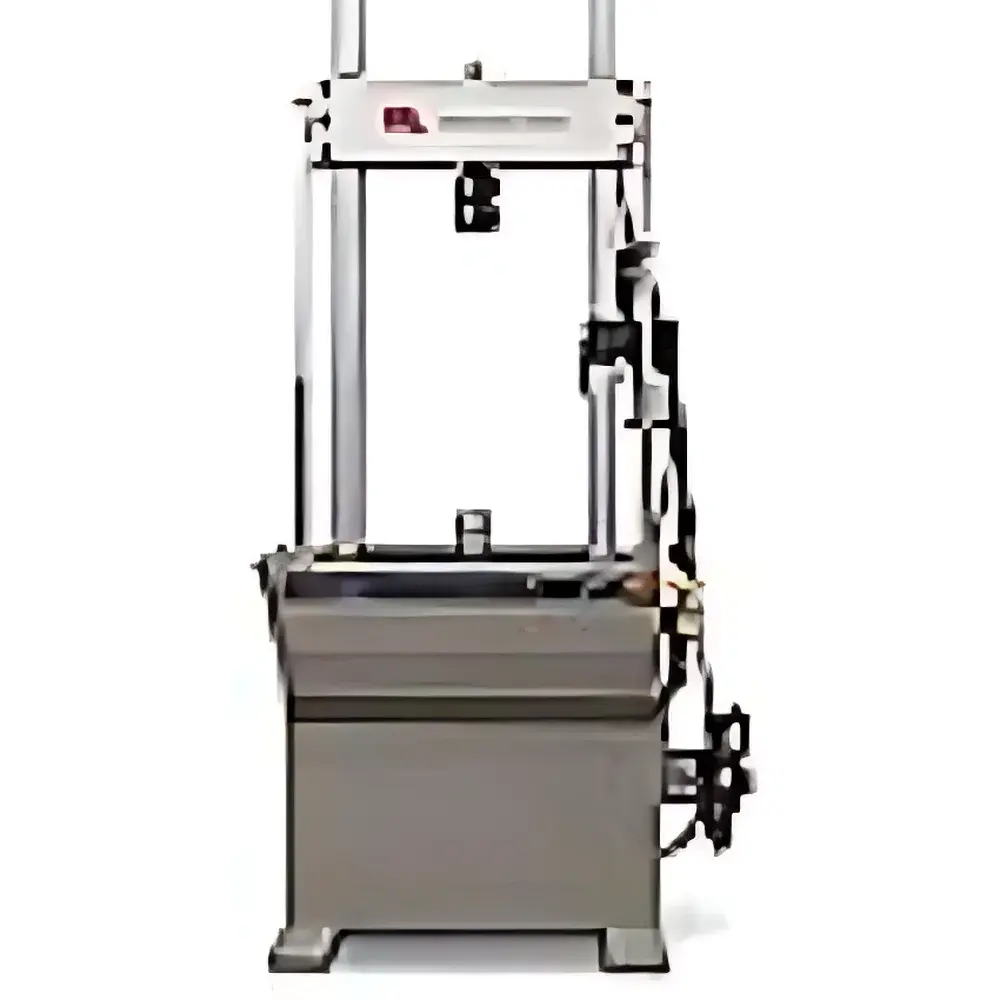
MTS 849/850/852 Series Shock Absorber Test Bench
| Origin | USA |
|---|---|
| Manufacturer Type | Authorized Distributor |
| Origin Category | Imported |
| Model | 849 / 850 / 852 |
| Quotation | Upon Request |
Overview
The MTS 849/850/852 Series Shock Absorber Test Bench is a high-precision electro-hydraulic servo-controlled testing system engineered for dynamic characterization of automotive and industrial shock absorbers, struts, and damping components. Built upon over 25 years of domain-specific application engineering by MTS Systems Corporation, this bench employs closed-loop force and displacement control based on servo-hydraulic actuation principles—leveraging real-time feedback from integrated LVDTs and multi-channel load cells—to replicate road-simulated waveforms, step inputs, and user-defined time-domain signals. Designed for R&D validation, durability assessment, and production QA/QC, the system delivers repeatable, traceable, and standards-aligned test data under controlled boundary conditions. Its architecture supports both single-axis vertical actuation and optional lateral loading configurations, enabling comprehensive evaluation of damping force-velocity hysteresis, rebound/compression asymmetry, temperature-dependent behavior, and seal friction characteristics.
Key Features
- Modular hydraulic actuation platform with selectable actuator capacities: 25 kN (5,500 lbf) or 50 kN (11,000 lbf), rated for continuous cyclic operation at frequencies up to 20 Hz and stroke ranges up to ±150 mm
- High-stiffness cast-iron base frame with low center of gravity and reinforced crosshead structure—optimized to minimize parasitic vibrations and ensure mechanical stability during high-force, high-frequency testing
- Integrated servo-hydraulic actuator featuring factory-calibrated internal LVDT for sub-micron displacement resolution and dual-range load cells (standard configuration supports up to six simultaneous test specimens; expandable to eight with optional sensor module)
- Triple-stage servo valve system with standard flow ratings of 340 L/min or 680 L/min, coupled with low-flow solenoid safety valves that limit actuator acceleration during specimen mounting/dismounting per ISO 12100 functional safety guidelines
- Dual-volume hydraulic accumulator system (5-gallon or 10-gallon options) for pressure stabilization and transient response compensation during high-bandwidth waveform reproduction
- Motorized crosshead positioning module with programmable travel limits and soft-stop logic for rapid setup and repeatable fixture alignment
Sample Compatibility & Compliance
The test bench accommodates standard mono-tube, twin-tube, and coilover shock absorbers—including OEM and aftermarket variants—with adjustable mounting interfaces for eye-to-eye, eye-to-stud, and top-mount configurations. Optional accessories extend capability to rotational damper testing (via motorized strut rotation assembly), thermal profiling (with embedded thermocouple inputs and PID-controlled environmental chambers), and side-load simulation (±10% of primary axial capacity). System compliance includes adherence to ASTM E2129–22 (Standard Practice for Validation of Dynamic Testing Systems), ISO 4968 (Damping Force Measurement Methods), and SAE J1510 (Automotive Shock Absorber Performance Requirements). All hardware and software components are designed for integration into GLP- and GMP-regulated environments, supporting audit-ready calibration logs and 21 CFR Part 11–compliant electronic signatures when paired with MTS TestSuite™ software.
Software & Data Management
Control and analysis are performed using MTS TestSuite™—a Windows-based, modular test software platform compliant with IEC 61508 SIL2 for safety-related functions. The software provides intuitive waveform definition tools (sine, triangle, trapezoidal, arbitrary time-series import via CSV or MATLAB®), real-time hysteresis loop visualization, automatic peak detection, and cycle counting with configurable pass/fail thresholds. Raw data streams (force, displacement, velocity, temperature, pressure) are recorded at up to 10 kHz sampling rate and stored in vendor-neutral HDF5 format. Export modules support direct generation of PDF reports aligned with AIAG CQI-15 guidelines and automated upload to enterprise LIMS or PLM systems via OPC UA or RESTful API interfaces. Audit trails record all parameter changes, operator logins, and calibration events with timestamped digital signatures.
Applications
- Dynamic force-velocity mapping across temperature gradients (–40 °C to +120 °C) for NVH optimization
- Durability cycling per OEM specifications (e.g., Ford WSS-M2P157-A, GM GMW14872, Toyota TSC-0001)
- Rebound/compression ratio verification and stiction quantification for adaptive damping systems
- Validation of magnetorheological (MR) and electrorheological (ER) damper response latency and field-dependent hysteresis
- Correlation of physical test data with ADAMS/Car or MATLAB/Simulink multibody simulation models
- Root-cause analysis of seal wear, gas chamber leakage, and fluid cavitation through harmonic distortion analysis
FAQ
What is the maximum test frequency supported by the 849/850/852 series?
The system achieves stable closed-loop control up to 20 Hz at full stroke, with bandwidth-limited operation extending to 50 Hz under reduced displacement amplitudes.
Can the bench perform temperature-controlled testing?
Yes—when integrated with optional environmental chambers and thermocouple-synchronized acquisition, the system supports synchronized thermal-dynamic profiling per ISO 12100 and SAE J2450 protocols.
Is remote monitoring and diagnostics available?
MTS offers optional Telemetry Gateway hardware and cloud-connected Health Monitoring Dashboard for predictive maintenance alerts, firmware updates, and real-time KPI dashboards accessible via secure HTTPS interface.
Does the system support third-party waveform generation tools?
Yes—the TestSuite™ software accepts imported time-history files in CSV, ASCII, and MAT formats, and provides API hooks for co-simulation with LabVIEW, Python (via PyMTS SDK), and Simulink.
How is calibration traceability maintained?
All load cells and LVDTs are supplied with NIST-traceable calibration certificates; onboard self-check routines verify sensor linearity, zero drift, and gain stability before each test sequence.
Related Products



