
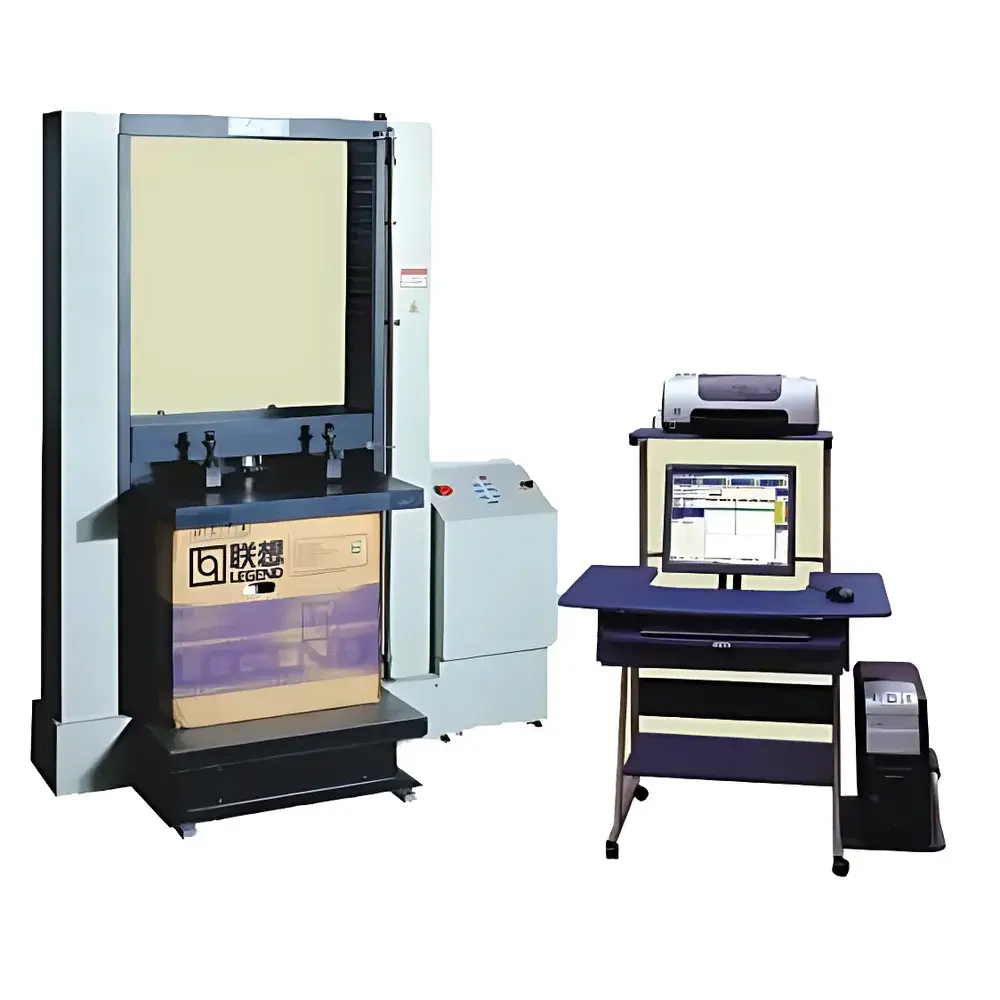
MTS CPT Series Microcomputer-Controlled Packaging Container Compression Tester
| Brand | MTS |
|---|---|
| Origin | Guangdong, China |
| Manufacturer Type | Authorized Distributor |
| Product Origin | Domestic (China) |
| Model | CPT Series Microcomputer-Controlled Packaging Container Compression Tester |
| Pricing | Available Upon Request |
| Max Test Load | 10 kN / 50 kN |
| Accuracy Class | 0.5 / 1 |
| Force Measurement Range | 0.4–100% FS (0.5 class) / 0.2–100% FS (1 class) |
| Force Resolution | 1/300,000 FS |
| Displacement Resolution | 0.03 µm |
| Crosshead Speed Range | 0.001–500 mm/min |
| Speed Accuracy | ±1.0% (<0.01 mm/min), ±0.2% (≥0.01 mm/min) |
| Effective Test Width | 703 mm (CPT4104) / 1300 mm (CPT5504) |
| Max Crosshead Travel | 1000 mm (CPT4104) / 1500 mm (CPT5504) |
| Power Supply | 220 V ±10%, 400 W (CPT4104) / 1 kW (CPT5504) |
| Weight | ~350 kg (CPT4104) / ~1500 kg (CPT5504) |
Overview
The MTS CPT Series Microcomputer-Controlled Packaging Container Compression Tester is a high-precision electromechanical testing system engineered for deterministic evaluation of compressive strength, crush resistance, and structural integrity of corrugated fiberboard boxes, rigid packaging containers, and unitized pallet loads. It operates on the principle of controlled axial compression using servo-controlled electromechanical actuation, delivering traceable, repeatable force-displacement data in accordance with international mechanical testing standards. Designed for laboratories requiring regulatory-grade compliance and long-term measurement stability, the CPT series integrates real-time closed-loop control of load, displacement, and deformation—enabling static crush tests, creep evaluations, and cyclic loading protocols (low-frequency force/displacement/deformation cycles). Its architecture supports full digital feedback control without analog signal conditioning, minimizing drift and hysteresis across extended test durations.
Key Features
- High-performance DSP-based control platform enabling real-time processing of multi-channel sensor data with deterministic latency and industrial-grade reliability.
- Adaptive neural-network-enhanced PID control algorithm for seamless, shock-free transitions between force, displacement, and strain control modes.
- 24-bit high-resolution analog-to-digital conversion system with scalable input capacity up to eight independent channels for auxiliary transducers (e.g., strain gauges, environmental sensors).
- USB 1.1 full-speed interface (12 Mb/s) supporting hot-pluggable peripheral integration and software-configurable I/O mapping for streamlined system expansion.
- Four-layer PCB design with optimized ground plane segmentation and differential routing to suppress EMI in shared laboratory environments.
- Real-time dynamic display of load, displacement, deformation, test speed, and live stress–strain curves via Windows-native GUI.
- Automated data logging with timestamped metadata; post-test curve replay, overlay comparison, and zoom functionality for forensic analysis.
- Comprehensive safety architecture including hardware-based overload cutoff, mechanical end-stop limit switches, and programmable emergency stop logic compliant with IEC 61800-5-2.
Sample Compatibility & Compliance
The CPT series is validated for standardized compression testing of single-wall and double-wall corrugated cardboard boxes (ASTM D642, ISO 12048, GB/T 4857.3–4), transit containers, beverage carriers, and shrink-wrapped unit loads. It accommodates specimens up to 1300 mm wide (CPT5504 model) and 1500 mm tall, supporting both flat-panel and full-assembly configurations. The system meets the metrological requirements of GB/T 16491–1996 (Electronic Universal Testing Machines), and its calibration traceability aligns with ISO/IEC 17025-accredited practices. Force verification follows ASTM E4 procedures using certified deadweight standards; displacement calibration conforms to ISO 9513. All firmware and software modules are architected to support audit-ready documentation for GLP, GMP, and FDA 21 CFR Part 11 environments—including electronic signatures, user access logs, and immutable test record retention.
Software & Data Management
The bundled Windows-based testing software provides full lifecycle management of test methods, specimen definitions, calibration records, and result archives. Users define multi-step test protocols—including ramp-hold-ramp sequences, constant-rate compression, and stepwise load increments—with parameter validation prior to execution. Raw data is stored in binary-encoded .MTS format with embedded XML metadata (operator ID, calibration date, environmental conditions). Export options include CSV, PDF reports with embedded graphs, and XML-compliant datasets for LIMS integration. Audit trails record all user actions—including method edits, calibration events, and report generation—with SHA-256 hashing for data integrity verification. Optional modules support automated report generation per ISTA 3A/3B or Amazon SQC-12 specifications.
Applications
- Compression strength validation of shipping containers per ASTM D642 and ISO 12048 for logistics qualification.
- Stack load simulation under static and dynamic conditions to assess warehouse storage stability.
- Corrugated board material characterization (ECT, BCT derivation) in conjunction with edge crush testers.
- Package design validation for e-commerce fulfillment centers subject to Amazon’s Frustration-Free Packaging (FFP) or Walmart’s Sustainable Packaging Playbook.
- Quality assurance in food & beverage, pharmaceutical, and consumer electronics packaging supply chains.
- Academic research in packaging engineering, material science, and transport dynamics at universities and national metrology institutes.
FAQ
What standards does the CPT series comply with for packaging compression testing?
The system fully supports ASTM D642, ISO 12048, GB/T 4857.3–4, and TAPPI T810 for box compression testing, with built-in test templates and reporting formats aligned to each standard.
Can the CPT system perform cyclic compression tests?
Yes—it supports low-frequency force, displacement, and deformation cycling with user-defined amplitude, frequency, and dwell parameters, enabling fatigue assessment of packaging structures.
Is the software compliant with FDA 21 CFR Part 11 requirements?
The optional 21 CFR Part 11 module provides electronic signature enforcement, role-based access control, and immutable audit trails—validated for regulated pharmaceutical and medical device packaging labs.
What is the maximum specimen height the CPT5504 can accommodate?
The CPT5504 offers 1500 mm of vertical crosshead travel, sufficient for full-height palletized unit loads and oversized industrial containers.
Does the system support third-party transducers or environmental chambers?
Yes—via the expandable 8-channel ADC interface and USB-configurable I/O ports, enabling integration with humidity/temperature chambers, acoustic emission sensors, or custom fixture instrumentation.




