
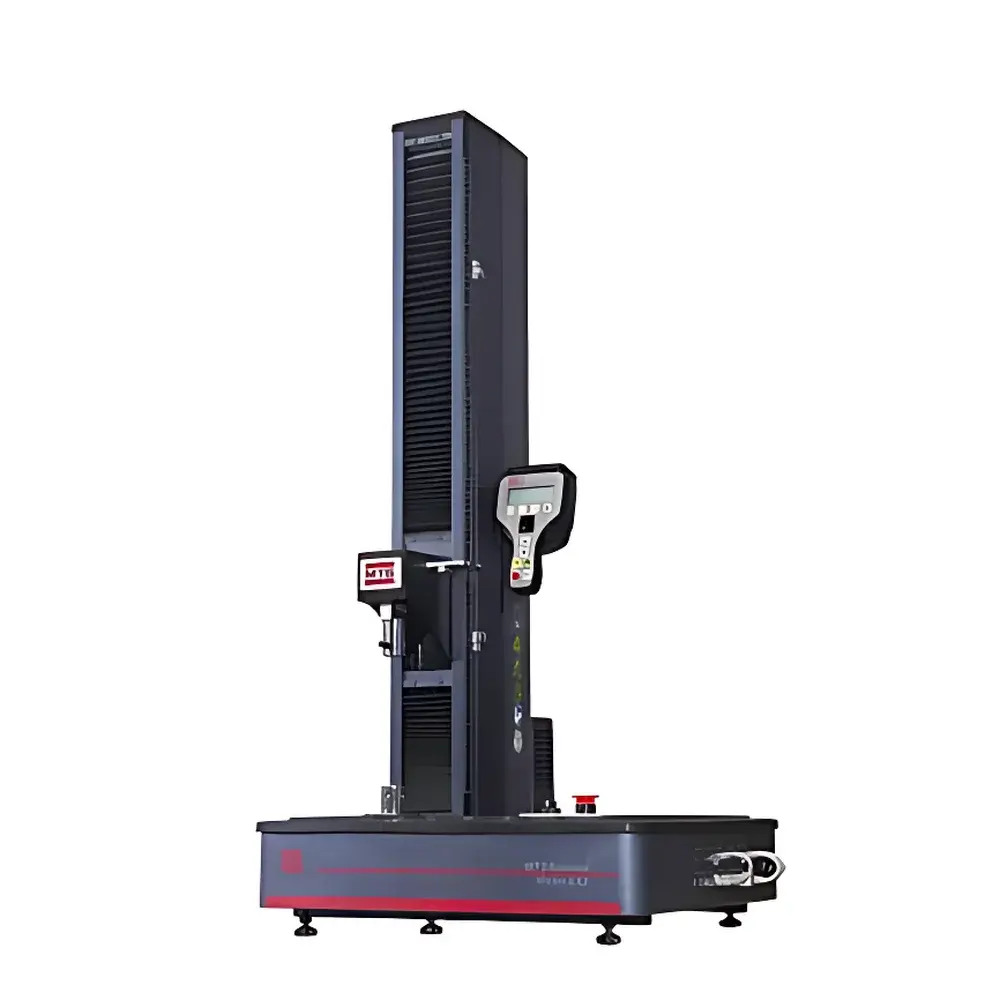
MTS Exceed E42.503 Universal Testing Machine (5 N – 5 kN)
| Brand | MTS |
|---|---|
| Origin | Shenzhen, China |
| Model | MTS Exceed E42.503 |
| Maximum Rated Force | 5 kN |
| Force Range Options | 5 N – 5 kN (selectable) |
| Frame Type | Benchtop |
| Test Space Configuration | Single-Column, Single-Space |
| Max Test Speed | 500 mm/min |
| Min Test Speed | 0.001 mm/min |
| Position Resolution | 0.000051 mm |
| Crosshead Travel (unloaded) | 700 mm |
| Crosshead Travel (with DSA502A fixture) | 550 mm |
| Test Width (distance from load axis to column housing) | 100 mm |
| Dimensions (H×W×D) | 1300 × 642 × 582 mm |
| Weight | ~120 kg |
| Power Supply | 220 V ±10%, 1100 W |
Overview
The MTS Exceed E42.503 Universal Testing Machine is a precision-engineered benchtop electromechanical system designed for static mechanical characterization of materials across a broad force range—from 5 N to 5 kN. Built upon MTS’s proven Exceed 40 Series architecture, it employs a high-stiffness single-column frame with integrated digital closed-loop control, enabling accurate and repeatable tensile, compression, peel, tear, and flexural testing. Its core actuation system utilizes a maintenance-free, high-efficiency AC servo motor coupled with a preloaded precision ball screw—ensuring minimal vibration, consistent speed fidelity, and full-force capability at maximum crosshead velocity. The system complies with fundamental principles of ISO 7500-1 (Class 0.5 force measurement accuracy), ASTM E4, and ISO 5893 for displacement and speed control performance. It is engineered for laboratory environments where space efficiency, operational reliability, and regulatory traceability are critical—particularly in QC/QA labs supporting medical device components, packaging validation, polymer R&D, and electronics interconnect testing.
Key Features
- High-rigidity, compact single-column benchtop frame optimized for low-to-moderate force applications (5 N – 5 kN)
- Integrated digital closed-loop controller housed directly within the load frame—eliminating external cabling delays and improving signal integrity
- High-speed, low-vibration AC servo drive system with full-force operation at up to 500 mm/min
- Precision preloaded ball screw transmission with <0.000051 mm position resolution
- TEDS-enabled load cells for automatic sensor identification, calibration data recall, and seamless channel configuration
- Intuitive handheld controller for rapid manual positioning, jog operation, and emergency stop activation
- Comprehensive safety architecture: crosshead travel limits, overload protection (force and thermal), voltage surge suppression, and mechanical beam-stop interlocks
- Modular accessory compatibility—including anti-rotation fixtures, T-slot tabletops, dual-space configurations (optional on E44/E45 variants), and environmental chambers
Sample Compatibility & Compliance
The E42.503 accommodates specimens ranging from fine filaments (e.g., 10–50 µm polymer monofilaments) to rigid metallic coupons (up to 10 mm thick). Standard fixture interfaces support wedge-action, pneumatic, hydraulic, and screw-tightened grips—including MTS DSA502A axial tension fixtures. It meets essential compliance requirements for regulated industries: test method execution aligns with ASTM D638, D882, D1876, ISO 527-1, ISO 1184, EN 13924, and USP for mechanical testing of pharmaceutical packaging. When configured with audit-trail-enabled software and calibrated transducers traceable to NIST or national metrology institutes, the system supports GLP and GMP documentation workflows per FDA 21 CFR Part 11.
Software & Data Management
TestSuite TW software provides an intuitive, role-based interface for test definition, real-time monitoring, and post-test analysis. It includes over 200 preconfigured test methods aligned with ASTM, ISO, DIN, EN, and BS standards—with version-controlled updates delivered via MTS Software Maintenance Service. All test parameters, raw data streams (1 kHz sampling), operator annotations, and calibration metadata are stored in encrypted .twx binary format. Export options include CSV, PDF reports (with embedded signature fields), and XML for LIMS integration. Audit trail functionality logs user actions, method modifications, and calibration events—supporting full 21 CFR Part 11 compliance when deployed with Windows domain authentication and electronic signature modules.
Applications
- Mechanical evaluation of thin-gauge metals, foils, and wires (e.g., Cu/Ni alloys, stainless steel 316L sutures)
- Tensile strength and elongation testing of thermoplastic films (PET, PE, PP) and biodegradable packaging substrates
- Peel adhesion assessment of pressure-sensitive tapes, laminates, and medical device pouch seals
- Tear resistance quantification of nonwovens, textiles, and geotextiles per ASTM D5529
- Compression modulus and yield behavior of soft polymers, hydrogels, and foam cores
- Shear and lap-shear performance of structural adhesives (epoxies, acrylics, cyanoacrylates)
- Mechanical screening of micro-components including PCB connectors, MEMS actuators, and battery tab welds
FAQ
What force ranges does the E42.503 support, and how is range switching accomplished?
The system supports selectable nominal capacities from 5 N to 5 kN using interchangeable TEDS-enabled load cells. No manual recalibration or hardware reconfiguration is required—the controller auto-detects cell identity and applies corresponding calibration coefficients.
Is the E42.503 compatible with extensometers for strain measurement?
Yes. It accepts both contact-type clip-on extensometers (e.g., MTS 634 series) and non-contact video extensometry systems (e.g., MTS VisionX) via analog/digital I/O or USB interface, with synchronized data acquisition at up to 1 kHz.
Can TestSuite TW generate compliant reports for ISO/IEC 17025-accredited laboratories?
Yes. When used with certified reference standards, documented SOPs, and enabled audit-trail features, TestSuite TW supports generation of traceable, timestamped reports meeting ILAC-P10 and ISO/IEC 17025 clause 7.8 requirements.
What environmental conditions are recommended for optimal performance?
Operate within 10–35 °C ambient temperature, ≤80% RH non-condensing, on a vibration-isolated optical table or reinforced concrete floor. Avoid direct sunlight and electromagnetic interference sources near the controller cabinet.
Does MTS provide installation qualification (IQ) and operational qualification (OQ) documentation?
Yes. Factory-verified IQ/OQ protocols—including mechanical verification, force calibration traceability, speed linearity checks, and software validation—are available upon request and align with ASTM E2500 and EU Annex 11 guidelines.



