
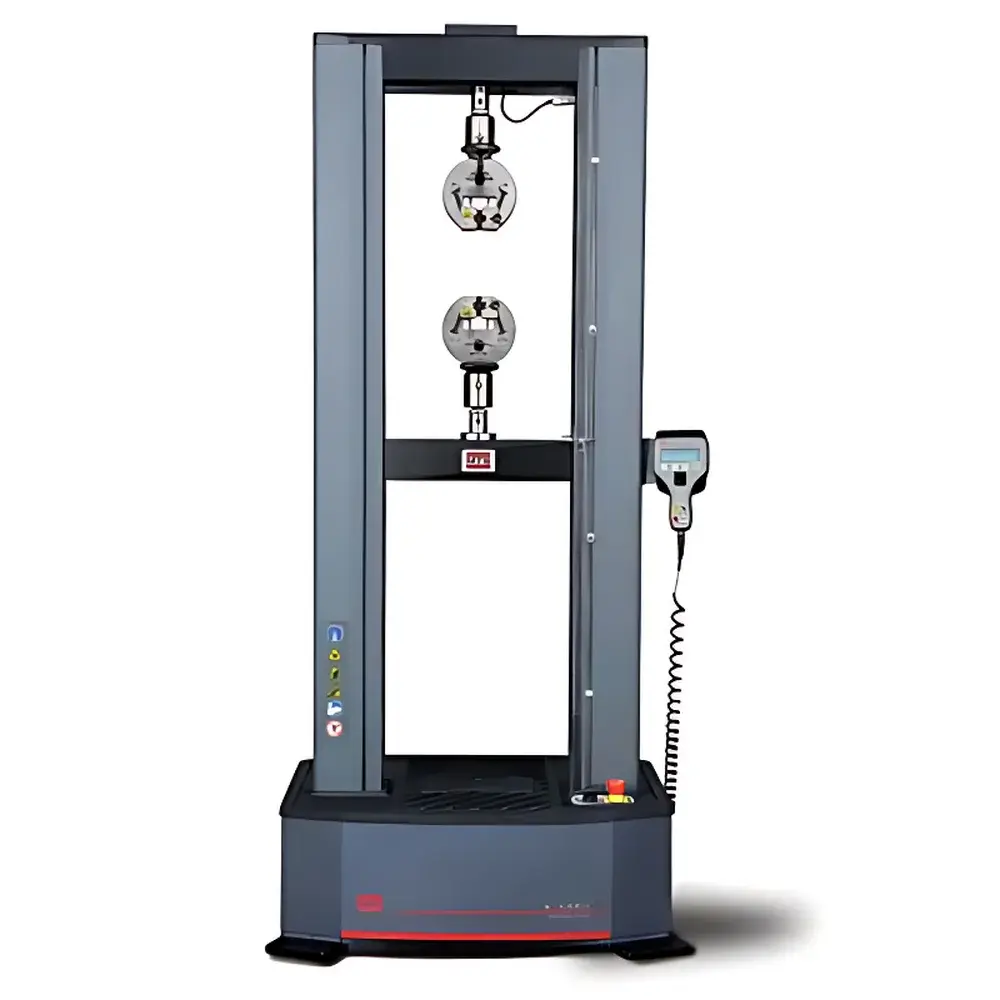
MTS Exceed E44 Series Electromechanical Universal Testing Machine (100 N – 30 kN)
| Brand | MTS |
|---|---|
| Origin | Shenzhen, China |
| Model | Exceed E44 Series |
| Force Range | 100 N – 30 kN |
| Frame Type | Floor-standing |
| Max Test Speed | 500 mm/min |
| Min Test Speed | 0.001 mm/min |
| Position Resolution | 0.000036 mm |
| Crosshead Travel (standard, no fixtures) | 1150 mm |
| Test Width | 400 mm |
| Power Supply | 220 V ±10%, 1100 W (E44.104) / 1760 W (E44.304) |
| Compliance Standards | ASTM, ISO, DIN, EN, BS |
Overview
The MTS Exceed E44 Series is a high-precision, floor-standing electromechanical universal testing machine engineered for static mechanical property evaluation across a broad spectrum of materials—from thin films and biological specimens to high-strength alloys and composite components. Operating on the principle of controlled displacement or force actuation via a high-fidelity servo-motor-driven system, the E44 platform delivers traceable, repeatable, and compliant mechanical test data in tension, compression, flexure, shear, peel, and tear modes. Its integrated digital closed-loop controller—mounted directly within the load frame—enables real-time synchronization of force, displacement, and strain signals at sampling rates sufficient to capture transient deformation behavior. Designed for production labs, R&D centers, and quality control environments, the E44 series meets the structural rigidity and thermal stability requirements essential for low-noise, high-resolution mechanical characterization under ISO 5893 and ASTM E4 compliance.
Key Features
- Robust floor-standing load frame with high axial stiffness and minimal deflection under full-rated load (up to 30 kN), ensuring measurement integrity during high-force testing.
- High-speed, low-vibration AC servo motor drive system with direct-coupled precision preloaded ball screws—eliminating backlash and enabling full-speed operation even at maximum load.
- Digital closed-loop controller embedded in the frame, supporting simultaneous force, displacement, and strain control with sub-micron position resolution (0.000036 mm) and 0.001 mm/min minimum speed capability.
- TEDS-enabled high-accuracy load cells (100 N – 30 kN range) with automatic sensor identification and calibration parameter recall—reducing setup errors and supporting audit-ready workflows.
- Optional dual-test-space configuration (models E44.44 and E44.45) for rapid transition between upper and lower test zones, minimizing fixture reconfiguration time in multi-standard testing protocols.
- Comprehensive safety architecture including crosshead travel limits, overload cutoff (force, thermal, voltage), and patented test-space protection mechanisms to safeguard both operator and instrumentation.
- Ergonomic handheld controller and intuitive front-panel interface for quick test initiation, manual positioning, and real-time parameter monitoring without PC dependency.
Sample Compatibility & Compliance
The E44 series accommodates specimens ranging from micro-scale fibers (diameter < 100 µm) to structural metal coupons (up to 400 mm wide × 1150 mm vertical clearance). Its modular gripping system supports pneumatic, wedge, hydraulic, and specialized fixtures—including anti-rotation jaw assemblies for torsion-sensitive samples and T-slot tabletop options for custom environmental chamber integration. The system complies with international standards governing mechanical testing procedures, including ASTM D638 (tensile plastics), ASTM D790 (flexural properties), ISO 6892-1 (metal tensile testing), ISO 179 (impact-modified plastics), and EN 10002-1. All hardware and software components are designed to support GLP/GMP-aligned validation protocols, with optional 21 CFR Part 11-compliant electronic signatures and audit trail functionality available through validated TestSuite TW configurations.
Software & Data Management
TestSuite TW is a standards-based, modular testing software platform that provides guided test method execution, automated report generation, and raw data export in CSV, XML, and vendor-neutral HDF5 formats. Its built-in library includes over 200 pre-configured methods aligned with ASTM, ISO, DIN, EN, and BS specifications—with continuous updates reflecting newly published revisions. The software supports multi-channel synchronized acquisition (force, displacement, extensometer, temperature, video), real-time curve overlay, and customizable pass/fail criteria based on slope, plateau, or threshold events. All test sessions are timestamped, user-authenticated, and stored with immutable metadata—enabling full traceability for internal audits or regulatory submissions. Optional add-ons include automated calibration logging, instrument interlock management, and LIMS integration via RESTful API.
Applications
The E44 series serves as a primary mechanical characterization tool across regulated and non-regulated sectors. In polymer science, it quantifies modulus, yield strength, elongation-at-break, and creep compliance in thermoplastics, elastomers, and foams. In medical device manufacturing, it validates suture tensile strength (ASTM D2256), catheter kink resistance, and orthopedic implant fixation mechanics. Aerospace QA labs employ it for composite laminate interlaminar shear (ASTM D2344) and fastener pull-out testing. Packaging engineers use it for seal strength (ASTM F88), peel adhesion (ASTM D903), and puncture resistance of laminated films. Additionally, it supports research-grade applications such as viscoelastic modeling (time–temperature superposition), fracture toughness estimation (R-curve analysis), and cyclic fatigue up to 5 Hz when paired with optional dynamic load cell upgrades.
FAQ
What is the difference between the E44.104 and E44.304 models?
The E44.104 is rated for a maximum force of 10 kN, while the E44.304 supports up to 30 kN; both share identical frame geometry, control architecture, and software compatibility.
Can the system be upgraded to support higher force capacities post-purchase?
No—force capacity is determined by structural frame design and load cell integration; upgrades require replacement of the complete load frame and controller assembly.
Is TestSuite TW compatible with third-party extensometers?
Yes, provided the extensometer outputs analog voltage or digital TTL/RS-422 signals and supports TEDS or manual calibration input within the software’s sensor configuration module.
Does the E44 series meet ISO/IEC 17025 requirements for accredited testing laboratories?
When deployed with documented calibration certificates, validated test methods, and configured with audit-trail-enabled software, the system satisfies technical requirements for ISO/IEC 17025 clause 6.4 (equipment) and 7.2 (test method validation).
What environmental chambers can be integrated with this system?
Standard integration is supported with MTS-approved temperature chambers (–70 °C to +300 °C), humidity-controlled enclosures, and custom-built solution baths—each requiring mechanical alignment brackets and signal feedthrough certification.



