
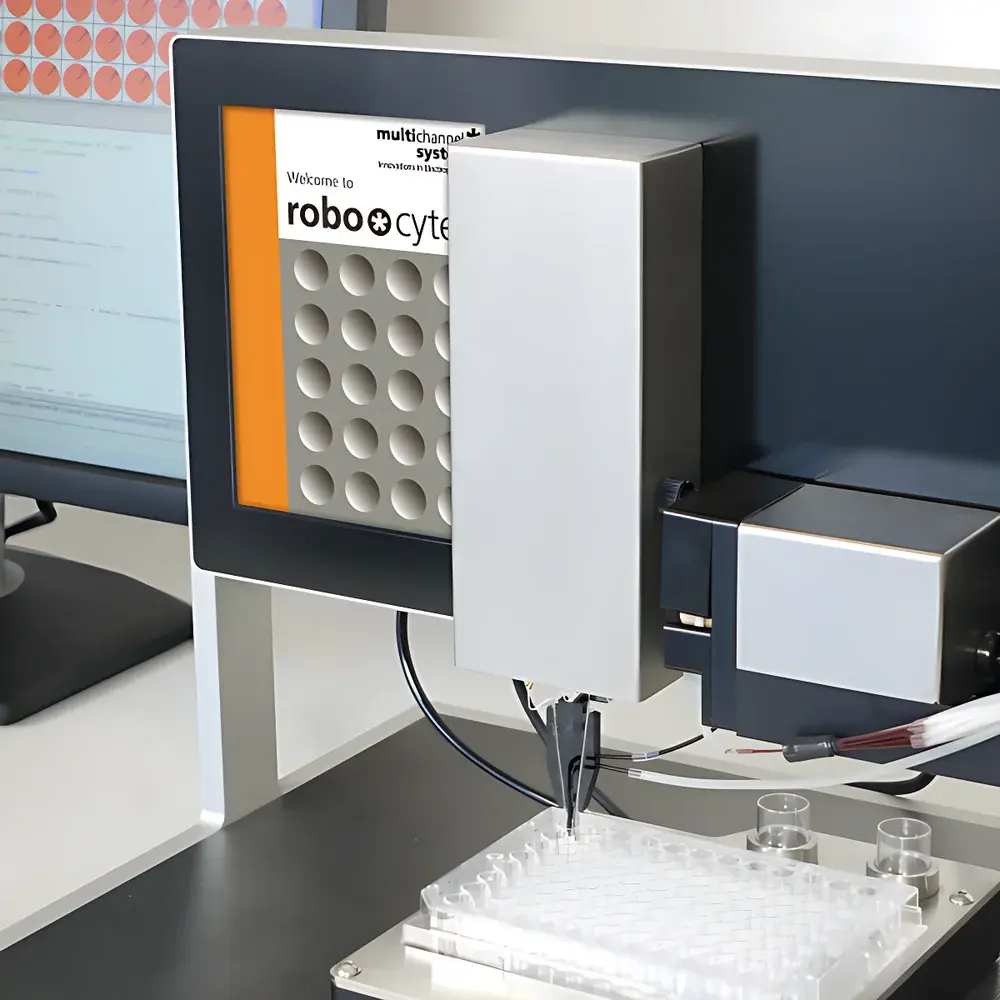
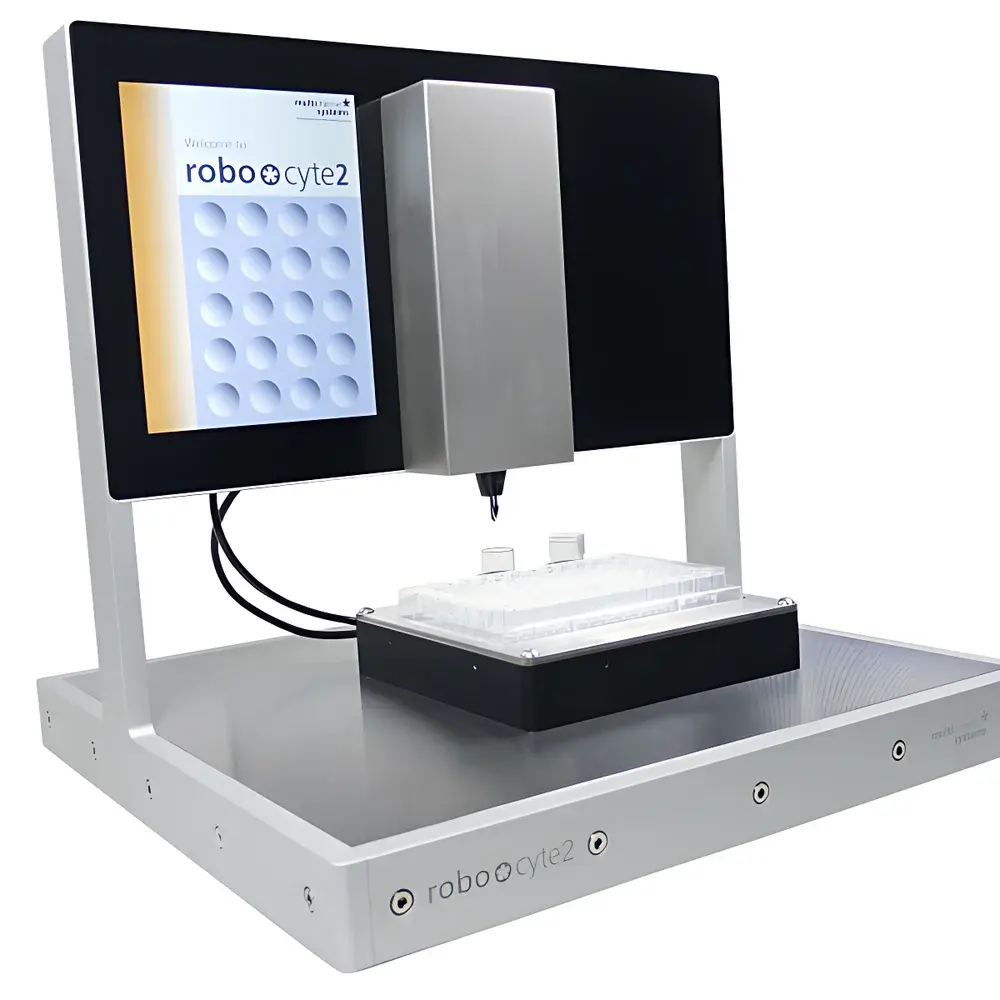
Multi Channel Systems Roboocyte2 Automated Xenopus Oocyte Two-Electrode Voltage Clamp (TEVC) Screening System
| Brand | Multi Channel Systems |
|---|---|
| Origin | Germany |
| Manufacturer | Multi Channel Systems GmbH |
| Model | Roboocyte2 |
| Detection Principle | Two-Electrode Voltage Clamp (TEVC) |
| Instrument Type | Fully Automated High-Throughput Electrophysiology Platform |
| Cell Type | Xenopus laevis oocytes |
| Seal Resistance | >1 GΩ |
| Throughput Format | 96-well plate |
| Amplifier Architecture | Integrated High-Stability TEVC Amplifier |
| Liquid Handling Compatibility | RoboFlow or Gilson Pipetting Systems (Optional) |
Overview
The Multi Channel Systems Roboocyte2 is a fully automated, high-throughput electrophysiology platform engineered for robust, reproducible two-electrode voltage clamp (TEVC) recordings from Xenopus laevis oocytes. Designed specifically for ion channel and electrogenic transporter pharmacology, the system enables quantitative functional characterization of voltage-gated and ligand-gated ion channels under controlled, physiologically relevant conditions. Unlike manual or semi-automated patch-clamp approaches, the Roboocyte2 leverages the intrinsic scalability and expression stability of oocyte-based heterologous expression systems—combined with precision microelectrode positioning, real-time seal monitoring, and programmable solution exchange—to deliver consistent, low-noise current measurements across 96 parallel recording sites. Its architecture adheres to fundamental electrophysiological design principles: stable electrode interface impedance (>1 GΩ seal resistance), low-noise analog signal conditioning, and closed-loop voltage control with sub-millisecond temporal resolution. The system is intended for use in core screening laboratories, CROs, and academic pharmacology units requiring GLP-aligned workflow traceability and regulatory-compliant data integrity.
Key Features
- Fully automated TEVC acquisition across all 96 wells of a standard microplate—no manual pipetting, electrode repositioning, or cell selection required
- Integrated high-fidelity TEVC amplifier with active electrode capacitance compensation and adjustable series resistance correction
- Real-time seal quality verification prior to voltage step protocols; automatic rejection of cells failing >1 GΩ threshold
- Programmable liquid handling integration with RoboFlow or Gilson platforms for precise compound dilution, perfusion, and washout sequences
- Unattended 24-hour operation capability with hardware-level fault detection, thermal drift compensation, and power-loss recovery
- Modular mechanical stage with motorized micromanipulator alignment ensuring repeatable electrode penetration depth and angle across plates
Sample Compatibility & Compliance
The Roboocyte2 is validated exclusively for Xenopus laevis stage V–VI oocytes expressing cloned human or model organism ion channels (e.g., hERG, Nav1.5, nAChR, GABAA, SGLT1). It supports standard cRNA or DNA injection protocols and accommodates oocytes embedded in agarose or suspended in Ca2+-free OR2 medium within 96-well plates. All hardware components comply with IEC 61000-6-3 (EMC emission) and IEC 61010-1 (safety for laboratory equipment). Software operation supports audit trail generation, electronic signatures, and user-access level management per FDA 21 CFR Part 11 requirements when deployed in regulated environments. Data files are stored in HDF5 format with embedded metadata (timestamp, protocol ID, operator, calibration log), enabling full traceability for ISO/IEC 17025 or GLP audits.
Software & Data Management
Acquisition and analysis are managed via MCS’s proprietary Roboocyte Control Suite—a Java-based application supporting script-driven experimental automation. Users define voltage-step protocols, concentration-response matrices, and perfusion timing via intuitive graphical editors or custom Java scripting. The software automatically generates dose–response curves, calculates EC50/IC50 values using nonlinear regression (four-parameter logistic fit), and exports results to CSV, Excel, or MATLAB-compatible formats. All raw current traces are archived with synchronized stimulus markers and environmental logs (temperature, bath potential, seal resistance). Version-controlled experiment templates allow cross-laboratory protocol harmonization, while built-in QC dashboards monitor signal-to-noise ratio, leak current stability, and inter-well coefficient of variation (CV) in real time.
Applications
- Primary and secondary screening of small-molecule modulators against voltage-gated Na+, K+, Ca2+, and HCN channels
- Functional profiling of mutant channel variants linked to cardiac arrhythmias, epilepsy, or pain disorders
- Characterization of allosteric modulators and state-dependent blockers using tailored voltage protocols
- Electrogenic transporter assays (e.g., SLC family members) requiring substrate-induced current measurement under voltage control
- Toxicity assessment of drug candidates via hERG inhibition profiling compliant with ICH S7B guidelines
- Validation of CRISPR-edited oocyte lines for structure–function studies
FAQ
What oocyte preparation protocols are compatible with the Roboocyte2?
Standard collagenase digestion, manual defolliculation, and cRNA injection protocols are supported; oocytes must be ≥800 µm in diameter and maintained in ND96-based solutions pre-recording.
Can the system perform dynamic clamp or conductance-clamp experiments?
No—the Roboocyte2 implements classical two-electrode voltage clamp only; it does not support real-time computational feedback loops or conductance injection.
Is third-party liquid handler integration limited to RoboFlow and Gilson systems?
Integration is standardized via RS-232 and TTL I/O; custom drivers can be developed for other platforms meeting MCS’s timing and command syntax specifications.
How is data integrity ensured during long-duration unattended runs?
The system performs periodic internal calibration checks, logs amplifier offset drift, and triggers alerts upon deviation exceeding ±2% of baseline holding current—data acquired outside defined thresholds is flagged but retained for review.
Does the software support batch analysis of historical datasets?
Yes—batch processing modules enable retrospective analysis of multiple plates using identical curve-fitting parameters, normalization methods, and outlier rejection criteria.
Related Products



