Multi Channel Systems STG5-Opto Optogenetic Stimulator
| Brand | Multi Channel Systems |
|---|---|
| Origin | Germany |
| Manufacturer Type | Original Equipment Manufacturer (OEM) |
| Product Category | Imported Instrument |
| Model | STG5-Opto |
| Instrument Type | Multichannel |
| Stimulation Mode | LED-based Optical Stimulation |
| Output Voltage Range | ±8 V |
| Channel Capacity | Up to 8 independent channels (stackable configuration) |
Overview
The Multi Channel Systems STG5-Opto is a high-precision, multichannel optogenetic stimulator engineered for rigorous electrophysiological experimentation requiring temporal fidelity, photometric stability, and seamless integration with microelectrode array (MEA) platforms. Unlike conventional electrical stimulators, the STG5-Opto delivers precisely timed, noise-free optical stimulation via high-efficiency LEDs—enabling targeted activation or silencing of genetically encoded light-sensitive ion channels (e.g., ChR2, NpHR, Chrimson, Jaws) in neurons, cardiomyocytes, retinal cells, or organoid models. Its core architecture employs digitally controlled constant-current LED drivers with sub-microsecond timing resolution, ensuring minimal jitter (<5 µs trigger latency) and reproducible pulse waveforms across all channels. Designed specifically for closed-loop and real-time feedback applications, the STG5-Opto operates within the broader MCS ecosystem—including the MEA2100 platform—supporting simultaneous recording and stimulation without cross-talk or electromagnetic interference.
Key Features
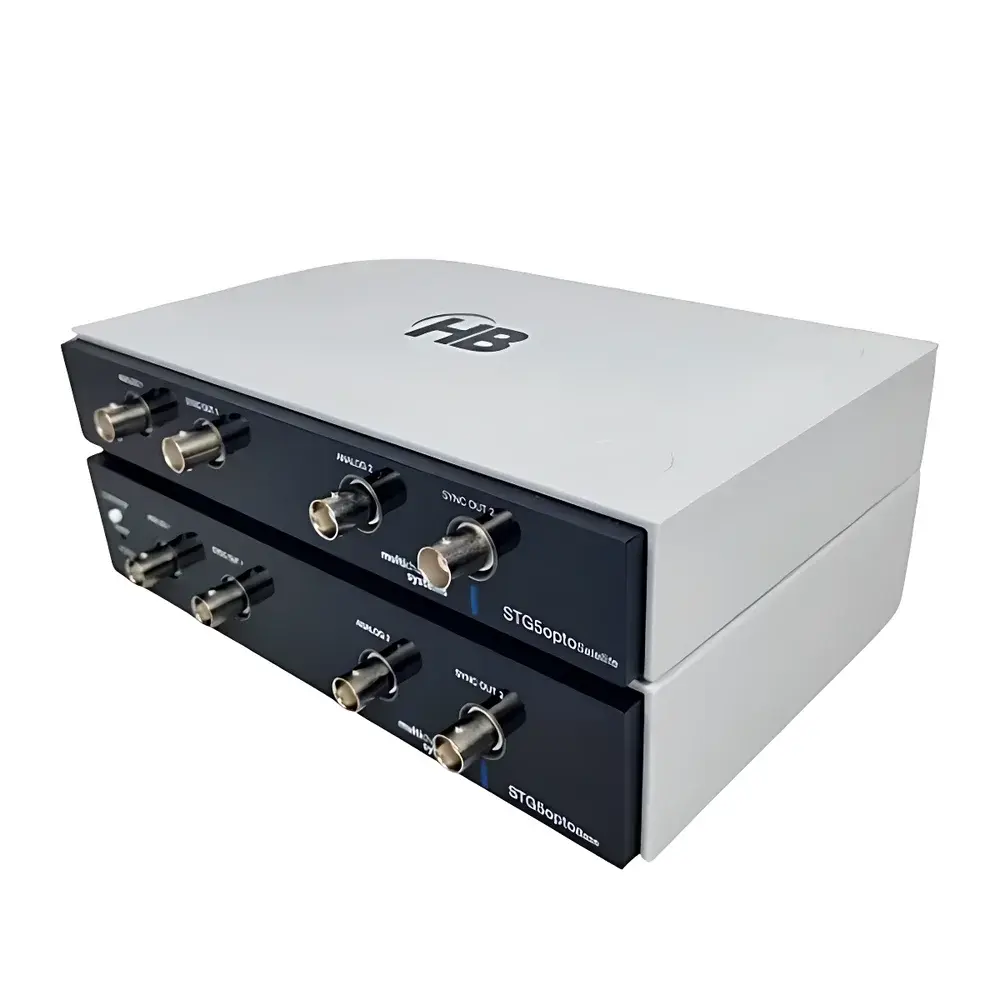
- True multichannel optical stimulation: Supports up to eight independently programmable LED channels in a compact, stackable 19-mm-thin chassis—ideal for space-constrained rigs and parallelized assays.
- High-fidelity pulse generation: Achieves <1 µs rise time and sub-100 ns jitter, enabling accurate replication of complex pulse trains (e.g., theta-burst, ramped frequency, or stochastic sequences) essential for synaptic plasticity or network entrainment studies.
- Stable irradiance output: Integrated photodiode monitoring and closed-loop intensity calibration ensure consistent photon flux across experiments—even during extended protocols or ambient temperature fluctuations.
- Low-latency hardware triggering: Accepts TTL, LVDS, or optical triggers with ≤5 µs response delay; fully compatible with external DAQ systems, patch-clamp amplifiers, and real-time analysis engines.
- Robust thermal management: Active heat dissipation and channel-wise thermal compensation maintain LED spectral output and drive current stability over multi-hour sessions.
Sample Compatibility & Compliance
The STG5-Opto is validated for use with primary neuronal cultures, iPSC-derived neurons, retinal explants, cardiac spheroids, brain organoids, and acute tissue slices mounted on standard MEA substrates (e.g., 60-, 120-, or 256-electrode arrays). It complies with IEC 61000-4-3 (radiated immunity) and IEC 61326-1 (EMC for laboratory equipment), and meets CE marking requirements for in vitro diagnostic (IVD) ancillary instrumentation. While not a medical device, its design supports GLP-compliant workflows when used in preclinical neurocardiac or vision research—particularly where traceability, audit-ready parameter logging, and version-controlled stimulus protocols are required per ISO/IEC 17025 or FDA 21 CFR Part 11 guidelines (when paired with MC_Stimulus III’s optional electronic signature module).
Software & Data Management
MC_Stimulus III—the dedicated control suite for the STG5-Opto—provides deterministic, scriptable stimulus orchestration without reliance on third-party environments. The software features a dual-mode interface: a graphical waveform builder for rapid protocol design (drag-and-drop pulse sequencing, amplitude ramping, inter-pulse interval modulation), and a Python API (via PyMCS) for automated experiment pipelines and integration with Neo, Elephant, or MNE-Python for spike sorting and network analysis. All stimulus parameters—including timestamps, LED drive currents, and hardware trigger events—are logged in HDF5 format with embedded metadata (e.g., user ID, session ID, firmware revision), supporting FAIR data principles. Audit trails record every parameter change, export action, and software update—critical for regulatory submissions or multi-lab reproducibility initiatives.
Applications
- Retinal circuit mapping: Precise spatiotemporal photostimulation of opsins-expressing ganglion or bipolar cells in ex vivo retina preparations.
- Cardiac optopacing and arrhythmia induction: Subthreshold and suprathreshold optical pacing of human iPSC-cardiomyocyte monolayers or engineered heart tissues.
- Network synchrony analysis: Closed-loop stimulation of MEA-cultured cortical networks to probe excitatory/inhibitory balance and seizure-like event propagation.
- Organoid functional phenotyping: Light-triggered Ca²⁺ dynamics interrogation in forebrain or midbrain organoids expressing step-function opsins.
- Hybrid electrophysiology-optogenetics: Simultaneous whole-cell patch clamp and focal LED stimulation for cell-type-specific input-output characterization.
FAQ
What LED wavelengths are supported by the STG5-Opto?
The STG5-Opto is available with user-selectable LED modules covering 405 nm, 470 nm, 530 nm, 590 nm, and 630 nm—each optimized for peak irradiance and thermal stability. Custom wavelength configurations can be ordered directly from Multi Channel Systems.
Can the STG5-Opto synchronize with third-party recording systems beyond MEA2100?
Yes—via standardized TTL/LVDS inputs and outputs, it interoperates with commercial patch-clamp amplifiers (e.g., HEKA EPC10, Axon Digidata), high-speed cameras (e.g., Hamamatsu ORCA-Fusion), and open-source acquisition platforms (e.g., OpenEphys, SpikeGLX).
Is optical power calibration traceable to NIST standards?
Each STG5-Opto unit ships with a factory calibration certificate referencing calibrated photodiode measurements; users may perform in-lab recalibration using an NIST-traceable power meter and collimated beam adapter kit (optional accessory).
How does channel crosstalk performance compare across stacked units?
Optical and electrical isolation between adjacent STG5-Opto modules exceeds 80 dB; mechanical light shielding and synchronized clock distribution eliminate inter-channel timing drift—even at maximum 8-channel capacity.
Does MC_Stimulus III support automated protocol validation for regulatory submissions?
With the optional Validation Package, MC_Stimulus III provides IQ/OQ documentation templates, parameter range verification scripts, and electronic signature compliance aligned with FDA 21 CFR Part 11 Annex 11 requirements.
Related Products