
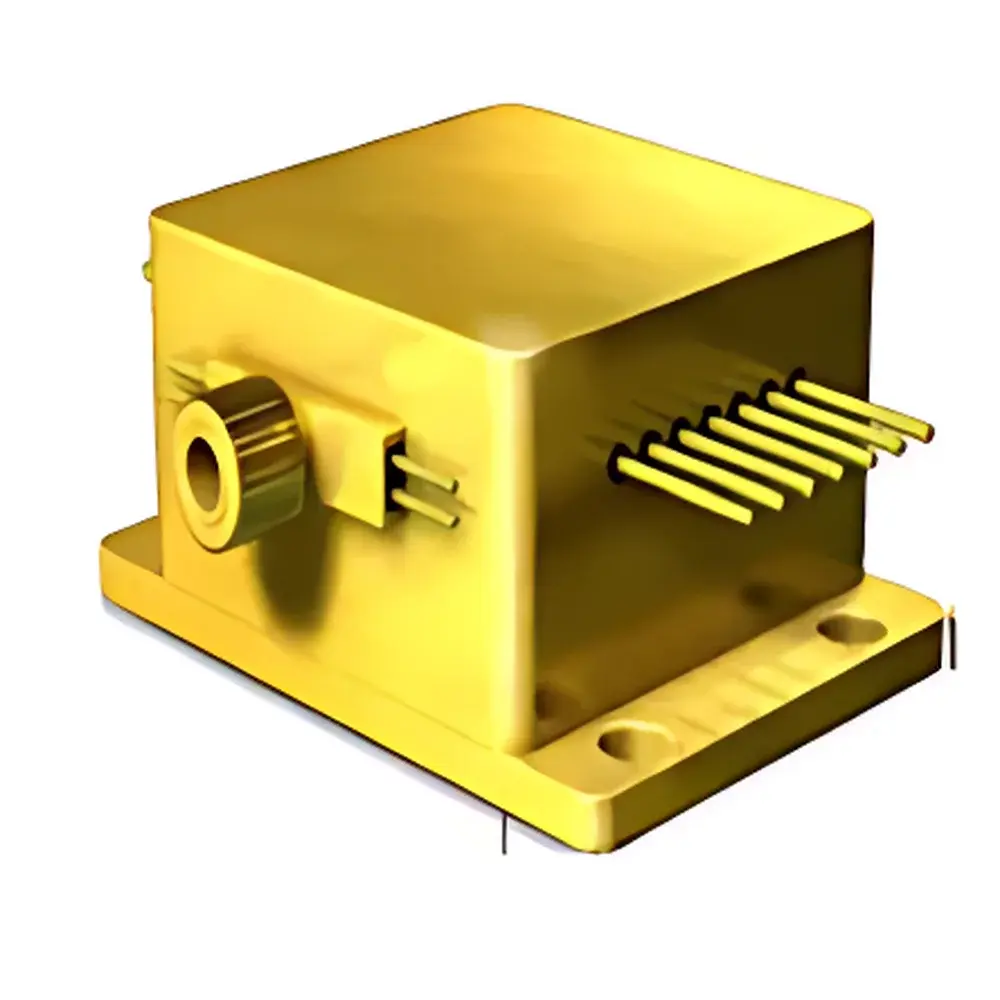
Multi-Mode Laser Diode Array DL by FLC
| Brand | FLC |
|---|---|
| Origin | USA |
| Type | Imported |
| Model | DL |
| Core Components | Solid-State Laser Systems and Modules |
| Wavelength Range | 375–2200 nm |
| Output Power Range | 100 mW – 60 W |
| Primary Applications | Laser Printing & Imaging, Solid-State Laser Pumping, Photobiomodulation Therapy, Ophthalmic Systems, Display & Projection, Target Illumination, Industrial Alignment |
Overview
The FLC DL Multi-Mode Laser Diode Array is a high-reliability, thermally stabilized semiconductor laser platform engineered for integration into demanding photonic systems requiring broad spectral coverage and scalable optical power. Unlike single-mode emitters, this array leverages multimode emitter architecture—comprising multiple spatially and spectrally distinct emitters within a single hermetically sealed package—to deliver high-brightness output with relaxed alignment tolerances. Its operational principle relies on stimulated emission from III–V compound semiconductor heterostructures (e.g., AlGaAs, InGaAs, GaN), with wavelength selection determined by epitaxial layer design and cavity geometry. The device operates in continuous-wave (CW) or quasi-CW pulsed mode, supporting duty-cycle–governed thermal management for sustained performance across industrial, medical, and scientific environments.
Key Features
- Wide spectral coverage spanning ultraviolet-visible-near-infrared (UV-VIS-NIR): 375 nm to 2200 nm—enabling cross-platform compatibility with optics designed for excitation, pumping, or illumination across diverse material interactions.
- Scalable output power from 100 mW up to 60 W per array module—achieved via parallel bar configuration and optimized thermal interface design using copper-tungsten submounts and microchannel coolers.
- Integrated thermoelectric cooler (TEC) and precision thermistor feedback loop—ensuring wavelength stability within ±0.1 nm/°C and power drift <±2% over 8-hour operation at rated load.
- Hermetic TO-can or CS-mount packaging options—qualified to MIL-STD-883H for humidity resistance and mechanical shock tolerance, suitable for embedded OEM integration.
- Driver-agnostic electrical interface with standard 2-pin or 4-pin configurations—compatible with industry-standard laser diode drivers supporting analog modulation (0–5 V) and TTL-triggered pulsing (up to 1 MHz).
Sample Compatibility & Compliance
The DL series supports integration with optical components including fiber-coupled collimators (FC/PC, SMA905), dichroic beam combiners, and diffraction-limited focusing optics. It complies with IEC 60825-1:2014 Class 3B and Class 4 laser safety requirements when properly housed and interlocked. For medical applications—including photobiomodulation and ophthalmic diagnostics—the array meets essential requirements of ISO 13485:2016 for design control documentation and supports traceable calibration protocols aligned with ANSI Z136.3. All units undergo burn-in testing (>100 hrs at 85% max power) and receive individual L-I-V (light-current-voltage) characterization reports. No FDA 510(k) clearance is claimed; end-user responsibility includes system-level regulatory validation per applicable jurisdiction (e.g., FDA 21 CFR Part 11 for electronic records in clinical use).
Software & Data Management
While the DL array itself is a hardware-only component, FLC provides optional SDKs (C/C++, Python) for integration with host controllers managing TEC setpoint, current ramping, and pulse timing. Data logging interfaces support IEEE-488 (GPIB), USB 2.0 (CDC class), and RS-485 protocols—enabling synchronization with oscilloscopes, power meters, and environmental monitors. Audit trails for operational parameters (current, temperature, runtime hours) are maintained in non-volatile memory and exportable as CSV for GLP/GMP-compliant record retention. Firmware updates follow secure signed-binary protocols compliant with NIST SP 800-193 guidelines for firmware integrity verification.
Applications
- Laser Pumping: Efficient optical pumping of Nd:YAG, Yb:fiber, and Ti:sapphire gain media—leveraging 808 nm, 940 nm, and 980 nm variants for high quantum-defect efficiency.
- Phototherapeutic Systems: Delivery of controlled irradiance (10–500 mW/cm²) in low-level laser therapy (LLLT) devices, adhering to empirical dose-response models defined in WHO and WALT consensus guidelines.
- Ophthalmic Instrumentation: Integration into retinal imaging illuminators and adaptive optics wavefront sensors where stable, broadband NIR illumination minimizes phototoxicity while maximizing scattering contrast.
- Industrial Alignment & Metrology: High-visibility line generation (via Powell lens coupling) for CNC machine tool calibration, structural deformation monitoring, and robotic guidance under ambient lighting conditions.
- Display & Projection: RGB+IR hybrid arrays for laser phosphor projection (LPP) engines and augmented reality waveguide illumination—supporting >120% NTSC color gamut when combined with quantum dot converters.
FAQ
Is the DL array supplied with a driver or cooling system?
No—FLC supplies the bare diode array only. Compatible drivers (constant-current, TEC-controlled) and liquid or conductive cooling solutions must be selected based on thermal load and modulation requirements.
Can multiple DL arrays be wavelength-multiplexed into a single fiber?
Yes—using fused-fiber combiners or free-space dichroic stacking, provided spectral separation exceeds 15 nm and polarization states are managed via half-wave plates or polarization-maintaining fiber.
What is the typical lifetime under rated operating conditions?
Median time-to-failure (MTTF) exceeds 20,000 hours at 70% of maximum rated current and junction temperature ≤55°C, per Telcordia GR-468-CORE reliability qualification.
Does FLC provide beam parameter measurements (M², BPP) for each unit?
Beam quality data is available upon request for custom orders; standard shipments include far-field intensity profiles and divergence angles measured per ISO 11146-1.
Are RoHS and REACH declarations available?
Yes—full substance compliance documentation, including SVHC screening reports and material declarations per IEC 62474, is provided with commercial orders.



