
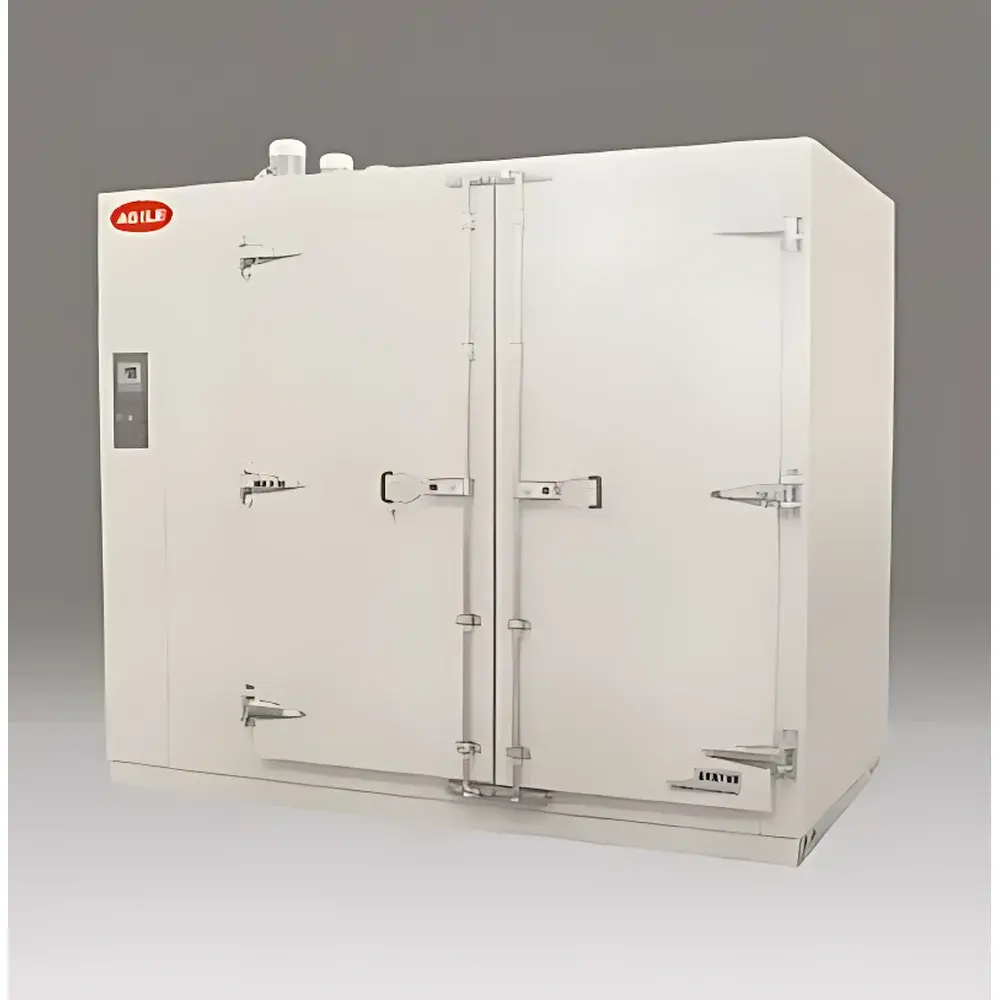
Multi-Purpose Drying Oven DGT2006(B) / DGT202(B) Series
| Origin | China |
|---|---|
| Manufacturer Type | Authorized Distributor |
| Model | DGT2006(B), DGT202(B), DGT302(B) |
| External Dimensions (D×W×H) | 107×130×128 cm / 144×207×190 cm / 148×211×194 cm |
| Chamber Dimensions (D×W×H) | 80×80×100 cm / 110×150×160 cm |
| Chamber Volume | 640 L / 2640 L |
| Temperature Range | Ambient +20 °C to 200 °C |
| Temperature Uniformity | ±2.5% of setpoint |
| Temperature Fluctuation | ±0.5 °C |
| Heating Power | 5.5 kW / 17.5 kW |
| Construction | Stainless Steel Interior (B-series), Epoxy-Coated Mild Steel Exterior |
| Control System | PID Digital Temperature Controller with LED Display |
| Air Circulation | Forced Convection via Rear-Mounted Horizontal Fan |
| Safety Features | Independent Over-Temperature Cut-Off, Short-Circuit Protection, Pressure-Relief Safety Door |
| Compliance | JB/T 5520–1991 “Technical Specifications for Drying Ovens” |
Overview
The DGT2006(B), DGT202(B), and DGT302(B) series multi-purpose drying ovens are engineered for precision thermal processing in research laboratories, quality control environments, and industrial manufacturing facilities. These ovens operate on the principle of forced convection heating—employing a rear-mounted horizontal fan and optimized airflow ducts to ensure uniform temperature distribution across the entire working chamber. Designed to meet the stringent requirements of JB/T 5520–1991, they deliver stable, repeatable thermal conditions essential for drying, baking, heat treatment, sterilization, and accelerated aging tests. The B-series models feature a fully welded 304 stainless steel interior chamber, eliminating corrosion risks when handling moisture-sensitive or chemically aggressive samples—critical for pharmaceutical stability studies, electronic component curing, and polymer post-curing applications.
Key Features
- Forced convection architecture with horizontally directed airflow, validated to achieve ≤±2.5% temperature uniformity across the full chamber volume per JB/T 5520–1991 test methodology
- PID digital temperature controller with high-resolution LED display (0.1 °C resolution), enabling precise setpoint programming and real-time deviation monitoring
- Dual-stage thermal safety system: independent mechanical over-temperature cut-off (adjustable up to 250 °C) plus electronic short-circuit protection integrated into the main power circuit
- Pressure-relief safety door mechanism compliant with Class II oven safety standards—automatically vents excess internal pressure during rapid thermal expansion events
- Modular panel construction with electrostatic epoxy powder coating (RAL 7035 light gray standard), supporting field-serviceable replacement of insulation, heating elements, and fan assemblies
- B-series models include seamless 1.2 mm thick 304 stainless steel chamber walls, weld-polished corners, and removable perforated stainless steel shelves for GMP-compliant cleaning validation
Sample Compatibility & Compliance
These ovens accommodate diverse sample types—including glassware, metal substrates, printed circuit boards, ceramic wafers, lyophilized vials, and composite laminates—without risk of outgassing contamination or surface oxidation under controlled airflow. The stainless steel chamber (B-series) is compatible with ISO 14644-1 Class 5 cleanroom maintenance protocols and supports residue-free cleaning using USP -compliant disinfectants. All models conform to JB/T 5520–1991 mechanical, thermal, and electrical performance criteria; optional factory calibration certificates (traceable to NIM, China) are available upon request. While not intrinsically rated for hazardous location use, units may be installed in non-classified laboratory zones per IEC 61000-6-3 EMC emission limits.
Software & Data Management
Standard configuration includes analog temperature recording capability via optional chart recorder interface (4–20 mA output). For digital data integrity, optional RS485 Modbus RTU communication enables integration with LabVantage, Siemens Desigo, or custom SCADA systems. When paired with certified third-party data loggers (e.g., Omega OM-DAQPRO-5300), the oven supports 21 CFR Part 11-compliant audit trails—including user ID, timestamped setpoint changes, alarm events, and temperature deviation logs—with encrypted storage and electronic signature functionality. Firmware updates maintain backward compatibility with legacy control modules, ensuring long-term platform sustainability beyond typical 10-year laboratory equipment lifecycles.
Applications
- Pharmaceutical: Residual solvent removal from active pharmaceutical ingredients (APIs), excipient drying per USP , and stability chamber qualification per ICH Q1A(R2)
- Electronics: PCB pre-bake prior to conformal coating, solder paste drying, and humidity preconditioning of MEMS sensors
- Materials Science: Moisture conditioning of carbon fiber prepregs, thermal aging of elastomers per ASTM D573, and binder burnout in ceramic green bodies
- Academic Research: Constant-temperature reaction staging, gravimetric moisture analysis (ASTM D4442), and catalyst activation protocols requiring inert-atmosphere-compatible thermal ramps
- Quality Assurance: Calibration of hygrometers and thermistors via fixed-point dry-well simulation, and reference-standard equilibration per ISO/IEC 17025 clause 5.10.3
FAQ
What is the maximum allowable operating temperature for continuous duty?
The DGT series is rated for continuous operation at 200 °C; intermittent exposure up to 220 °C is permissible for ≤30 minutes per cycle, provided chamber loading does not exceed 70% volume capacity.
Can the oven be validated for GMP-regulated processes?
Yes—B-series models support IQ/OQ/PQ documentation packages including as-installed sensor mapping (15-point grid), alarm response verification, and thermal recovery testing per Annex 15 guidelines.
Is external ventilation ducting required?
Not mandatory for standard air-drying applications; however, ducting to an external exhaust manifold is recommended when processing volatile organic solvents or generating particulate aerosols.
How often must the temperature sensor be recalibrated?
Annual calibration against a NIST-traceable reference thermometer is advised; internal Pt100 sensor drift remains within ±0.3 °C over 24 months under typical lab usage per manufacturer’s accelerated life testing data.
Are spare parts available globally?
Heating elements, fan assemblies, PID controllers, and stainless steel shelves are stocked by authorized distributors in North America, EU, and APAC regions with lead times ≤10 business days ex-warehouse.



