
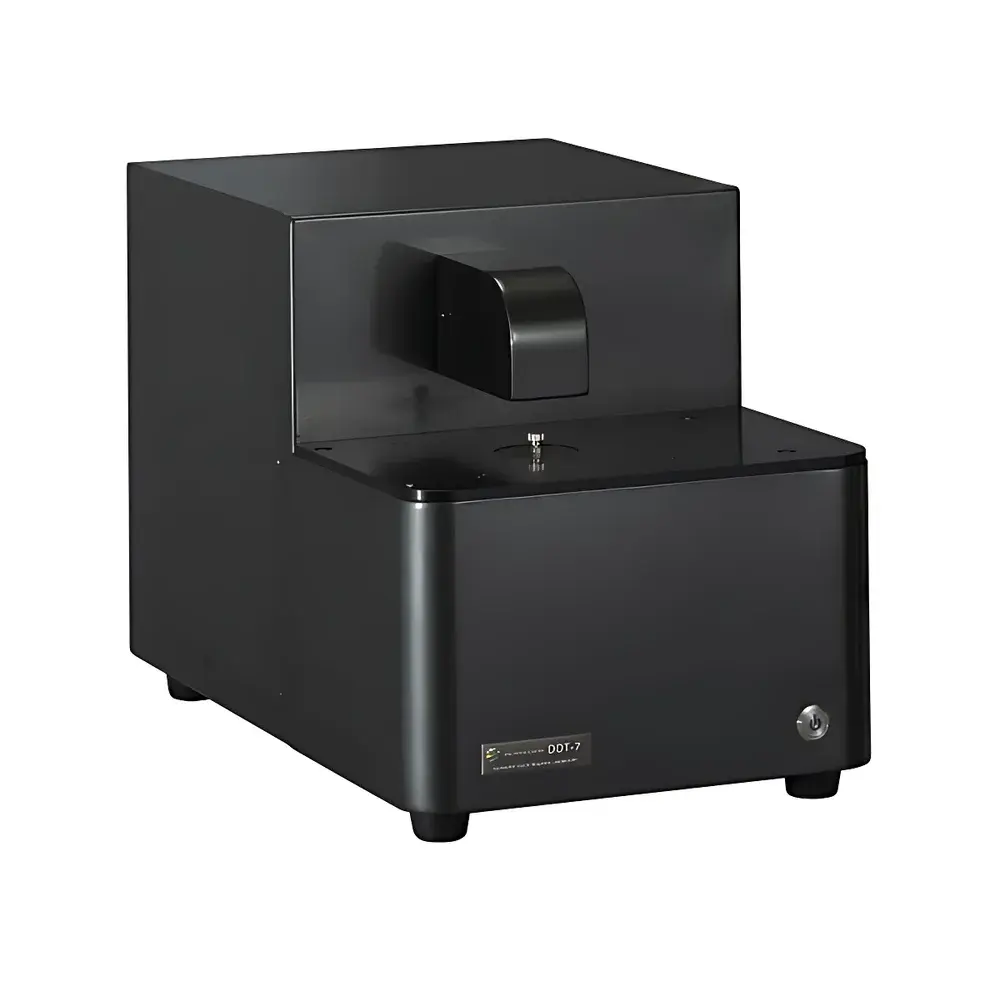
Murakami Color DOT-7 Integrating Sphere Spectrophotometer for Transmittance Measurement
| Origin | Japan |
|---|---|
| Manufacturer Type | Authorized Distributor |
| Origin Category | Imported |
| Model | DOT-7 |
| Price Range | USD 42,000 – 70,000 |
| Light Source | Broadband White LED |
| Spectral Range | 380–720 nm (standard), 390–730 nm (optional) |
| Wavelength Interval | 10 nm |
| Sensitivity Adjustment | Auto-Gain Calibration |
| Optical Configuration | Dual-Beam with Top-Illumination Integrating Sphere |
| Sample Thickness Capacity | Up to 30 mm |
| Polarization Measurement Capability | Crossed-Nicol configuration supported |
| Detection Sensitivity | 10× higher than predecessor model (DOT-6) |
Overview
The Murakami Color DOT-7 Integrating Sphere Spectrophotometer is a precision optical instrument engineered for high-fidelity spectral transmittance measurement of transparent, translucent, and highly diffusing materials. Based on the fundamental principle of integrating sphere photometry—where incident light is uniformly diffused across an inner spherical coating to enable spatially averaged detection—the DOT-7 employs a dual-beam optical architecture with top-down illumination. This design eliminates mechanical door operation, enabling rapid sample loading and minimizing operator-induced variability. The system utilizes a thermally stabilized broadband white LED as its primary light source, ensuring long-term radiometric stability, reduced warm-up time, and superior repeatability compared to traditional tungsten-halogen or xenon sources. With a standard spectral range of 380–720 nm (CIE 1931 V(λ)-weighted visible spectrum), the DOT-7 supports full-colorimetric analysis—including CIE XYZ, L*a*b*, and Yxy coordinates—as well as spectral transmittance curves at 10 nm resolution. Its top-access open-stage configuration accommodates thick, curved, or irregularly shaped specimens up to 30 mm in thickness, making it particularly suited for ophthalmic lens evaluation, automotive glazing, display cover glass, and polymer film QA.
Key Features
- Dual-beam optical path with real-time reference compensation, delivering exceptional long-term photometric stability (<0.1% drift over 8 hours)
- Top-illuminated integrating sphere (150 mm diameter, BaSO₄-coated interior) optimized for diffuse transmittance quantification of non-planar and textured samples
- Auto-gain calibration system dynamically adjusts detector sensitivity to maintain optimal signal-to-noise ratio across wide transmittance ranges (0.01–100%)
- 10× enhanced detection sensitivity relative to the DOT-6 platform, enabling reliable measurement of low-transmittance polarized systems (e.g., crossed-Nicol configurations with extinction ratios >10⁴:1)
- Open-stage sample holder eliminates door actuation delays; compatible with plano-convex lenses, progressive addition lenses (PALs), and molded optical components without repositioning
- Compact footprint (W320 × D410 × H390 mm) achieved through optomechanical miniaturization and integrated thermal management
Sample Compatibility & Compliance
The DOT-7 is validated for use with optically heterogeneous specimens including corrective eyewear lenses (CR-39, polycarbonate, high-index plastics), anti-reflective coated substrates, frosted acrylic panels, opal glass, and liquid-filled cuvettes. Its geometry accommodates both flat and curved surfaces with minimal vignetting, and the absence of lateral constraints permits edge-transmittance profiling. The instrument complies with ISO 13655:2017 (Spectral measurement—Requirements for instrumentation), JIS Z 8722 (Methods of color measurement for transparent objects), and ASTM E308-22 (Standard Practice for Computing the Colors of Objects). Data acquisition protocols support GLP-compliant audit trails when operated with optional secure software modules meeting FDA 21 CFR Part 11 requirements.
Software & Data Management
The DOT-7 operates with Murakami’s proprietary SpectraView v4.x application, which provides real-time spectral visualization, multi-sample comparative analysis, batch reporting, and export to CSV, XML, and CxF/XRGA formats. The software includes built-in color difference algorithms (ΔE₀₀, ΔE₇₆), haze correction routines per ASTM D1003, and polarization transmittance calculation modules. All measurement parameters—including integration time, gain setting, wavelength range, and calibration history—are digitally logged with timestamp and user ID. Optional network-enabled licensing allows centralized fleet management and remote firmware updates via HTTPS-secured channels.
Applications
- Transmittance and colorimetry of prescription and safety eyewear lenses under standardized illuminants (D65, A, F2)
- Quality control of AR/HR coatings on optical substrates using spectral shift and peak transmission analysis
- Diffuse transmittance characterization of architectural glazing and smart window films
- Batch consistency verification for medical device packaging films (e.g., PETG, PP) per ISO 11664-6
- Polarization-dependent transmission analysis in LCD backlight units and retardation film development
- Research-grade spectral evaluation of bio-inspired translucent biomaterials and hydrogel-based optical interfaces
FAQ
What spectral resolution does the DOT-7 provide, and is it configurable?
The DOT-7 acquires spectra at fixed 10 nm intervals across its standard 380–720 nm range. Resolution is hardware-determined and not software-variable.
Can the DOT-7 measure samples with strong surface scattering, such as ground glass or opal diffusers?
Yes—the integrating sphere geometry and top-illumination path are specifically optimized for high-diffusion samples, minimizing directional bias and ensuring representative bulk transmittance values.
Is NIST-traceable calibration available for the DOT-7?
Yes—Murakami offers factory-certified calibration kits traceable to NIST SRM 2035 (spectral transmittance) and SRM 2065 (diffuse transmittance), with annual recalibration services.
Does the system support automated thickness compensation for absorbance calculations?
No—thickness input is manual within the software; Beer-Lambert modeling requires user-defined path length entry for quantitative absorbance derivation.
What is the maximum sample weight the stage can support?
The open-stage platform supports loads up to 2.5 kg with stable positioning; heavier fixtures require optional vibration-isolated mounting adapters.





