
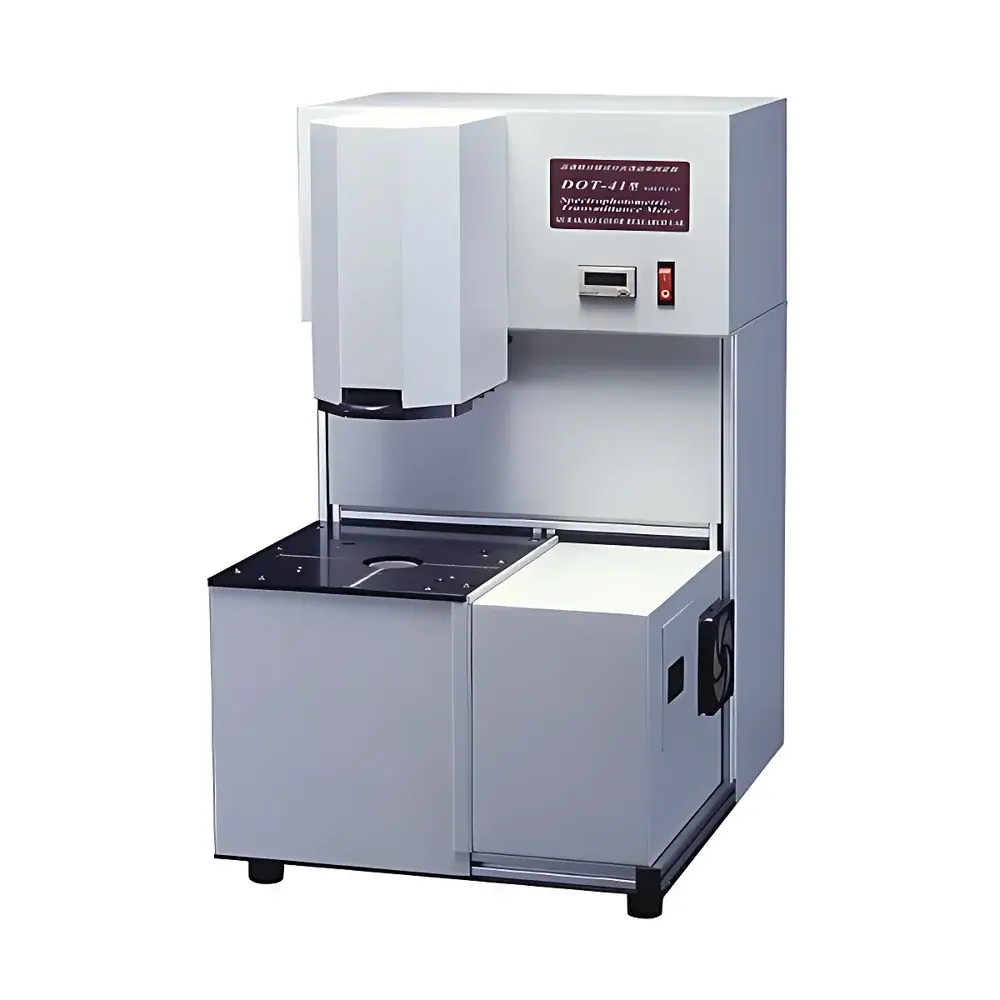
Murakami DOT-41 Integrating Sphere Transmittance Spectrophotometer
| Origin | Japan |
|---|---|
| Manufacturer Type | Authorized Distributor |
| Origin Category | Imported |
| Model | DOT-41 |
| Price Range | USD 70,000 – 112,000 (FOB Japan) |
| Optical Configuration | Dual-beam, integrating sphere |
| Wavelength Range | 380–780 nm (standard) |
| Wavelength Interval Options | 1, 5, 10, 20, or 50 nm |
| Sensitivity Enhancement | Optional 100× gain module for low-transmittance and polarization degree measurement |
| Sample Chamber Depth | 15 cm from optical axis to sample stage |
| Maximum Sample Width | 30 cm (centered on stage) |
| Illumination Geometry | Diffuse illumination via integrating sphere |
| Polarization Measurement Capability | Yes, with crossed-Nicol configuration |
| Calibration Method | Manual SPAN knob adjustment |
Overview
The Murakami DOT-41 is a high-precision dual-beam integrating sphere spectrophotometer engineered for accurate transmittance, colorimetric, and polarization-dependent optical characterization of highly scattering, semi-transparent, and surface-textured materials. Based on the proven optical architecture of the DOT-3C series, the DOT-41 eliminates systematic polarization bias inherent in conventional collimated-path instruments—enabling reliable quantification of transmittance in optically complex samples such as molded lenses, textured acrylics, diffuser plates, anti-glare automotive glazing, and polarizing films. Its core measurement principle relies on diffuse illumination within a calibrated integrating sphere, ensuring uniform angular distribution of incident light and minimizing directional artifacts caused by surface microstructure or bulk heterogeneity. The system operates across the full visible spectrum (380–780 nm), with an optional UV-Vis extension (280–780 nm) supporting applications requiring ultraviolet transmittance validation—e.g., UV-blocking lens coatings or photostability assessment of polymer substrates.
Key Features
- Dual-beam optical design ensures exceptional long-term photometric stability, reducing drift during extended measurement sequences or environmental fluctuations.
- Integrating sphere illumination (with calibrated BaSO₄-coated interior) provides Lambertian input irradiance, enabling repeatable transmittance measurements on optically non-ideal samples—including those with surface relief, internal haze, or macroscopic diffusion.
- Optional 100× sensitivity enhancement module enables stable detection of transmittance values below 0.1%, critical for evaluating high-extinction polarizers, neutral density filters, and multilayer interference stacks.
- Integrated polarization measurement capability using precision-aligned Nicol prism optics supports rapid determination of polarization degree (DoP) under crossed configuration—validated per ISO 15397 and ASTM E284 definitions.
- Open-top sample stage (no access door) allows rapid placement and alignment of large-format specimens up to 30 cm wide; optical axis offset of 15 cm accommodates thick or recessed fixtures without repositioning.
- Manual SPAN knob calibration permits field-adjustable photometric gain without software dependency—supporting traceable recalibration between NIST-traceable reference standards.
Sample Compatibility & Compliance
The DOT-41 is validated for use with optically heterogeneous media where traditional collimated spectrophotometers yield inconsistent results: injection-molded optical lenses (glass and thermoplastic), laminated safety glass, frosted polycarbonate, microlens arrays, gradient-index optics, and birefringent polymer films. Its diffuse illumination geometry complies with CIE Publication No. 15:2018 for spectral transmittance measurement of diffusing materials and satisfies the geometric requirements of ISO 13655:2017 (Spectral measurement of reflective and transmissive materials). For regulated industries, the instrument supports audit-ready documentation workflows compatible with GLP and GMP environments—though it does not include built-in 21 CFR Part 11 electronic signature functionality, raw spectral data export (ASCII, CSV) enables integration into validated LIMS or ELN platforms.
Software & Data Management
The DOT-41 operates via Murakami’s proprietary Windows-based control software, providing real-time spectral acquisition, CIE color space conversion (CIELAB, CIELCH, Yxy), transmittance ratio calculation (Tspec, Ttotal, Tdiffuse), and polarization degree computation. All spectra are timestamped and annotated with operator ID, calibration status, and instrument configuration metadata. Data export supports multiple formats (TXT, CSV, XML) for downstream analysis in MATLAB, Python (NumPy/Pandas), or commercial statistical packages. Software logs retain full audit trails of measurement parameters, calibration events, and user actions—facilitating internal quality reviews and external regulatory inspections.
Applications
- Automotive: Transmittance and color consistency testing of HUD combiners, IR-cut filters, and electrochromic rearview mirrors.
- Ophthalmics: Quantitative evaluation of tint uniformity, UV cutoff sharpness, and haze-related luminance transmission in prescription lenses.
- Display Manufacturing: Characterization of touch panel overlays, anti-reflection coatings, and circular polarizer stacks used in OLED and microLED modules.
- Optical Materials R&D: Diffuse transmittance profiling of nanoparticle-doped polymers, aerogel composites, and bio-inspired light-diffusing films.
- Quality Control: In-line verification of batch-to-batch consistency in coated optical substrates prior to final assembly.
FAQ
What is the minimum measurable transmittance with the 100× sensitivity option?
With the optional high-gain module and optimized integration time, the system achieves stable signal detection down to 0.05% transmittance (T = 5 × 10⁻⁴) under controlled ambient conditions.
Can the DOT-41 measure both total and diffuse transmittance separately?
Yes—the integrating sphere configuration inherently captures total transmittance; diffuse component isolation requires optional auxiliary baffling and secondary port configuration, available as a factory-installed accessory kit.
Is UV-Vis capability standard or optional?
The UV-Vis wavelength extension (280–780 nm) is an optional hardware upgrade requiring quartz optical components and UV-optimized detector calibration—ordered at time of purchase.
Does the instrument support automated sample changers or robotic integration?
No native automation interface is provided; however, the RS-232 and USB virtual COM port enable third-party SCADA or PLC-driven sequencing via ASCII command protocol.
How often is recalibration required for routine QC use?
Murakami recommends annual calibration using certified reference standards (e.g., NIST SRM 2036); interim verification with a stable white reflectance tile is advised before each daily measurement session.





