
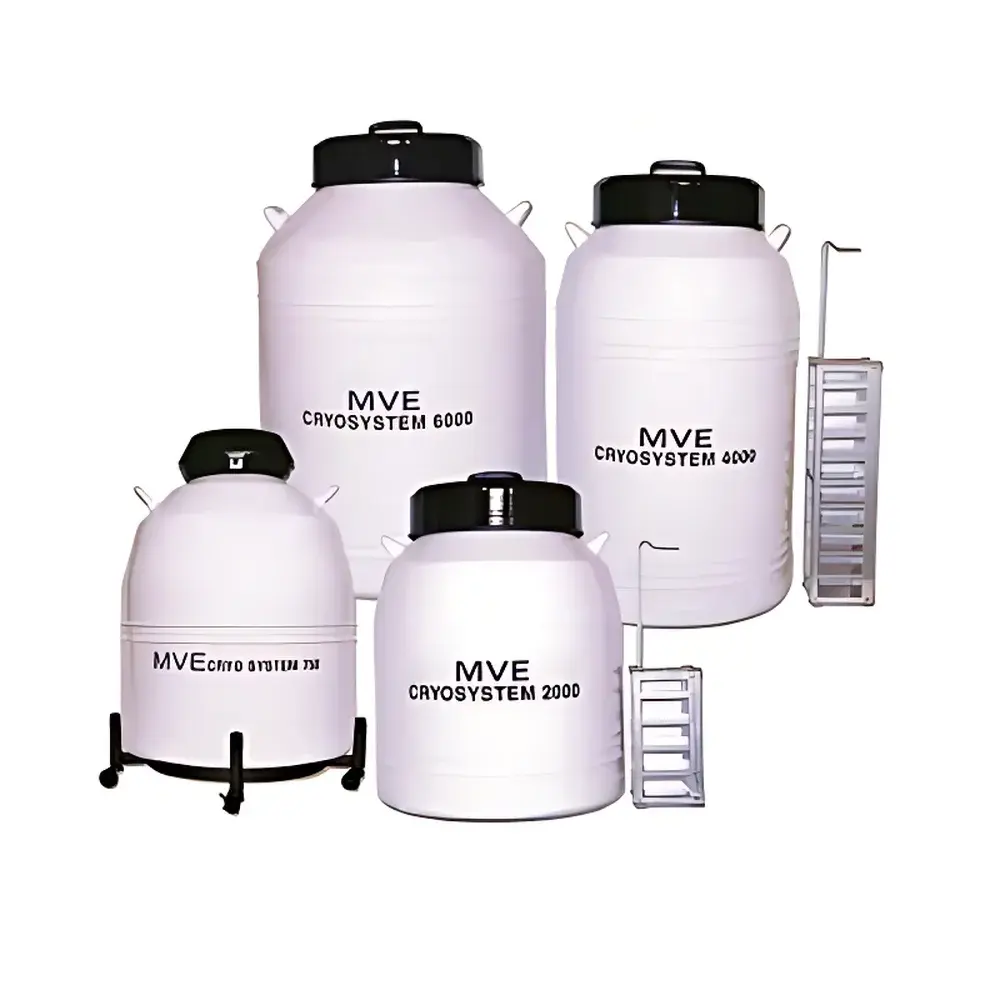
MVE CryoSystem Series Liquid Nitrogen Storage Tanks
| Origin | USA |
|---|---|
| Manufacturer Type | Authorized Distributor |
| Origin Category | Imported |
| Model | CryoSystem 750 / 2000 / 4000 / 6000 |
| Price Range | USD $2,500 – $6,200 |
Overview
The MVE CryoSystem Series is a family of high-efficiency, static-phase liquid nitrogen (LN₂) storage tanks engineered for reliable long-term cryopreservation of biological specimens—including cell lines, primary tissues, stem cells, embryos, and genomic samples—at sustained temperatures below −190 °C. Designed using vacuum-insulated double-wall stainless steel construction with multilayer superinsulation (MLI), each CryoSystem model operates on passive cryogenic storage principles: no active cooling or electrical components are required. The system relies on controlled boil-off vapor pressure management and optimized thermal geometry to minimize static LN₂ evaporation while maximizing usable storage volume per unit footprint. This architecture delivers exceptional energy efficiency and operational simplicity—critical for core biorepositories, clinical IVF labs, pharmaceutical R&D facilities, and academic cryobiology programs where uptime, sample integrity, and cost-per-vial sustainability are paramount.
Key Features
- Optimized static LN₂ consumption: Evaporation rates as low as 0.39 L/day (CryoSystem 750) enable extended unattended operation—up to 104 days at full capacity (CryoSystem 6000) under controlled ambient conditions.
- Space-efficient footprint: Compact external diameters (ranging from 508 mm to 665 mm) and vertical height profiles (673–965 mm) allow integration into standard laboratory aisles and walk-in cold rooms without structural modification.
- Modular rack-based storage: Precision-machined aluminum racks accommodate standardized cryobox formats—compatible with both 25- and 100-compartment cryoboxes for 1.2 mL and 2.0 mL vials—ensuring traceable, organized inventory management.
- Lightweight yet robust construction: Empty weights range from 19 kg (CryoSystem 750) to 46.7 kg (CryoSystem 6000), facilitating manual repositioning without mechanical assistance while maintaining ASME BPVC Section VIII Division 1–compliant pressure vessel integrity.
- Integrated neck tube design: Standardized 127 mm (5″) or 216 mm (8.5″) neck diameters support compatibility with automated sample retrieval systems, LN₂ level sensors, and temperature monitoring probes (e.g., thermocouple or RTD ports).
Sample Compatibility & Compliance
The CryoSystem series supports long-term storage of cryovials (1.2 mL and 2.0 mL), cryobags, straws, and microtubes conforming to ANSI/ISO 15189, CLSI GP44-A4, and ISBER Best Practices guidelines. All models are manufactured in accordance with ISO 9001-certified processes and meet U.S. Department of Transportation (DOT) 4L specification requirements for transportable cryogenic containers. While not classified as medical devices under FDA 21 CFR Part 820, the tanks are routinely validated for use in GLP- and GMP-regulated environments—particularly when paired with electronic LN₂ level loggers and audit-trail-capable monitoring software that comply with FDA 21 CFR Part 11 data integrity standards.
Software & Data Management
Although the CryoSystem tanks operate autonomously, they are fully compatible with third-party environmental monitoring platforms—including Vaisala viewLinc, DicksonOne, and Sensitech TempTale—enabling real-time remote tracking of LN₂ level, internal temperature gradients, and door-open events. Optional integrated probe sleeves (available per model) support calibrated Pt100 or Type T thermocouples for continuous thermal mapping across the storage chamber. All data streams may be archived in secure cloud or on-premise databases with configurable alert thresholds, user-access controls, and electronic signature workflows—supporting full compliance with ISO/IEC 17025 accreditation requirements for testing and calibration laboratories.
Applications
- Clinical embryology and reproductive medicine labs requiring uninterrupted storage of oocytes, sperm, and blastocysts.
- Biobanking operations managing large-scale collections of human biospecimens under NCI Best Practices or BBMRI-ERIC standards.
- Cell therapy manufacturing suites where cryopreserved CAR-T and NK cell products must maintain viability during intermediate hold steps.
- Academic research facilities conducting longitudinal studies on cryopreserved iPSC lines or organoid cultures.
- Pharmaceutical stability programs storing reference standards and comparability panels at ultra-low temperatures for ICH Q5C compliance.
FAQ
What is the difference between static and dynamic liquid nitrogen storage?
Static storage relies solely on passive vacuum insulation and thermal mass to limit LN₂ boil-off; no refrigeration compressor or recirculation system is used. Dynamic systems actively recondense vapor, enabling near-zero consumption—but at higher capital and maintenance cost.
Can the CryoSystem tanks be used for shipping?
No—these are stationary storage units designed for fixed-location use only. For transport, MVE offers separate DOT-compliant shipping dewars (e.g., CryoShip series) certified under 49 CFR 173.319.
Are custom rack configurations available?
Yes—OEM rack layouts can be specified for non-standard vial formats (e.g., 0.5 mL straws, 5 mL cryobags) subject to minimum order quantities and engineering review.
How often should the vacuum insulation be tested?
Annual performance verification via LN₂ hold-time validation is recommended; formal vacuum decay testing is advised every 3–5 years or following any physical impact event.
Is training provided for safe handling and maintenance?
Comprehensive operator training—including PPE requirements, frostbite prevention, oxygen deficiency hazard (ODH) mitigation, and routine inspection protocols—is included with all installations through authorized MVE distributors.



