
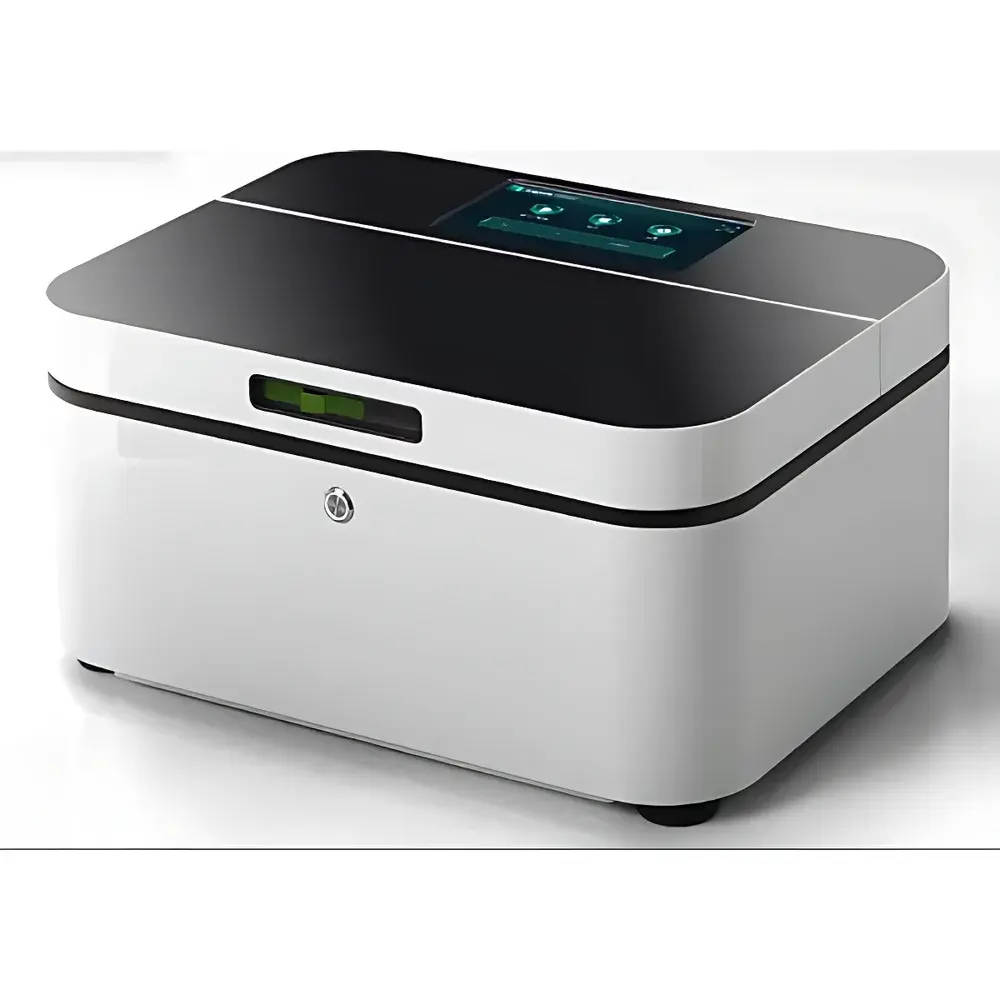
mWB-X2 Single-Cell Multiplex Protein Analysis System
| Brand | Water Bear Technology |
|---|---|
| Origin | Zhejiang, China |
| Manufacturer Type | Authorized Distributor |
| Product Category | Domestic |
| Model | mWB-X2 |
| Instrument Type | Protein Electrophoresis System |
| Sample Capacity | 6400 single cells per run |
| UV Source | Integrated long-life LED-based UV-C module (254 nm) |
| Gel Format | Photocrosslinkable hydrogel microarray chip (6000 micro-wells) |
| Electrophoresis Time | Adjustable, typical 5 min |
| Full Workflow Duration | 4–6 h |
| Detection Mode | On-chip fluorescent immunodetection |
| Data Output | Quantitative protein expression profiles with molecular weight estimation |
| Safety Features | Interlocked lid, real-time UV status monitoring, auto-shutdown, digital level calibration |
Overview
The mWB-X2 Single-Cell Multiplex Protein Analysis System is an integrated electrophoretic platform engineered for high-throughput, quantitative protein profiling at single-cell resolution. Unlike conventional Western blotting—which relies on bulk lysates and membrane transfer—the mWB-X2 implements a solid-phase, chip-based adaptation of the Western blot principle. It utilizes a photocrosslinkable hydrogel microarray containing 6,000 addressable micro-wells to capture individual cells, followed by on-chip electrophoretic separation under controlled voltage and time parameters. Proteins are covalently immobilized via UV-C (254 nm) irradiation directly within the gel matrix—eliminating the need for electroblotting and minimizing sample loss, especially critical for low-abundance targets. The system supports multiplexed immunodetection using fluorophore-conjugated antibodies, enabling simultaneous quantification of up to six distinct protein targets per cell, each resolved by apparent molecular weight. Designed for reproducible, GLP-aligned workflows, the mWB-X2 delivers robust inter-run consistency and traceable operational metadata—including UV exposure history, electrophoresis log, and chip-level calibration records.
Key Features
- Integrated touchscreen interface with customizable electrophoresis protocols (voltage range: 10–200 V; time: 1–30 min; stepwise gradient support)
- On-board UV-C source (254 nm) with real-time intensity monitoring, automatic duty-cycle adjustment, and predictive end-of-life alerting
- Digital inclinometer ensuring ±0.1° leveling accuracy—critical for uniform electric field distribution across the 6400-well chip
- Interlock-enabled safety architecture: UV emission and high-voltage output disabled when lid is open or tilt exceeds threshold
- Chip auto-recognition via embedded RFID tag; stores lot-specific calibration data, expiration date, and usage history
- Zero-transfer workflow: direct in-gel protein fixation (>80% efficiency in ≤30 s), preserving epitope integrity and spatial context
Sample Compatibility & Compliance
The mWB-X2 accepts suspension cells (primary, cultured, or dissociated tissue-derived) with diameters between 5–25 µm. Adherent cells may be harvested using non-enzymatic dissociation reagents compatible with downstream antibody binding. Chip loading is performed via centrifugal sedimentation or microfluidic aspiration (accessory kits available). All consumables—including photogel chips, running buffers, and antibody diluents—are manufactured under ISO 13485-certified conditions and supplied with CoA documentation. The system complies with IEC 61010-1 (electrical safety), IEC 62471 (UV radiation safety), and supports audit-ready operation per FDA 21 CFR Part 11 requirements when paired with validated LIMS integration. Routine performance verification follows ASTM E2925-22 (standard guide for validation of electrophoretic systems).
Software & Data Management
The mWB Control Suite (v3.2+) provides instrument control, real-time electropherogram visualization, and automated fluorescence image acquisition. Raw TIFF stacks are processed using proprietary deconvolution algorithms that correct for well-to-well crosstalk, background heterogeneity, and photobleaching drift. Each detected band is assigned an estimated molecular weight based on internal ladder calibration embedded in every chip. Export formats include CSV (normalized intensity × MW × cell ID), MIAF-compliant metadata JSON, and PDF summary reports compliant with ISO/IEC 17025 reporting guidelines. Audit trail logs record user actions, parameter changes, and system events with SHA-256 hashing for integrity verification. Optional API enables bidirectional integration with LabVantage, Benchling, or custom ELN platforms.
Applications
The mWB-X2 is optimized for studies requiring functional proteomic heterogeneity assessment at cellular resolution. Primary use cases include: characterization of tumor subclonal signaling states (e.g., p-ERK/p-AKT co-expression in melanoma biopsies); longitudinal monitoring of immune cell activation markers (CD69, CD25, FOXP3) in CAR-T expansion cultures; phosphoproteome dynamics during drug perturbation screens; and validation of single-cell RNA-seq findings at the protein level. Its throughput and sensitivity make it particularly suitable for translational cohorts where limited clinical material necessitates maximal information yield per cell—such as cerebrospinal fluid–derived lymphocytes or fine-needle aspirates from solid tumors.
FAQ
Does the mWB-X2 require external imaging equipment?
No. The system includes a cooled CMOS detector with dual-band excitation/emission filters (488/520 nm and 640/670 nm) and autofocus optics calibrated for 100-µm chip thickness.
Can I reuse the photogel chip?
No. Each chip is single-use and sterilized via gamma irradiation. Reuse compromises crosslinking fidelity and increases carryover risk.
Is antibody validation required before assay deployment?
Yes. Users must confirm antibody specificity and linear dynamic range on the mWB-X2 platform using spiked controls or reference cell lines prior to experimental runs.
What buffer systems are supported?
Tris-Glycine-SDS and Bis-Tris-MES running buffers are pre-validated. Custom formulations require compatibility testing per manufacturer’s protocol TS-047.
How is data traceability ensured for regulatory submissions?
All raw images, processing parameters, calibration files, and operator logs are archived with immutable timestamps and digitally signed upon report generation—meeting ALCOA+ principles for GxP environments.





