
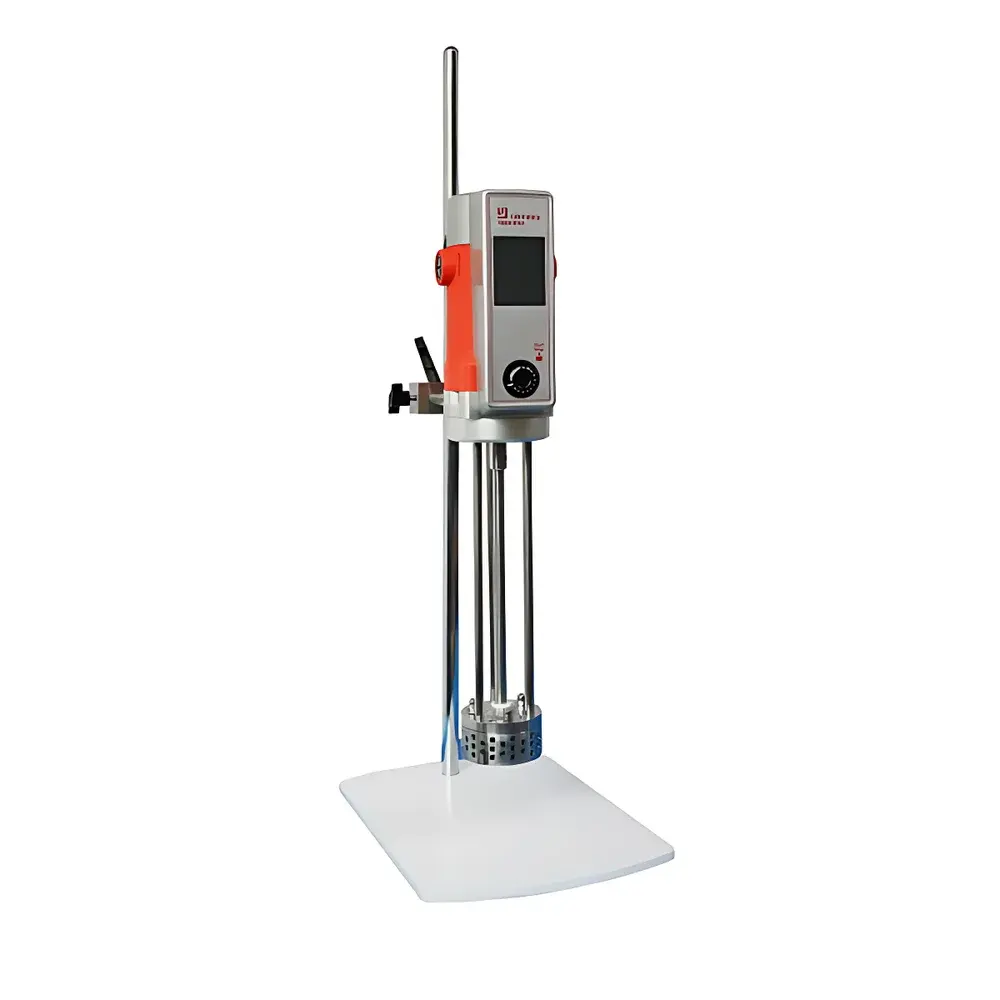
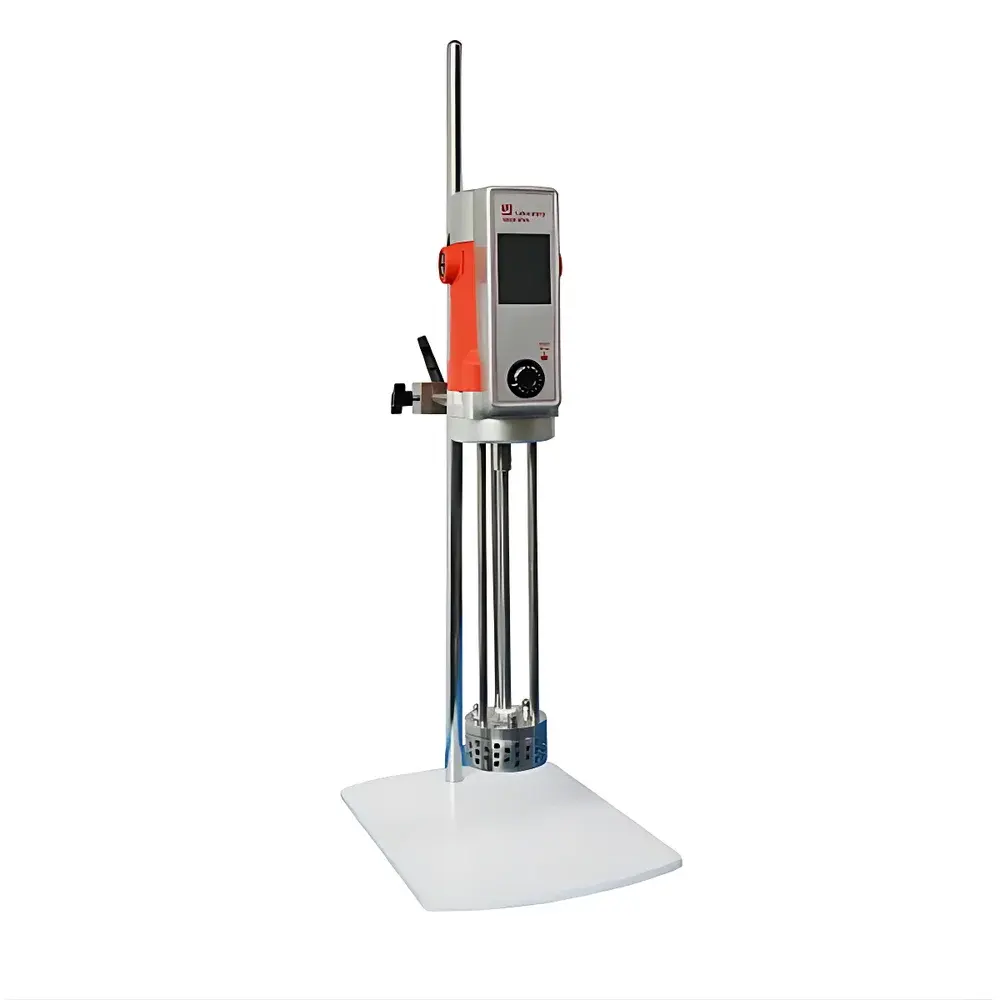
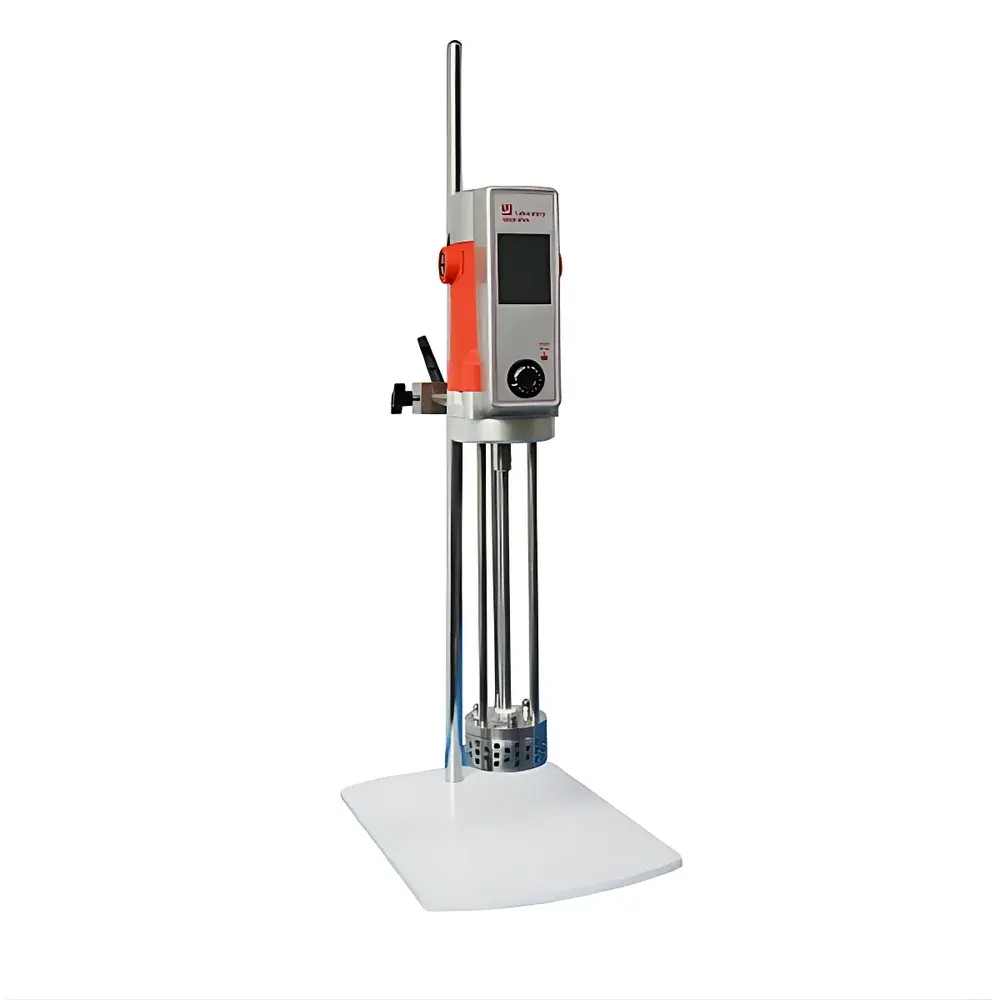
Myingpu LYE500W-T High-Shear Dispersing and Emulsifying Homogenizer
| Brand | Myingpu |
|---|---|
| Origin | Shanghai, China |
| Model | LYE500W-T |
| Power Rating | 500 W |
| Speed Range | 1,000–13,000 rpm |
| Display | 2.8-inch TFT color touchscreen |
| Real-time monitoring | Voltage, frequency, current, power, torque curve |
| Safety features | Overload protection, overcurrent protection, self-diagnostic system |
| Operational functions | Programmable timer, speed memory, pause/resume, digital speed readout |
| Compliance | Designed for GLP-compliant laboratory environments |
| Enclosure rating | IP20 (indoor laboratory use) |
Overview
The Myingpu LYE500W-T is a benchtop high-shear dispersing and emulsifying homogenizer engineered for reproducible, scalable processing of viscous and heterogeneous liquid-phase systems in research and quality control laboratories. It operates on the principle of rotor-stator shear hydrodynamics: a precision-machined rotating shaft (rotor) rotates at controlled speeds within a fixed concentric sleeve (stator), generating intense localized shear gradients—up to 10⁶ s⁻¹—capable of disrupting interfacial films, breaking down agglomerates, and inducing turbulent energy dissipation across dispersed phases. This mechanism enables efficient particle size reduction, droplet breakup in oil-in-water or water-in-oil emulsions, and uniform dispersion of nanomaterials, pigments, or active pharmaceutical ingredients (APIs) into carrier matrices. Unlike ultrasonic or magnetic stirrer-based systems, the LYE500W-T delivers consistent mechanical energy input independent of sample volume or viscosity within its operational envelope (0.5–500 mL), making it suitable for method development preceding pilot-scale colloid milling or high-pressure homogenization.
Key Features
- 500 W brushless DC motor with closed-loop speed regulation ensures stable rotational output across the full 1,000–13,000 rpm range, minimizing drift under load variations.
- Integrated 2.8-inch TFT color touchscreen provides real-time visualization of operational parameters—including voltage, frequency, current draw, instantaneous power consumption, and dynamic torque curve—enabling correlation between mechanical input and process outcome.
- Digital speed presetting and memory function allow storage of up to 10 user-defined protocols; each includes target rpm, run duration, and acceleration profile.
- Intelligent safety architecture includes dual-stage electronic overload protection, automatic shutdown upon abnormal current surge or thermal threshold exceedance, and built-in self-diagnostics that verify sensor integrity and motor commutation prior to startup.
- Ergonomic stainless-steel housing with non-slip rubber feet ensures vibration damping and positional stability during high-rpm operation; compatible with standard laboratory fume hoods and laminar flow workstations.
Sample Compatibility & Compliance
The LYE500W-T accommodates a wide spectrum of sample types—including aqueous suspensions, polymer solutions, lipid-based emulsions, ceramic slurries, and biopolymer gels—when used with appropriate rotor-stator geometries (e.g., narrow-gap, conical, or multi-stage heads). It supports batch volumes from 0.5 mL (micro-tip configuration) to 500 mL (standard 90G probe), with compatibility verified per ISO 13320:2020 (laser diffraction particle sizing) and ASTM D2703-16 (emulsion stability testing). While not certified to IEC 61000-6-3 for EMC emissions or UL 61010-1 for safety, its design adheres to general laboratory equipment best practices outlined in ISO/IEC 17025:2017 clause 6.4.2 (equipment suitability verification). Data logging functionality meets basic GLP documentation requirements, though full 21 CFR Part 11 compliance requires external audit-trail software integration.
Software & Data Management
The onboard firmware supports export of time-stamped operational logs (CSV format) via USB-A port, including timestamped rpm, torque, power, and temperature (if optional external probe connected). No proprietary cloud platform or Windows/Mac application is bundled; however, raw log files are structured for direct import into MATLAB, Python (pandas), or LabVIEW for statistical process analysis. The torque curve display enables empirical correlation of mechanical resistance with formulation rheology—particularly useful for tracking viscosity evolution during emulsification or nanoparticle deagglomeration kinetics. All parameter settings persist through power cycles without battery-backed memory.
Applications
- R&D of topical pharmaceutical formulations (e.g., nanoemulsions for transdermal delivery)
- Preparation of stable pigment dispersions for inkjet inks and coatings
- Homogenization of cell lysates prior to centrifugal fractionation
- Development of food-grade emulsions (e.g., mayonnaise analogues, plant-based dairy alternatives)
- Dispersion of carbon nanotubes or graphene oxide in polymer matrices for composite studies
- Accelerated stability testing of suspension concentrates in agrochemical formulation
FAQ
What rotor-stator configurations are supported?
The LYE500W-T is supplied with a standard 90G probe (90 mm working length, Ø12 mm stator diameter); optional accessories include 70G, micro-tip (Ø3 mm), and high-viscosity conical heads—all mechanically interchangeable without tools.
Is calibration traceable to national standards?
Speed calibration is factory-verified using NIST-traceable tachometric reference; torque and power readings are engineering estimates derived from motor current and back-EMF models—not metrologically certified.
Can the unit be integrated into automated workflows?
No native RS-232, Ethernet, or Modbus interface is provided; external PLC triggering is possible only via dry-contact relay output (optional add-on module required).
What maintenance intervals are recommended?
Rotor-stator assemblies require visual inspection after every 20 hours of cumulative operation; lubrication of drive shaft bearings is advised every 200 hours or annually—whichever occurs first.
Does the device comply with FDA regulations for pharmaceutical use?
It is not classified as GMP-equipment per FDA guidance; however, its design permits cleaning validation and routine performance qualification (PQ) per USP and when operated under documented SOPs.



