
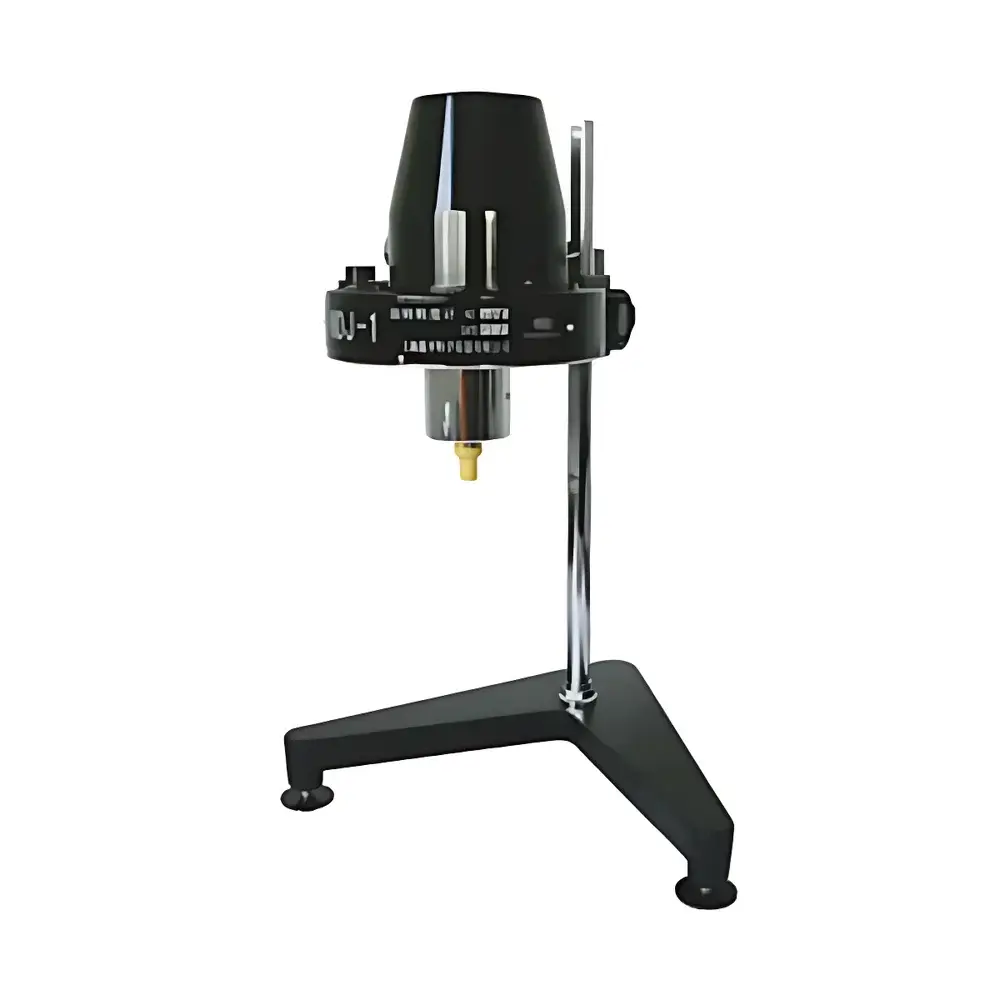
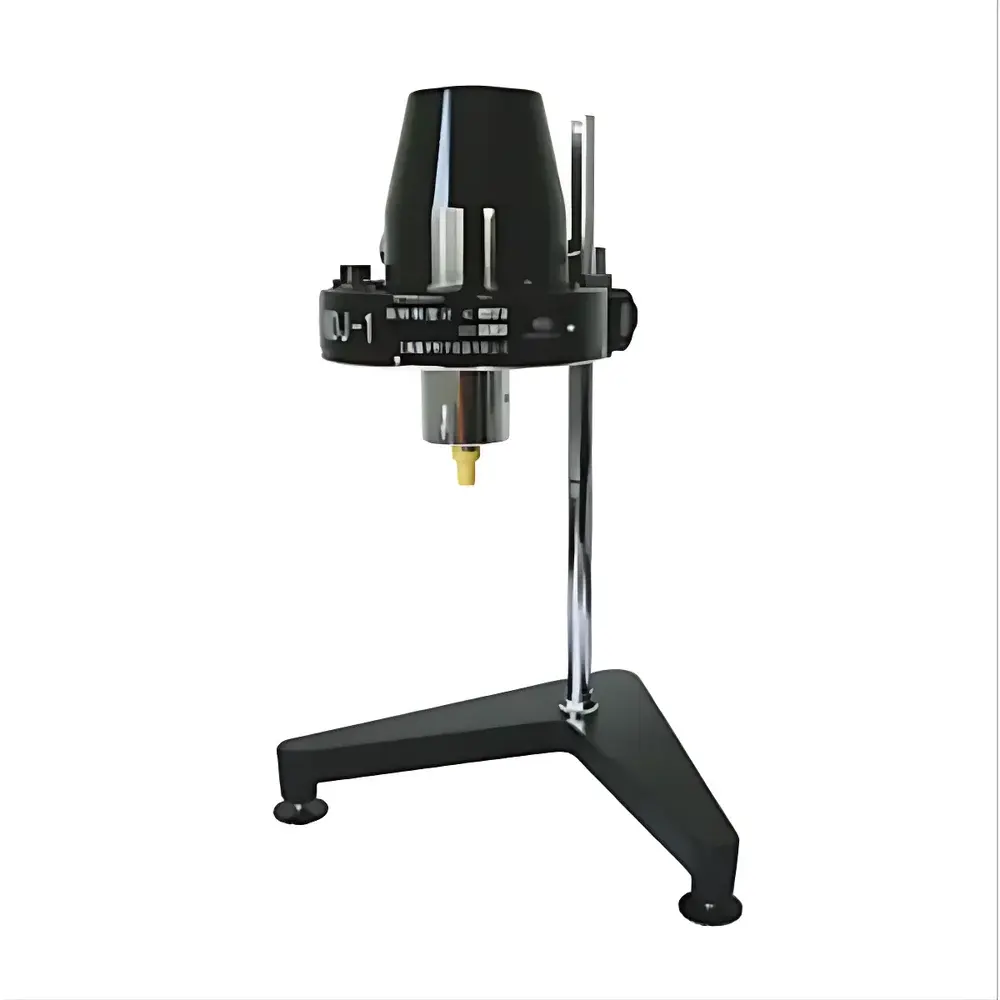
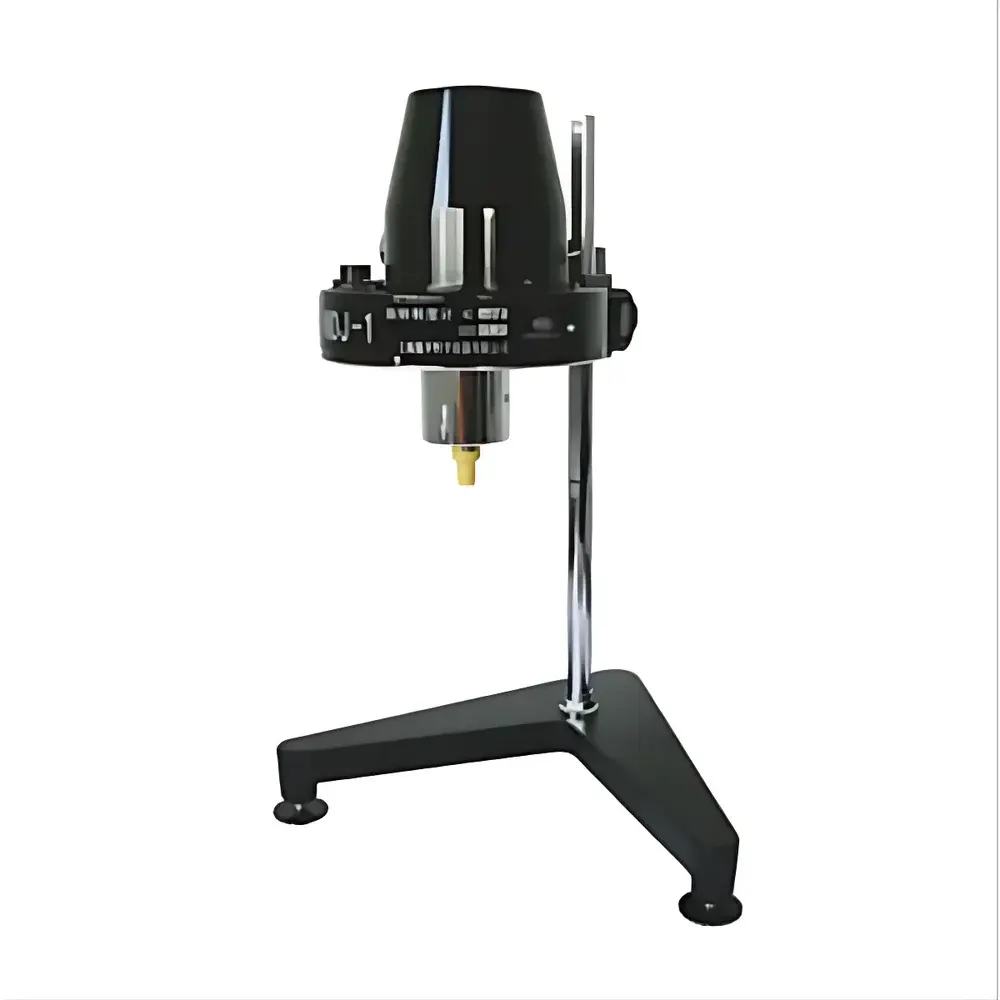
MyiP NDJ-1 Rotational Viscometer
| Brand | MyiP |
|---|---|
| Origin | Shanghai, China |
| Manufacturer Type | Authorized Distributor |
| Product Origin | Domestic (China) |
| Model | NDJ-1 |
| Instrument Type | Benchtop Rotational Viscometer |
| Operating Environment | Ambient Temperature |
| Viscosity Range | 1–1×10⁵ mPa·s |
| Accuracy | ±5% (for Newtonian fluids) |
| Rotors | No. 0 (optional), No. 1–4 |
| Rotational Speeds | 6, 12, 30, 60 rpm |
| Compliance | GB/T 265–1988 |
| Dimensions | 280 × 290 × 450 mm |
| Sample Temperature Control | External bath required (no integrated Peltier or heater) |
Overview
The MyiP NDJ-1 Rotational Viscometer is a mechanically robust, analog-digital hybrid benchtop instrument engineered for precise and repeatable viscosity measurement of Newtonian and near-Newtonian liquids under ambient laboratory conditions. Based on the classical coaxial cylinder (Couette) principle, the NDJ-1 determines dynamic viscosity by measuring the torque required to rotate a spindle—selected from a standardized set of five geometrically defined rotors—at fixed angular velocities in a stationary sample. Its design adheres to the fundamental metrological framework outlined in GB/T 265–1988, the Chinese national standard equivalent to ISO 3219 and ASTM D2196 for rotational viscometry. While not equipped with active temperature control, the NDJ-1 is routinely deployed in conjunction with external thermostatic baths to ensure thermal stability—a prerequisite for reliable inter-laboratory comparison and process-relevant data generation.
Key Features
- Four discrete rotational speeds (6, 12, 30, and 60 rpm) enable systematic shear-rate profiling across low- to medium-viscosity regimes.
- Five interchangeable spindles (rotors No. 0–4) provide extended dynamic range coverage—from low-viscosity solvents (1 mPa·s) to highly viscous polymer solutions and pastes (up to 1×10⁵ mPa·s).
- Analog pointer display coupled with digital speed indication ensures intuitive real-time readout without software dependency.
- Benchtop-fixed architecture minimizes mechanical drift and enhances long-term operational stability during routine QC workflows.
- Compliance with GB/T 265–1988 supports traceable calibration using certified mineral oil standards and facilitates alignment with regional regulatory documentation requirements.
- Modular rotor mounting system allows rapid interchange without tools, reducing cross-contamination risk and downtime between samples.
Sample Compatibility & Compliance
The NDJ-1 is validated for homogeneous, non-aerated, non-particulate Newtonian liquids—including lubricating oils, syrups, resins, coatings, and pharmaceutical suspensions within specified shear-rate limits. It is not suitable for thixotropic, rheopectic, or strongly shear-thinning non-Newtonian systems where time-dependent or rate-dependent behavior dominates. For such materials, a controlled-stress rheometer with oscillatory capability is recommended. All measurements must be conducted at thermally stabilized conditions; deviations exceeding ±0.5 °C significantly affect reported values due to the intrinsic temperature sensitivity of viscosity (typically –1% to –3% per °C for organic liquids). The instrument satisfies basic GLP documentation needs when paired with manual logbooks and calibrated reference oils traceable to NIM (National Institute of Metrology, China).
Software & Data Management
The NDJ-1 operates as a standalone hardware platform without embedded firmware or proprietary software. Data acquisition is manual: users record pointer deflection (scale units), select corresponding calibration constants from the included rotor/speed lookup table, and compute absolute viscosity (mPa·s) using linear conversion formulas. This analog-first architecture eliminates cybersecurity vulnerabilities, reduces validation overhead, and aligns with legacy QA environments where electronic records are not mandated. For laboratories requiring digital archiving, third-party USB microscope cameras or document scanners may be used to capture scale readings, and spreadsheets can be configured to automate unit conversion and uncertainty propagation per GUM (Guide to the Expression of Uncertainty in Measurement) principles.
Applications
- Quality assurance of industrial lubricants and transformer oils per GB/T 265–1988 protocols.
- In-process viscosity monitoring of food emulsions (e.g., salad dressings, sauces) during formulation development.
- Batch release testing of topical pharmaceutical gels and ointments where Newtonian approximation holds at low shear.
- Educational demonstration of Newton’s law of viscosity in university physical chemistry and chemical engineering laboratories.
- Supplier qualification of raw material viscosity specifications in paint, ink, and adhesive manufacturing.
FAQ
Does the NDJ-1 support temperature-controlled measurements?
No—the NDJ-1 lacks an integrated temperature sensor, heating/cooling element, or PID controller. Accurate temperature-dependent studies require coupling with an external circulating bath and independent thermometer verification.
What is the minimum sample volume required for each rotor?
Rotor No. 1–4 require ≥20 mL in a standard 60-mm-diameter sample container; No. 0 rotor (optional) is designed for volumes as low as 5 mL but necessitates specialized geometry verification.
Can the NDJ-1 measure yield stress or thixotropy?
No—it provides only steady-state shear viscosity at discrete rates and cannot resolve yield points, creep compliance, or time-sweep recovery behavior.
Is calibration traceable to international standards?
Yes—when performed using NIM-certified silicone oil standards (e.g., Cannon N47 or similar), calibration satisfies national metrological traceability requirements under CNAS accreditation frameworks.
How often should mechanical zero adjustment be performed?
Before each measurement session, and immediately after rotor changes or transport-induced vibration—verified via unloaded spindle rotation at 6 rpm yielding a zero-scale reading within ±0.2 divisions.



