
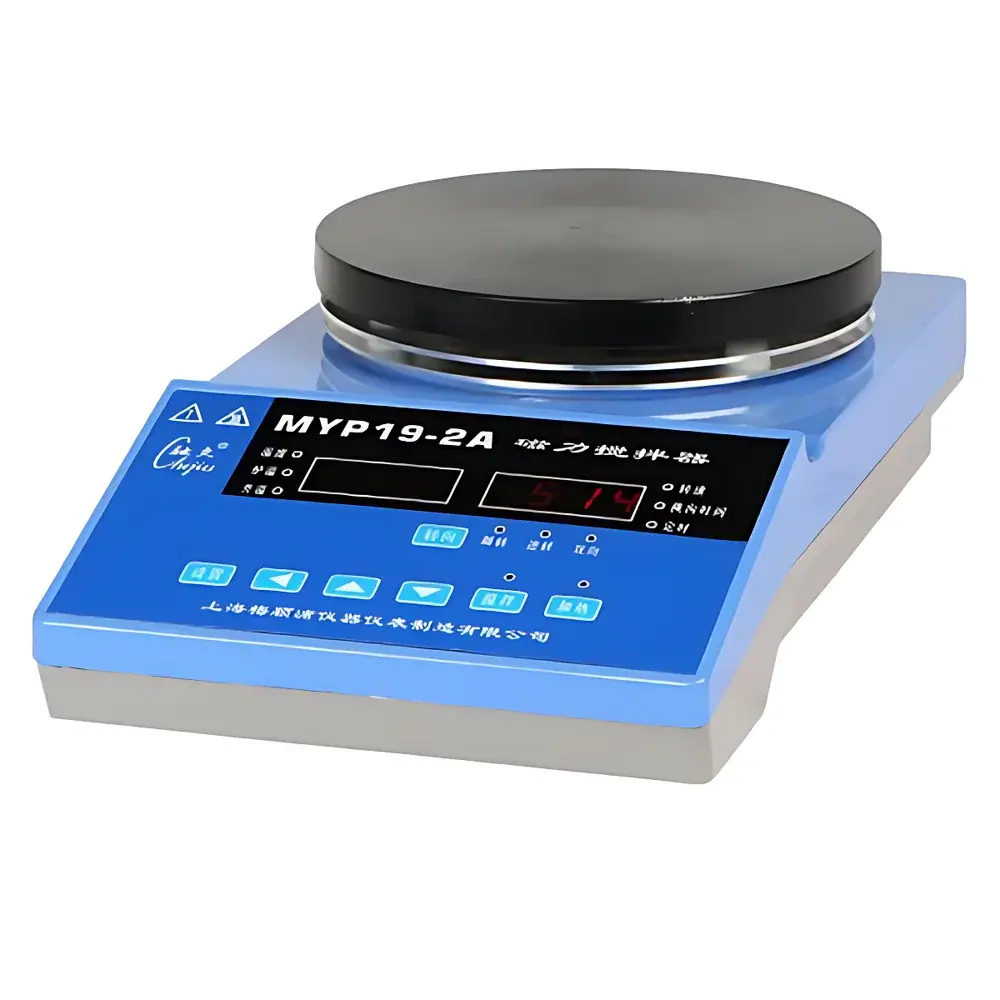
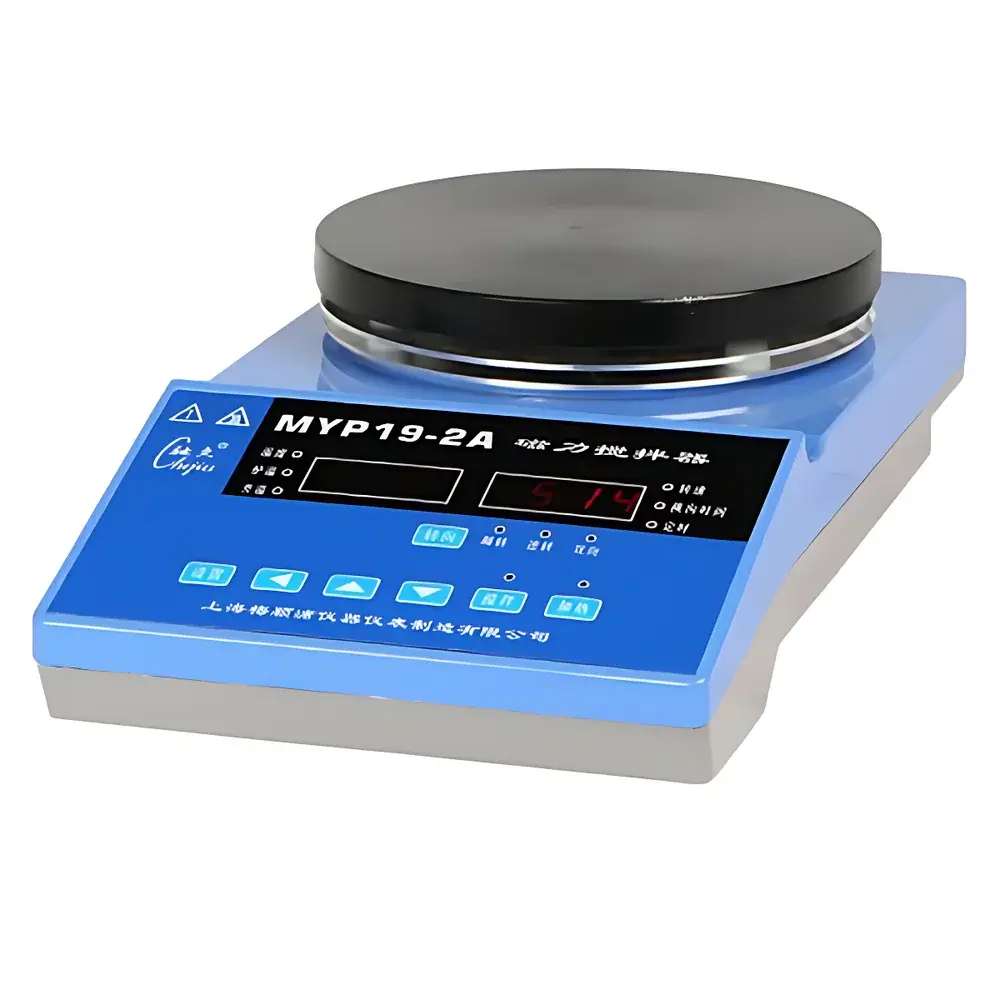
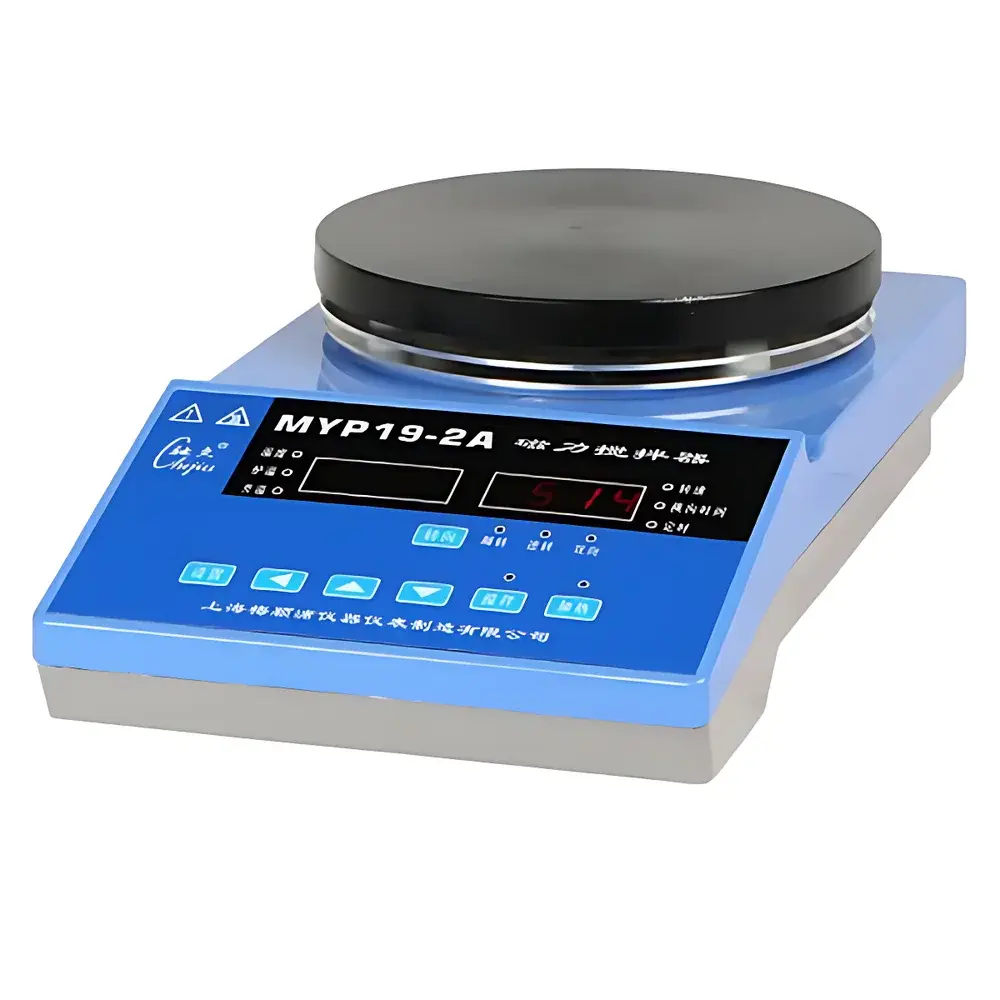
MyPu MYP19-2A Bidirectional Magnetic Stirrer with Integrated Heating
| Brand | MyPu |
|---|---|
| Model | MYP19-2A |
| Type | Magnetic Stirrer |
| Max Stirring Volume | 10 L |
| Speed Range | 50–1500 rpm |
| Heating Temperature Range | Up to 350 °C (adjustable) |
| Heating Power | 1000 W |
| Stirring Torque | 130 mN·m |
| Temperature Control Accuracy | ±0.5 °C |
| Bidirectional Switching Interval | 30–1999 s |
| Timer Range | Up to 9999 min |
| Stir Bar Max Length | 80 mm |
| Heater Plate Diameter | Ø200 mm |
| Dimensions (L×W×H) | 375 × 220 × 110 mm |
| Weight | 4.8 kg |
| Power Supply | AC 220 V ±10% |
| Sensor Type | External PT100 probe |
Overview
The MyPu MYP19-2A Bidirectional Magnetic Stirrer with Integrated Heating is an engineered solution for laboratories requiring precise, reproducible mixing under controlled thermal conditions. Designed around the principles of magnetic coupling and resistive heating, this instrument employs a high-torque permanent magnet drive system—powered by a brushless DC motor—to rotate ferromagnetic stir bars within vessels without mechanical shaft penetration. The integrated aluminum alloy heating plate delivers uniform thermal distribution across its Ø200 mm surface, enabling rapid and stable temperature ramping up to 350 °C. Unlike conventional unidirectional stirrers, the MYP19-2A implements programmable bidirectional rotation logic: users can define forward, reverse, or alternating rotational sequences, with fully adjustable switching intervals (30–1999 seconds). This capability supports advanced suspension homogenization, particle dispersion, and reaction kinetics studies where directional shear reversal mitigates sedimentation or improves mass transfer efficiency.
Key Features
- Microprocessor-controlled speed regulation ensures consistent rotational output across the full 50–1500 rpm range, with minimal drift under load variations.
- Dual-mode thermal control: PID-regulated heating with external PT100 sensor feedback enables ±0.5 °C accuracy and repeatable setpoint tracking.
- High-efficiency 1000 W heating element embedded in a cast-aluminum plate provides rapid thermal response and long-term stability at elevated temperatures.
- Programmable bidirectional operation allows user-defined forward/reverse cycles—including dwell time per direction—supporting complex mixing protocols.
- Large-capacity design accommodates vessels up to 10 L volume, compatible with standard laboratory glassware (e.g., beakers, flasks, jacketed reactors).
- LED display interface presents real-time speed, temperature, timer, and status indicators; intuitive keypad navigation simplifies parameter entry and recall.
- Robust mechanical architecture includes vibration-damping feet, reinforced housing, and thermal overload protection for continuous-duty operation.
Sample Compatibility & Compliance
The MYP19-2A is suitable for aqueous, organic, and viscous non-corrosive media commonly encountered in chemical synthesis, pharmaceutical formulation, materials science, and quality control laboratories. It supports stir bars up to 80 mm in length and delivers sufficient torque (130 mN·m) to maintain rotation in solutions with viscosities up to ~5000 mPa·s (dependent on vessel geometry and bar design). While not certified for hazardous area use, the unit complies with IEC 61010-1:2010 safety standards for laboratory electrical equipment. Its temperature and timing functions support documentation requirements aligned with GLP and GMP workflows when paired with external data loggers or validated software interfaces.
Software & Data Management
The MYP19-2A operates as a standalone instrument with no proprietary software dependency. All operational parameters—including speed, temperature, timer duration, and bidirectional cycle settings—are stored in non-volatile memory and retained after power cycling. For audit-trail compliance in regulated environments, users may integrate the unit with third-party data acquisition systems via analog voltage outputs (0–10 V) for speed and temperature signals (when equipped with optional analog interface module). The external PT100 input supports traceable calibration against NIST-traceable reference standards, facilitating routine verification per ISO/IEC 17025 requirements.
Applications
- Controlled-temperature synthesis of polymers, nanoparticles, and metal-organic frameworks (MOFs), where bidirectional stirring prevents localized agglomeration.
- Standardized dissolution testing in pharmaceutical QC labs, complying with USP & Ph. Eur. methodologies requiring defined agitation profiles.
- Preparation of homogeneous catalyst suspensions prior to catalytic hydrogenation or cross-coupling reactions.
- Accelerated aging studies of battery electrolytes and lubricants under thermal stress with dynamic mixing.
- Cell culture media preparation and buffer equilibration where gentle yet thorough mixing avoids foaming or shear-induced protein denaturation.
- Educational demonstrations of fluid dynamics, heat transfer, and process control principles in undergraduate chemistry and chemical engineering labs.
FAQ
Does the MYP19-2A support external temperature probes?
Yes—it accepts standard PT100 sensors (2-wire or 3-wire configuration) via a dedicated input port, enabling accurate vessel-bottom or immersion-point temperature monitoring.
Can the bidirectional function be disabled to operate in fixed-direction mode?
Yes—the instrument defaults to unidirectional operation unless bidirectional mode is explicitly enabled and configured via the control panel.
Is the heating plate compatible with glass vessels having curved or irregular bases?
Optimal thermal transfer requires flat-bottomed containers; concave or rounded bases may reduce heating efficiency and compromise temperature uniformity.
What maintenance is required for long-term reliability?
Routine cleaning of the heating plate surface and periodic inspection of stir bar integrity are recommended; no internal lubrication or motor servicing is required due to the brushless DC design.
Does the unit meet electromagnetic compatibility (EMC) requirements for shared lab environments?
It conforms to EN 61326-1:2013 for laboratory equipment, minimizing radiated and conducted emissions during simultaneous multi-instrument operation.



