
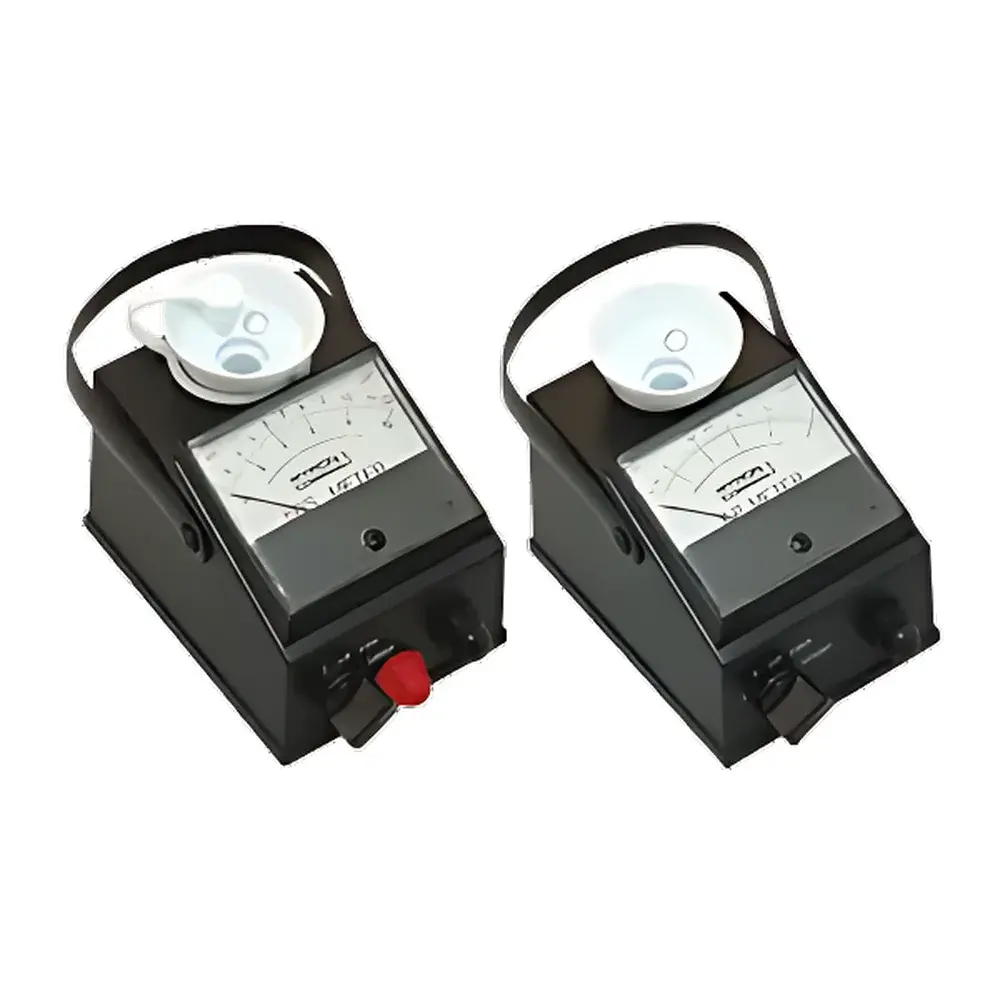
MyronL EP/512M5/EP10 Analog Conductivity and Resistivity Meter
| Brand | MyronL |
|---|---|
| Origin | USA |
| Model | EP/512M5/EP10 |
| Conductivity Ranges | 0–0.5 µS, 0–5 µS, 0–50 µS, 0–500 µS, 0–5000 µS, 0–10 mS, 0–100 mS, 0–1000 mS, 0–10,000 µS |
| Resistivity Range | 2–30 MΩ |
| Accuracy | ±2% of full scale (all ranges) |
| Automatic Temperature Compensation | 10–71 °C |
| Power | 9 V alkaline battery (≈2000 measurements/year) |
| Electrode Type | Maintenance-free conductive cell |
| Compliance | Designed for field and lab use in accordance with ASTM D1125 and ISO 7888 principles |
Overview
The MyronL EP/512M5/EP10 Analog Conductivity and Resistivity Meter is a rugged, field-deployable electrochemical instrument engineered for reliable measurement of aqueous solution conductivity and resistivity across multiple decades of magnitude. Based on the fundamental principle of two-electrode AC conductance measurement—employing a fixed-frequency sinusoidal excitation signal to minimize polarization effects—the meter delivers stable, repeatable readings without requiring frequent recalibration. Its analog needle-display architecture eliminates digital noise susceptibility and provides immediate visual trend interpretation, making it especially suited for educational laboratories, industrial process spot-checking, water treatment facilities, and environmental field surveys where power infrastructure is limited or transient. Unlike digital meters dependent on microprocessor-based compensation algorithms, the EP series implements passive analog temperature compensation circuitry aligned with the standard NaCl-based conductivity vs. temperature curve (0.021 °C⁻¹), ensuring traceable consistency with ASTM D1125 and ISO 7888 reference methodologies.
Key Features
- Rugged analog panel meter design with precision-movement galvanometer—resistant to mechanical shock, humidity, and ambient electromagnetic interference
- Manual range selection across nine calibrated conductivity scales (0.5 µS to 10,000 µS) and one resistivity scale (2–30 MΩ), enabling optimized resolution per application
- Maintenance-free graphite or stainless-steel conductivity cells with integrated temperature sensor—no electrolyte refills, no membrane replacements, no electrode polishing required
- Interchangeable pH electrode compatibility (via standard BNC connector) supports dual-parameter verification in quality control workflows
- True automatic temperature compensation (ATC) over 10–71 °C using a built-in thermistor—calibrated to match the thermal coefficient of common aqueous electrolytes
- Low-power operation via single 9 V alkaline battery, rated for approximately 2,000 measurements annually under typical usage conditions
Sample Compatibility & Compliance
The EP/512M5/EP10 is validated for use with low-to-moderate ionic strength aqueous solutions including deionized water, boiler feedwater, reverse osmosis permeate, cooling tower blowdown, hydroponic nutrient solutions, and municipal wastewater effluents. It is not intended for highly viscous, suspended-solid-laden, or non-aqueous media. The instrument conforms to the measurement geometry and cell constant definitions specified in ASTM D1125 (Standard Test Methods for Electrical Conductivity and Resistivity of Water) and ISO 7888 (Water quality — Determination of electrical conductivity). While not a GLP/GMP-certified system per se, its analog architecture inherently avoids software-related validation burdens; documentation of calibration checks, range selection, and ATC settings satisfies basic audit requirements under ISO/IEC 17025 Clause 6.4 for non-automated instrumentation.
Software & Data Management
As a fully analog, non-digital instrument, the EP/512M5/EP10 does not incorporate firmware, internal memory, or data logging capabilities. This design eliminates cybersecurity vulnerabilities, software obsolescence, and regulatory complications associated with electronic records (e.g., FDA 21 CFR Part 11 compliance). Users record measurements manually in bound logbooks or LIMS-integrated paper forms, with each reading annotated by operator ID, date/time, sample ID, selected range, and observed needle position. Calibration verification is performed using certified NIST-traceable KCl standard solutions (e.g., 0.001 M, 0.01 M, 0.1 M), and results are documented per internal SOPs. Optional MyronL calibration accessories—including portable dry-cell simulators and temperature-controlled calibration baths—are available to support metrological traceability.
Applications
- Field verification of ultrapure water resistivity in semiconductor fab utilities
- Routine monitoring of ion exchange resin exhaustion in pharmaceutical water systems
- Educational demonstration of Kohlrausch’s law and electrolyte dissociation behavior
- Quick-check validation of RO membrane integrity in desalination pilot plants
- Process troubleshooting in electroplating bath chemistry control
- Environmental site assessment of groundwater salinity gradients
FAQ
Does the EP/512M5/EP10 require annual recalibration?
No formal annual recalibration is mandated; however, users must perform functional verification before each measurement session using at least one certified KCl standard solution appropriate to the selected range.
Can the meter measure conductivity in seawater (≈50 mS/cm)?
No—the maximum range is 10,000 µS (10 mS/cm); seawater exceeds this limit and requires a high-range digital meter or dilution protocol.
Is the temperature compensation adjustable or fixed?
Fixed, based on the standardized NaCl thermal coefficient (0.021 °C⁻¹); no user adjustment is possible or recommended.
What is the cell constant of the standard conductive cell?
The default cell constant is 1.0 cm⁻¹, optimized for general-purpose aqueous measurements; alternative cells (0.1 or 10 cm⁻¹) are available as accessories.
Can the battery be replaced in the field without tools?
Yes—the rear battery compartment features a snap-fit cover accessible with a coin or flathead screwdriver; no soldering or disassembly is required.




