
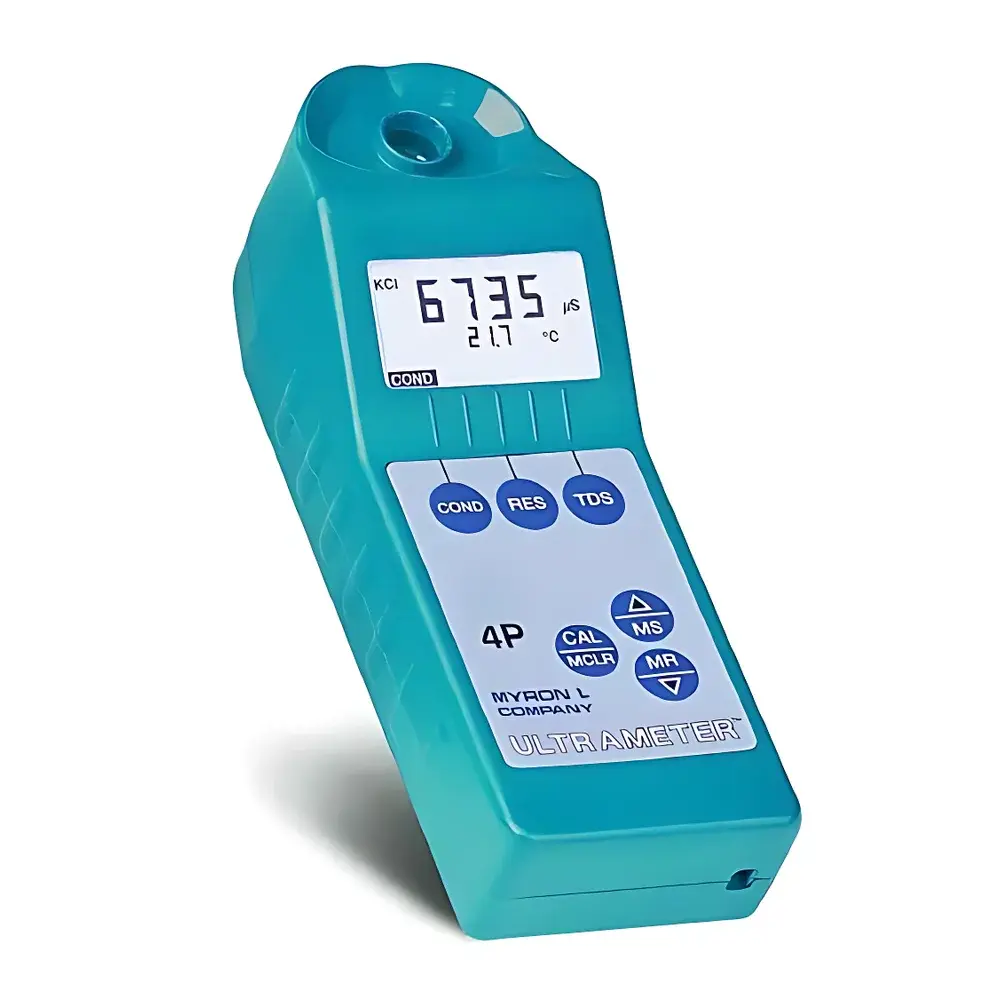
MYRONL Ultrameter 4P Portable 4-Parameter Conductivity Meter
| Brand | MYRONL |
|---|---|
| Origin | USA |
| Model | Ultrameter 4P |
| Portability | Portable |
| Conductivity Range | 0–200 mS/cm |
| TDS Range | 0–9999 ppm |
| Resistivity Range | 10 kΩ·cm – 30 MΩ·cm |
| Salinity Range | Not applicable (dedicated conductivity/TDS/resistivity/temperature model) |
| Temperature Range | 0–71 °C |
| Accuracy | ±1% of reading |
| Minimum Conductivity Resolution | 0.01 µS/cm |
| Enclosure Rating | IP67 (NEMA 6) |
| Data Storage | 20 points with timestamp |
| Auto-Temperature Compensation | Yes (0–71 °C) |
| Electrode Design | Integrated, field-replaceable dual-cell conductivity sensor with built-in temperature probe |
Overview
The MYRONL Ultrameter 4P is a rugged, handheld 4-parameter conductivity meter engineered for precision field and laboratory measurement of aqueous solutions across industrial, environmental, pharmaceutical, and municipal water quality applications. Based on four-electrode (4P) conductometric principle—employing two current electrodes and two potential-sensing electrodes—the instrument eliminates polarization effects and contact resistance errors inherent in traditional 2-electrode systems. This architecture ensures high reproducibility and stability when measuring ultra-pure water (up to 18.2 MΩ·cm), process rinse water, cooling tower fluids, wastewater effluents, and saline brines—all without electrode swapping or manual range selection. The device operates on the fundamental relationship between solution conductivity (σ), temperature (T), and dissolved ion concentration, applying NIST-traceable algorithms for automatic temperature compensation (ATC) per ASTM D1125 and ISO 7888 standards.
Key Features
- Rugged IP67-rated housing: Fully sealed against dust and submersion up to 1 meter for 30 minutes; certified to NEMA 6 specifications for harsh environments.
- Integrated 4-electrode conductivity cell: Dual-current and dual-potential electrode configuration minimizes polarization drift and enables accurate measurements from 0.01 µS/cm (ultrapure water) to 200 mS/cm (high-salinity brines).
- True multi-range auto-scaling: Seamless switching between µS/cm, mS/cm, ppm (TDS), kΩ·cm, and MΩ·cm units without manual intervention—optimized for dynamic field conditions.
- Single-hand operability: Ergonomic design with large backlit LCD, tactile sealed membrane keys, and integrated sample cup for rapid, spill-free testing.
- Onboard data integrity: Stores 20 measurement records with date/time stamp, conductivity, TDS, resistivity, and temperature values—exportable via optional IR interface (not Bluetooth or USB).
- Factory-calibrated sensor system: Pre-characterized dual-cell assembly with NIST-traceable calibration certificates; field recalibration supported using standard KCl solutions (e.g., 1413 µS/cm, 12.88 mS/cm).
Sample Compatibility & Compliance
The Ultrameter 4P is validated for use with deionized water, reverse osmosis permeate, boiler feedwater, semiconductor rinse baths, wastewater influent/effluent, and seawater-diluted process streams. It complies with ASTM D1125 (Standard Test Methods for Electrical Conductivity of Water), ISO 7888 (Water Quality — Determination of Electrical Conductivity), and USP (Water Conductivity) for pharmaceutical purified water qualification. While not FDA 21 CFR Part 11 compliant out-of-the-box (lacking electronic signature and audit trail functionality), its measurement traceability supports GLP/GMP documentation workflows when paired with controlled calibration logs and manual record-keeping per internal SOPs.
Software & Data Management
The instrument operates autonomously without PC connectivity. All data are stored locally in non-volatile memory with real-time timestamping. No proprietary software is required for basic operation. For integration into LIMS or QA/QC reporting systems, users may manually transcribe readings or employ third-party IR-to-serial adapters (e.g., IrDA-compliant receivers) to capture ASCII-formatted output. Calibration history, date/time settings, and unit preferences are retained through battery replacement. Firmware updates are not user-accessible; service-level updates require authorized MYRONL technical support.
Applications
- Pharmaceutical water systems: Monitoring conductivity of Purified Water (PW) and Water for Injection (WFI) per USP Stage 1–3 testing protocols.
- Power generation: Routine verification of condensate purity and demineralizer effluent conductivity in steam cycle chemistry control programs.
- Microelectronics manufacturing: Validation of ultrapure rinse water resistivity (>15 MΩ·cm) prior to wafer processing steps.
- Municipal water treatment: Field assessment of source water, coagulation/flocculation efficiency, and distribution system integrity via TDS and conductivity trends.
- Food & beverage production: Sanitation validation (CIP rinse conductivity), ingredient dissolution monitoring, and brine concentration control.
- Environmental field surveys: Rapid profiling of surface water conductivity as an indicator of ionic load, agricultural runoff, or saltwater intrusion.
FAQ
Does the Ultrameter 4P support pH or ORP measurement?
No. The 4P model measures only conductivity, TDS, resistivity, and temperature. For pH and ORP capability, select the Ultrameter 6P variant.
Is the conductivity cell replaceable in the field?
Yes. The integrated 4-electrode sensor module is a user-serviceable component with standardized threading and O-ring seal—no soldering or calibration reset required after replacement.
What temperature compensation algorithm does it use?
Linear ATC per DIN EN 27888, with default coefficient α = 2.0 %/°C, adjustable within ±2.5 %/°C to match specific solution behavior (e.g., NaCl vs. CaSO₄).
Can it measure seawater salinity directly?
Not natively. While conductivity and temperature data can be used to calculate Practical Salinity Scale (PSS-78) values externally, the 4P lacks built-in salinity conversion firmware.
How often should calibration be performed?
Daily verification is recommended for critical applications; full 2-point calibration (low and high standards) every 24–48 hours under continuous use, or per ISO/IEC 17025 method validation requirements.





