
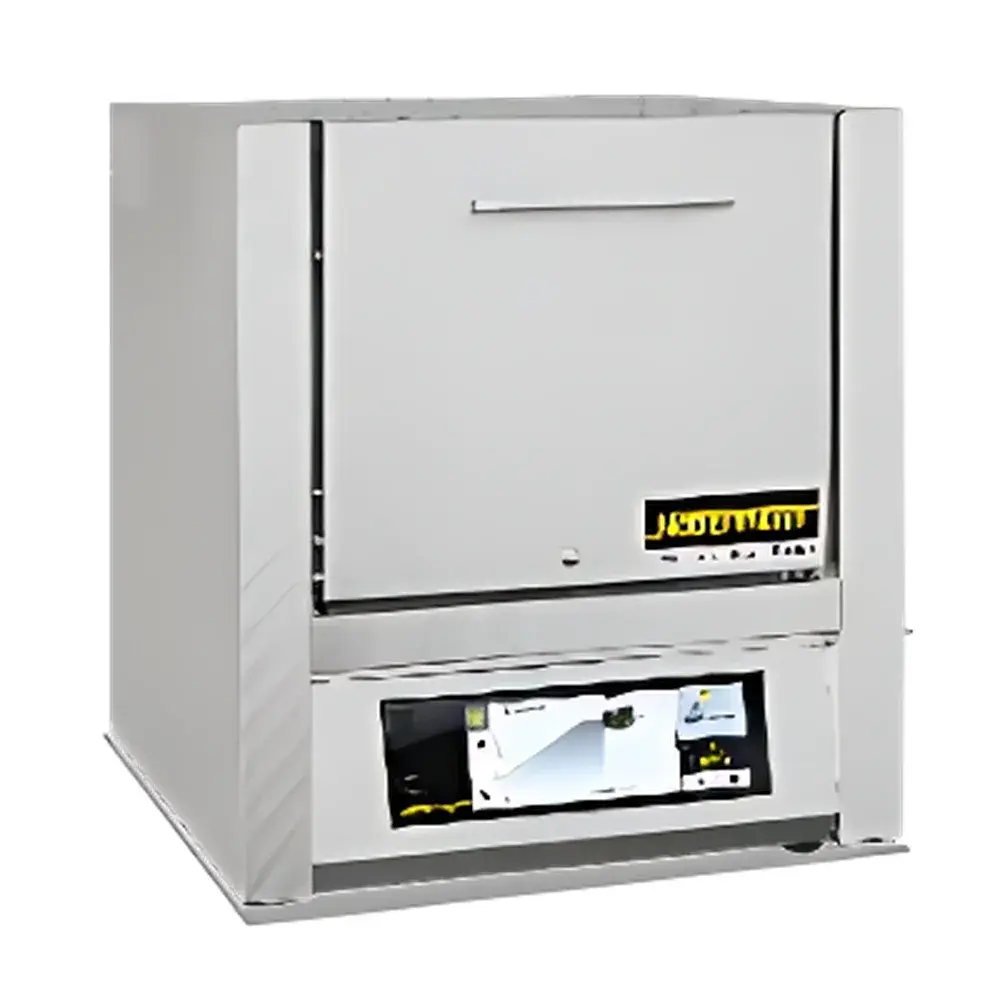
Nabertherm L, LT 9/11/SKM High-Performance Muffle Furnace
| Brand | Nabertherm |
|---|---|
| Origin | Germany |
| Model | L, LT 9/11/SKM |
| Max. Operating Temperature | 1100 °C |
| Internal Dimensions (W×D×H) | 230 × 240 × 170 mm |
| Chamber Volume | 9 L |
| External Dimensions (W×D×H) | 490 × 505 × 580 mm |
| Electrical Connection | 1-phase, 230 V, 50 Hz |
| Power Rating | 3.4 kW |
| Net Weight | 90 kg |
| Heating Element | Embedded Ceramic-Sheathed Resistance Wire |
| Chamber Material | Corrosion-Resistant Ceramic Fiber Liner with Smooth, Non-Shedding Surface |
| Door Options | Front-Opening (L) or Top-Opening (LT) |
| Air Inlet | Adjustable on Door |
| Exhaust Port | Rear Wall-Mounted |
| Safety | Dual Overtemperature Protection per EN 60519-2 (Class 2 Thermal Protection), Cut-off Setpoint Configurable |
| Optional Accessories | Catalytic Exhaust System, Forced-Air Exhaust Fan, Gas Inlet Fitting for Inert/Reducing Atmospheres |
Overview
The Nabertherm L, LT 9/11/SKM is a precision-engineered laboratory muffle furnace designed for controlled high-temperature thermal processing in research, quality control, and industrial testing environments. Operating up to 1100 °C, it employs a four-sided ceramic-sheathed heating element configuration embedded directly into the furnace chamber wall — a design that ensures exceptional temperature uniformity (±5 °C at 1000 °C across the working zone) while simultaneously isolating the resistive elements from corrosive process atmospheres. The chamber features a monolithic, smooth-surface ceramic fiber liner — free of binders and particulate shedding — making it suitable for ashing, calcination, heat treatment, and residue analysis where contamination control is critical. Its robust stainless steel housing (brushed finish) provides mechanical stability and long-term corrosion resistance, while the thermally insulated door — available in front-opening (L) or top-opening (LT) configurations — supports ergonomic workflow integration and operator safety during high-temperature loading/unloading.
Key Features
- Four-directional ceramic-encapsulated heating system for homogeneous thermal distribution and extended heater service life in aggressive chemical environments
- Smooth, binder-free ceramic fiber chamber liner — compliant with ISO 8573-1 Class 4 for particulate cleanliness — minimizes ash carryover and ensures reproducible gravimetric results
- Dual-stage overtemperature protection per EN 60519-2: primary controller-based limit and independent mechanical cut-off (Class 2 thermal protection), both field-configurable
- Adjustable air inlet integrated into the door assembly and rear-mounted exhaust port enable precise atmosphere management for oxidative, inert, or mildly reducing processes
- Low-noise solid-state relay (SSR) power control eliminates mechanical switching wear and supports stable PID regulation with <1 °C setpoint deviation under steady-state conditions
- Optional gas inlet port (M10 thread) on rear wall facilitates integration with manual or automated gas dosing systems for nitrogen, argon, or forming gas applications
- Modular exhaust interface supports add-on catalytic converters or forced-draft fans — certified for continuous operation under DIN EN 13121-3 ventilation guidelines
Sample Compatibility & Compliance
The L, LT 9/11/SKM accommodates crucibles, boats, and sample holders up to 230 mm wide × 240 mm deep × 170 mm high, supporting standard ASTM E1529, ISO 1171, and USP ash content determination protocols. Its inert chamber surface and absence of metallic protrusions prevent catalytic interference during organic matrix decomposition. The furnace meets CE marking requirements under the EU Machinery Directive 2006/42/EC and Electromagnetic Compatibility Directive 2014/30/EU. For GLP/GMP-regulated laboratories, optional data logging modules provide audit-ready temperature profiles with timestamped event records traceable to NIST-traceable references.
Software & Data Management
While the base model operates via intuitive rotary encoder + LCD interface with programmable ramp/soak profiles (up to 16 segments), optional Nabertherm THERMCONTROL software enables PC-based monitoring, remote parameter adjustment, and CSV-exportable thermal history files. When paired with an external USB data logger (e.g., Testo 176 T4), the system satisfies FDA 21 CFR Part 11 requirements for electronic records — including user authentication, change tracking, and digital signature support. All firmware updates are distributed via Nabertherm’s secure customer portal and validated against IEC 62443-3-3 cybersecurity benchmarks.
Applications
- Gravimetric ash analysis per ASTM D2879, ISO 6297, and EPA Method 2540E
- Calcination of catalyst precursors, metal oxides, and battery cathode materials
- Thermal cleaning of quartz and ceramic labware in semiconductor QA labs
- Pre-treatment of filters and membranes prior to TOC or IC analysis
- Heat treatment validation for medical device sterilization packaging components
- Research-scale sintering of functional ceramics under controlled ambient conditions
FAQ
What is the maximum recommended continuous operating temperature?
The furnace is rated for continuous operation at 1100 °C; however, sustained use above 1050 °C may reduce ceramic fiber liner service life. Recommended maintenance interval is 500 operating hours at ≥1000 °C.
Can this furnace be used under inert gas atmosphere?
Yes — the rear-mounted gas inlet (M10) and adjustable door vent allow safe purging with nitrogen or argon. For full inert operation, optional gas flow meter and pressure regulator kits are available.
Is the chamber liner replaceable in the field?
Yes — the ceramic fiber liner is modular and secured with high-temp refractory screws; replacement can be completed by trained personnel using standard tools and Nabertherm’s documented procedure A-9112.
Does the furnace support ramp-and-soak programming?
Yes — the built-in controller stores up to 16 program steps with independent ramp rates (0.1–60 °C/min), soak times (0–99 h 59 min), and loop repetition (1–999 cycles).
What safety certifications does the unit hold?
It complies with EN 60519-2 (electrical safety for industrial electroheating equipment), EN 61000-6-3 (EMC emission limits), and carries CE, UKCA, and EAC markings for global deployment.



