
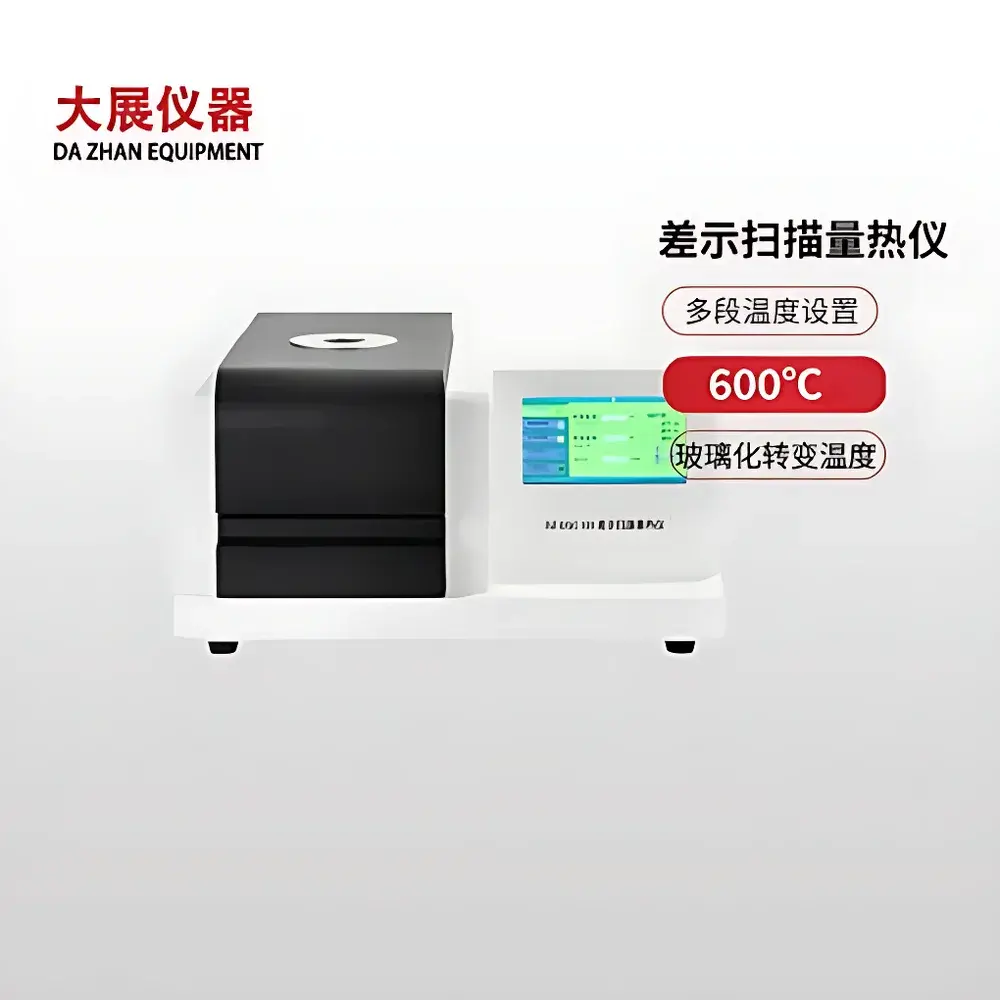
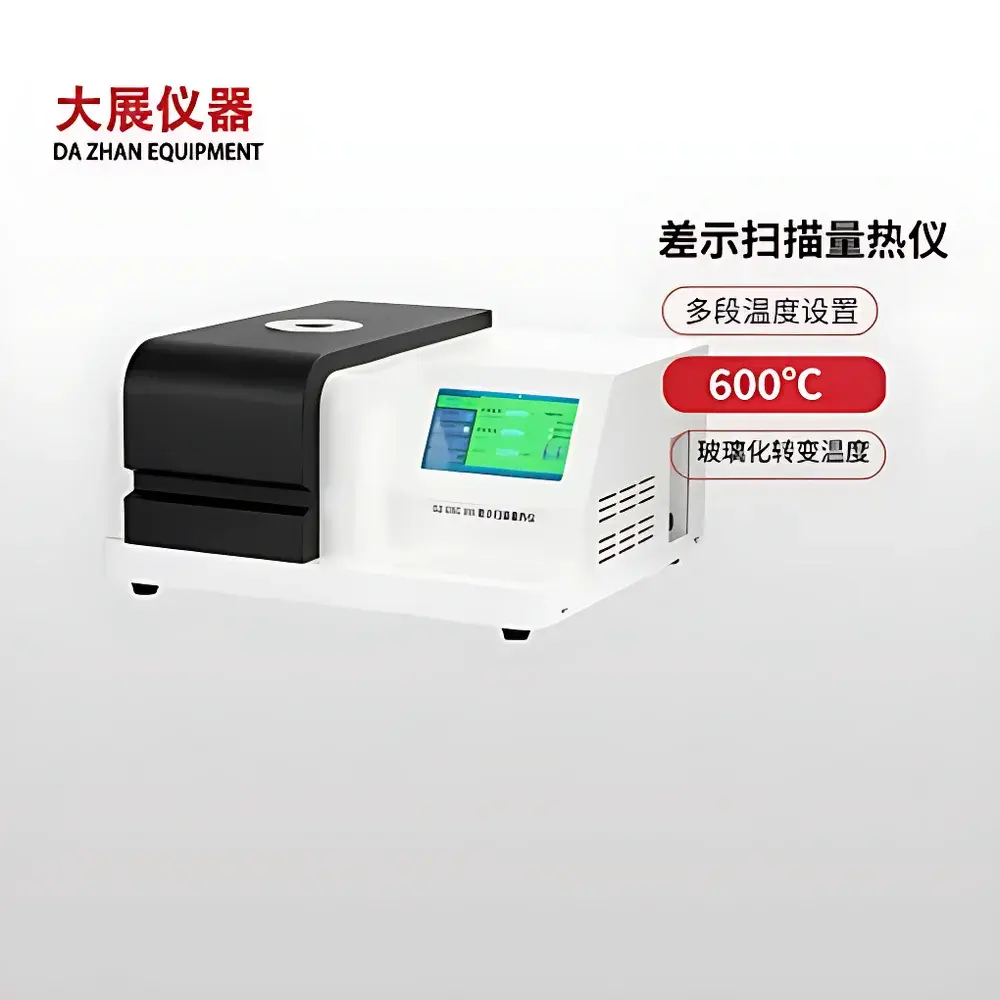
Nanjing Dazhan DZ-DSC300 Intelligent Temperature-Controlled Differential Scanning Calorimeter
| Brand | Nanjing Dazhan |
|---|---|
| Origin | Jiangsu, China |
| Manufacturer Type | Manufacturer |
| Origin Category | Domestic |
| Model | DZ-DSC300 |
| Sample Capacity | Single |
| Instrument Type | DSC |
| Temperature Range | Ambient to 600 °C |
| Heating/Cooling Rate | 0.1–100 K/min |
| Temperature Accuracy | ±0.001 °C |
| DSC Signal Range | 0 to ±600 mW |
| DSC Resolution | 0.01 µW |
| DSC Sensitivity | 0.001 mW |
| Atmosphere Control | Dual-gas automatic switching (0–300 mL/min, ≤5 MPa) |
| Temperature Calibration Standards | Indium, Tin, Lead included |
| Display | 7-inch 24-bit color LCD touchscreen |
| Interface | Standard USB |
| Power Supply | AC 220 V / 50 Hz (customizable) |
Overview
The Nanjing Dazhan DZ-DSC300 is a high-precision, intelligent temperature-controlled differential scanning calorimeter engineered for rigorous thermal characterization of solid and semi-crystalline materials. Based on the heat-flux DSC principle, it measures the difference in heat flow between a sample and an inert reference as both are subjected to identical, programmable temperature profiles under controlled atmospheric conditions. This enables quantitative determination of endothermic and exothermic transitions—including glass transition (Tg), melting onset and enthalpy (ΔHfus), crystallization behavior, oxidative induction time (OIT), reaction kinetics, and thermal stability—across a broad operational range from ambient to 600 °C. Its integrated furnace architecture features enhanced thermal insulation and minimized thermal lag, contributing to superior baseline stability and signal-to-noise ratio—critical for detecting subtle thermal events in polymers, pharmaceuticals, composites, and energetic materials.
Key Features
- Optimized heat-flux furnace design with high thermal mass and low thermal inertia, delivering improved resolution, reproducibility, and long-term baseline stability.
- Multi-segment programmable temperature control supporting up to six independent heating, isothermal, and cooling steps—enabling complex thermal protocols such as modulated DSC (MDSC)-compatible sequences.
- Dual-control operation: fully functional via intuitive 7-inch 24-bit color touchscreen interface or external PC-based software—both modes synchronized in real time with identical parameter access and logging capability.
- Advanced sensor assembly utilizing thermal fusion bonding (replacing conventional spot welding), resulting in higher thermal coupling efficiency and sub-milliwatt sensitivity (0.001 mW) with 0.01 µW resolution.
- Electromagnetic interference (EMI)-hardened signal acquisition circuitry, including multi-layer shielding and differential analog front-end design, ensuring robust performance in shared laboratory environments.
- Automated dual-gas switching system with mass-flow-controlled delivery (0–300 mL/min, pressure-rated to 5 MPa), supporting inert (N2, Ar), oxidative (O2, air), or reactive atmospheres without manual valve intervention.
Sample Compatibility & Compliance
The DZ-DSC300 accommodates standard aluminum, gold, or hermetic stainless-steel crucibles (typically 25–50 µL volume), enabling analysis of powders, films, fibers, granules, and small-volume liquids (e.g., drug formulations, electrolytes). It complies with core thermal analysis standards including ASTM E794 (melting point), ASTM E1356 (Tg and heat capacity), ISO 11357 series (polymer characterization), and USP (thermal analysis in pharmaceutical development). Built-in calibration routines support multi-point temperature verification using certified reference materials (indium, tin, lead), traceable to NIST-traceable standards. Data integrity features align with GLP/GMP documentation requirements, including user-accessible audit trails, electronic signature support, and secure export of raw .dsc and ASCII files.
Software & Data Management
The instrument is supplied with proprietary Windows-compatible analysis software featuring real-time data visualization, baseline correction (tangent, sigmoidal, polynomial), peak integration, kinetic modeling (Ozawa-Flynn-Wall, Kissinger), and comparative overlay tools. All measurement parameters—including gas flow rate, purge timing, and temperature ramp profiles—are stored with metadata (operator ID, timestamp, instrument serial number) in encrypted project files. Export formats include CSV, PDF reports, and XML-compliant output for LIMS integration. The software supports FDA 21 CFR Part 11-compliant configuration when deployed in regulated environments, including role-based access control, electronic signatures, and immutable audit logs for all method modifications and result exports.
Applications
- Pharmaceutical R&D: Polymorph screening, amorphous content quantification, excipient compatibility studies, and stability-indicating assay development.
- Polymer science: Crystallinity assessment (via ΔHfus normalization), crosslink density estimation, degradation onset evaluation, and processing window optimization.
- Materials engineering: Phase diagram validation, alloy solidus/liquidus mapping, composite interfacial reaction analysis, and battery electrode thermal runaway profiling.
- Food science: Starch gelatinization, fat crystallization kinetics, protein denaturation thermodynamics, and shelf-life prediction models.
- Quality control laboratories: Batch-to-batch consistency verification, raw material identity confirmation, and release testing per internal specifications or pharmacopoeial monographs.
FAQ
What reference materials are included for calibration?
Indium (Tm = 156.6 °C), tin (Tm = 231.9 °C), and lead (Tm = 327.5 °C) are supplied as certified standards for temperature calibration; enthalpy calibration is performed using high-purity indium.
Can the DZ-DSC300 operate under vacuum?
No—vacuum operation is not supported. The system is designed exclusively for positive-pressure gas environments (inert or oxidative) with automatic dual-gas switching.
Is the software compatible with Windows 11 and 64-bit architectures?
Yes—the latest version of the control and analysis software is validated for Windows 10 and Windows 11 (64-bit), requiring .NET Framework 4.8 and minimum 4 GB RAM.
Does the instrument meet ISO/IEC 17025 requirements for accredited testing labs?
While the hardware and software provide essential metrological functionality (traceable calibration, uncertainty estimation tools, and full data auditability), formal ISO/IEC 17025 accreditation requires lab-specific validation, uncertainty budgeting, and documented quality management procedures beyond instrument-level capabilities.
How is baseline drift corrected during extended isothermal holds?
The software implements adaptive baseline modeling using segmented polynomial fitting over user-defined regions, allowing manual or automated correction before peak integration—particularly critical for OIT and decomposition onset analysis.



