
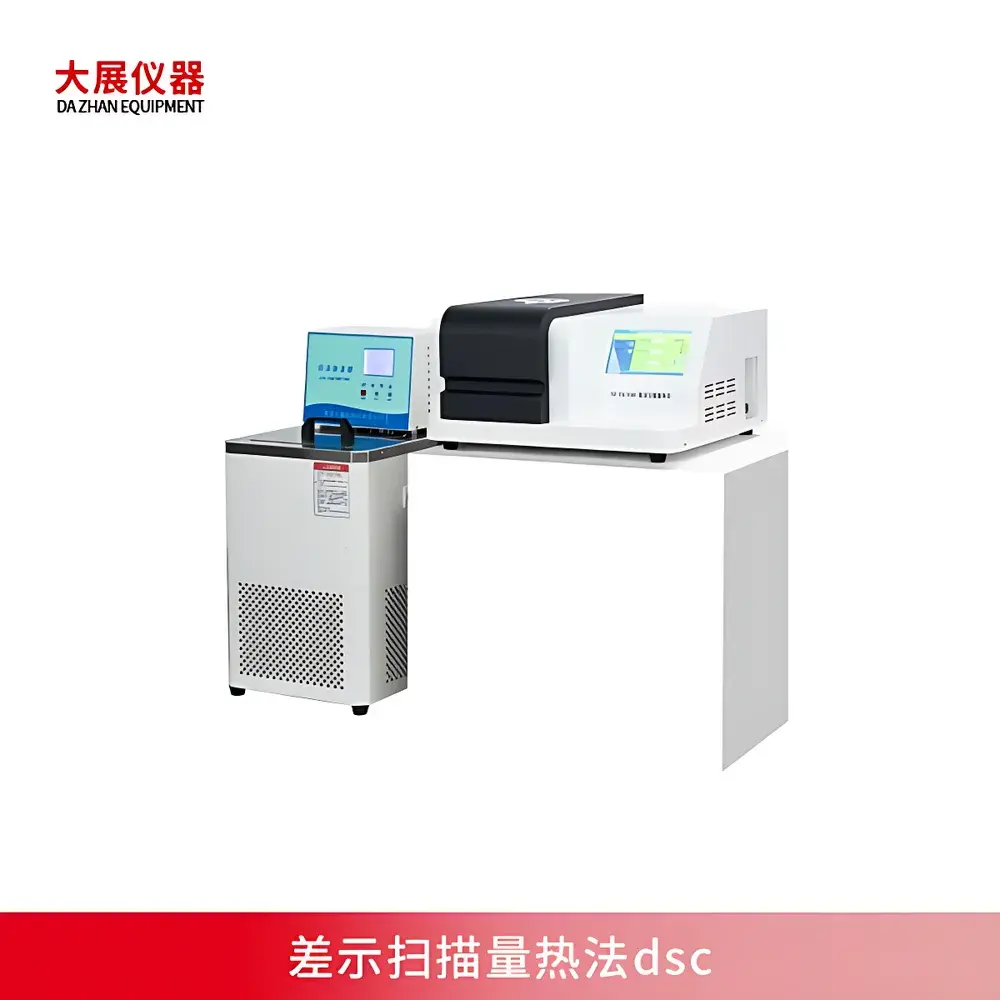
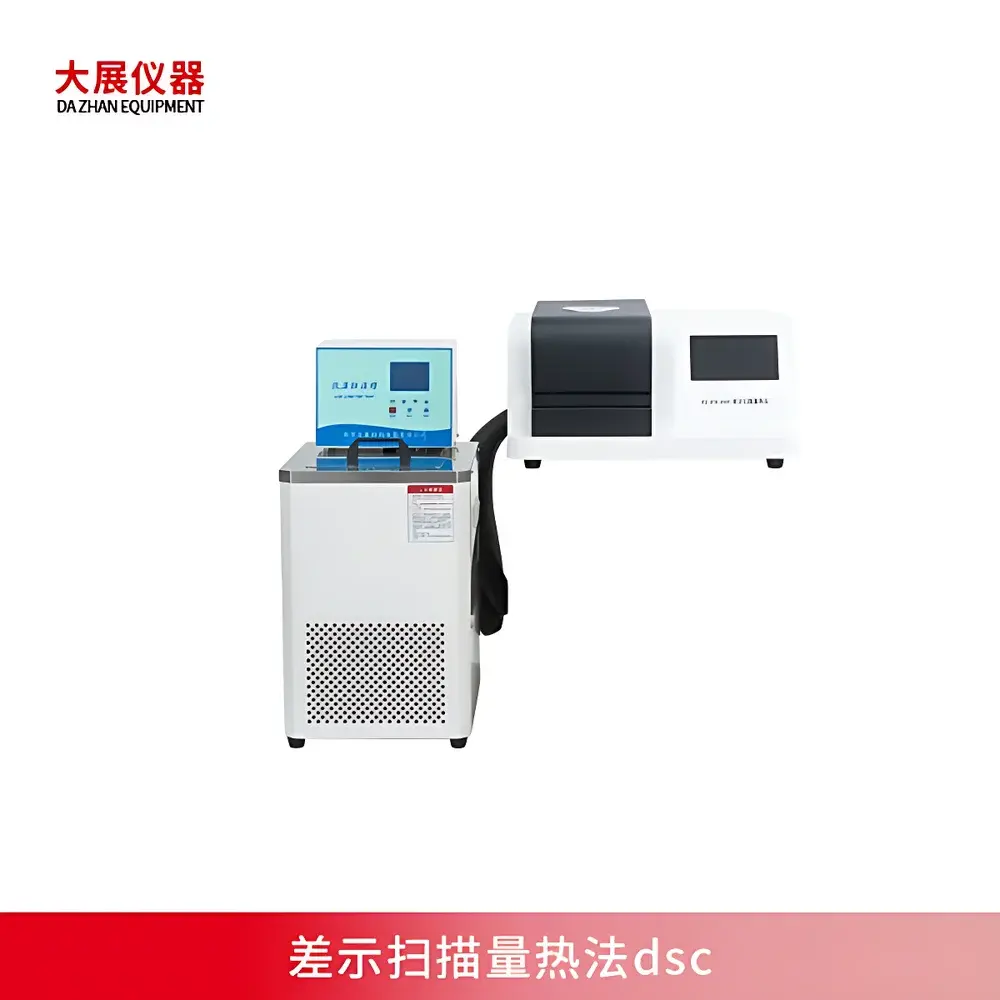
Nanjing Dazhan DZ-DSC300C Differential Scanning Calorimeter
| Brand | Nanjing Dazhan |
|---|---|
| Origin | Jiangsu, China |
| Manufacturer Type | Manufacturer |
| Product Category | Domestic |
| Model | DZ-DSC300C |
| Sample Capacity | Single |
| Instrument Type | Differential Scanning Calorimeter |
| Temperature Range | −40 to 600 °C |
| Heating/Cooling Rate | 0.1–100 °C/min (heating), 0.1–40 °C/min (cooling) |
| DSC Signal Range | 0 to ±600 mW |
| DSC Resolution | 0.01 µW |
| DSC Sensitivity | 0.001 mW |
| Temperature Stability | ±0.01 °C |
| Temperature Resolution | 0.01 °C |
| Atmosphere Control | Dual gas channels with auto-switching (0–300 mL/min, ≤5 MPa), plus dedicated purge/protect gas inlet |
| Power Supply | AC 220 V / 50 Hz (customizable) |
| Interface | Standard USB 2.0 with auto-recovery connection |
| Display | 7-inch 24-bit color LCD touchscreen |
| Thermal Program | Up to six programmable segments (ramp/hold/cool) |
| Calibration Standards Included | Indium, Tin, Lead |
Overview
The Nanjing Dazhan DZ-DSC300C Differential Scanning Calorimeter is a high-precision thermal analysis instrument engineered for quantitative measurement of heat flow differences between a sample and an inert reference as a function of temperature or time. Based on the heat-flux DSC principle, it employs a symmetrical twin-furnace design with integrated thermopile sensors to deliver high signal-to-noise ratio and exceptional baseline stability. The instrument is optimized for routine and research-grade applications in polymer science, pharmaceutical development, metallurgy, and advanced materials characterization—where accurate determination of thermal transitions, enthalpic changes, and kinetic parameters is essential under controlled atmospheric conditions.
Key Features
- Robust all-metal furnace architecture with optimized thermal mass distribution, ensuring superior baseline flatness and long-term thermal stability (±0.01 °C temperature fluctuation over extended runs).
- High-resolution thermal control system supporting programmable heating and cooling rates from 0.1 to 100 °C/min (heating) and 0.1 to 40 °C/min (cooling), enabling precise simulation of processing and storage conditions.
- 7-inch full-color LCD touchscreen interface with intuitive navigation, real-time curve overlay, and on-device data review—designed for operation without external PC dependency during routine analysis.
- Dual independent gas channel management with automatic switching logic; supports rapid transition between reactive (e.g., O2, air) and inert (e.g., N2, Ar) atmospheres, plus a dedicated protective gas inlet for oxidation-sensitive measurements.
- USB 2.0 communication interface with built-in fault-tolerant protocol: maintains data integrity during transient disconnections and resumes transmission automatically upon reconnection.
- Comprehensive thermal programming capability—including up to six user-defined ramp/hold/cool segments—with customizable dwell times, rate limits, and end-condition triggers for complex multi-step protocols.
Sample Compatibility & Compliance
The DZ-DSC300C accommodates standard aluminum, gold-plated aluminum, and high-pressure stainless-steel crucibles (up to 10 MPa rated), supporting solids, powders, gels, and small-volume liquids (≤30 mg typical). Its modular sensor platform ensures compatibility with optional accessories including high-sensitivity micro-furnaces and UV-curable sample holders. The system complies with core international thermal analysis standards, including ISO 11357 (plastics — DSC), ASTM E794 (melting and crystallization temperatures), and USP <1163> (thermal analysis in pharmaceutical development). All temperature calibration is traceable to NIST-certified reference materials (indium, tin, lead), and the instrument supports user-performed calibration verification per GLP/GMP documentation requirements.
Software & Data Management
Bundled with DZ-TA Analysis Suite v3.x, the instrument provides full data acquisition, peak integration, baseline correction (tangent, linear, polynomial), and kinetic modeling (Ozawa-Flynn-Wall, Kissinger). Raw data files are stored in ASCII-compatible .DTA format for third-party interoperability (e.g., TA Instruments Universal Analysis, Netzsch Proteus). Audit trail functionality records operator ID, method version, calibration history, and environmental logs—fully compliant with FDA 21 CFR Part 11 requirements when deployed with password-protected user roles and electronic signature modules. Export options include CSV, PDF reports with embedded metadata, and image-ready PNG/SVG plots.
Applications
- Determination of glass transition temperature (Tg), melting point (Tm), crystallization onset (Tc), and solid-solid phase transitions in polymers, composites, and ceramics.
- Quantification of specific heat capacity (Cp) via stepwise modulation or dual-scan methods.
- Oxidative stability assessment via Oxidation Induction Time (OIT) and Oxidation Induction Temperature (OITT) under dynamic oxygen environments.
- Reaction enthalpy and kinetics evaluation for curing, decomposition, and crosslinking processes—particularly relevant in epoxy resin formulation and battery electrode material development.
- Polymorph screening and batch-to-batch consistency verification in active pharmaceutical ingredient (API) manufacturing per ICH Q5A and Q5C guidelines.
- Thermal aging studies and shelf-life prediction using accelerated isothermal and non-isothermal protocols.
FAQ
What calibration standards are supplied with the DZ-DSC300C?
Indium (Tm = 156.60 °C), tin (Tm = 231.93 °C), and lead (Tm = 327.50 °C) reference metals are included for temperature and enthalpy calibration verification.
Can the instrument operate under vacuum or high-pressure conditions?
Standard configuration supports ambient pressure and inert/vacuum-purged modes. High-pressure operation (up to 10 MPa) requires optional sealed crucibles and reinforced gas delivery hardware—available as a factory-configured upgrade.
Is the software validated for regulated environments?
Yes—the DZ-TA Analysis Suite supports 21 CFR Part 11 compliance when configured with role-based access control, electronic signatures, and audit-trail archiving enabled per site-specific validation protocols.
What is the minimum detectable heat flow change?
The system achieves a DSC sensitivity of 0.001 mW and resolution of 0.01 µW, enabling detection of subtle thermal events such as secondary relaxations in amorphous polymers or low-enthalpy crystallization in semi-crystalline systems.
Does the instrument support modulated DSC (MDSC®) or TGA-DSC coupling?
The DZ-DSC300C is a conventional heat-flux DSC platform. MDSC and simultaneous TGA-DSC capabilities require separate instrumentation models with dedicated hardware architectures.



