
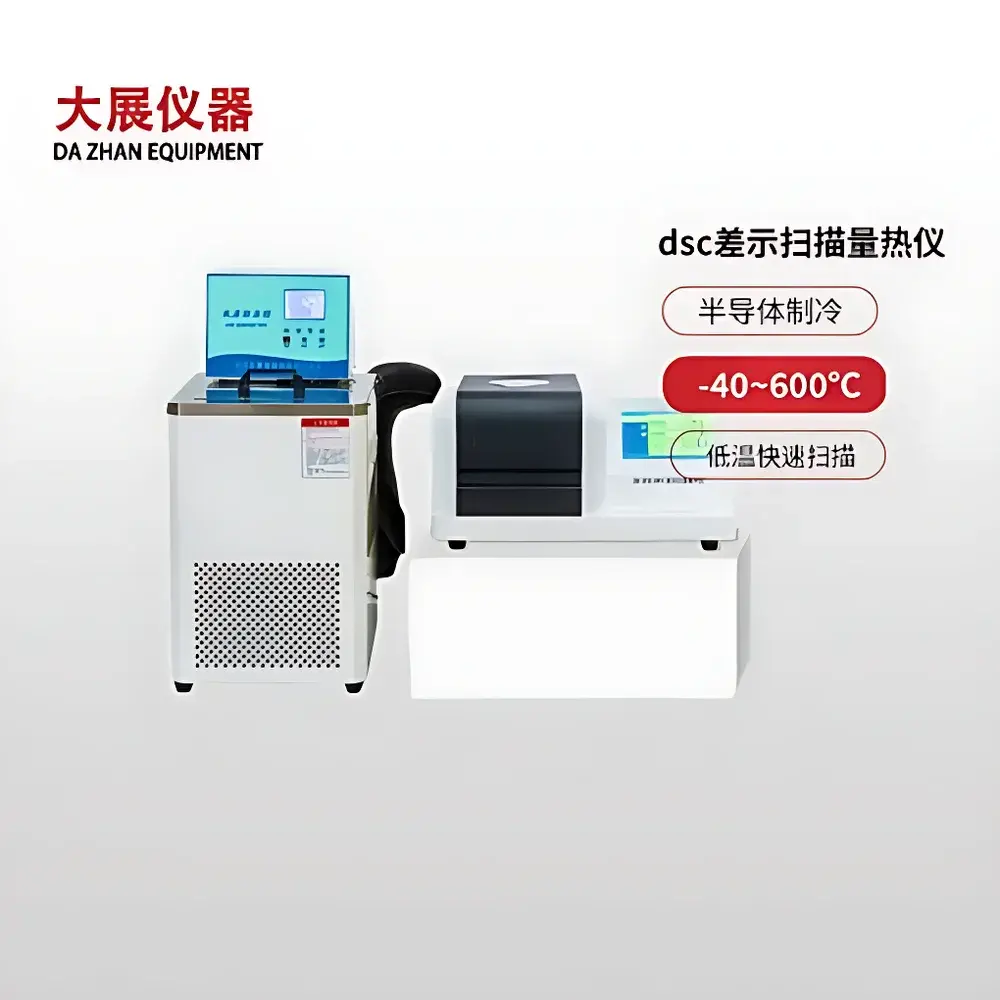
Nanjing Dazhan DZ-DSC300C Semiconductor-Cooled Differential Scanning Calorimeter
| Brand | Nanjing Dazhan |
|---|---|
| Origin | Jiangsu, China |
| Manufacturer Type | Direct Manufacturer |
| Country of Origin | China |
| Model | DZ-DSC300C |
| Sample Capacity | Single |
| Instrument Type | DSC |
| Temperature Range | −40 to 600 °C |
| Temperature Accuracy | ±0.01 °C |
| Heating/Cooling Rate | 0.1–100 K/min (heating), 0.1–40 K/min (cooling) |
| Temperature Precision | ±0.01 °C |
| Temperature Stability | ±0.01 °C |
| DSC Signal Range | 0 to ±600 mW |
| DSC Resolution | 0.01 µW |
| DSC Sensitivity | 0.001 mW |
| Atmosphere Control | Dual gas channels with auto-switching (including inert purge), max flow 300 mL/min, max pressure 5 MPa |
| Calibration Standards Included | Indium, Tin, Lead |
| Display | 7-inch 24-bit color capacitive touchscreen |
| Interface | Standard USB 2.0 with auto-reconnect capability |
| Power Supply | AC 220 V / 50 Hz (customizable) |
Overview
The Nanjing Dazhan DZ-DSC300C is a high-stability, semiconductor-cooled differential scanning calorimeter engineered for precise thermal characterization across a broad operational temperature range—from cryogenic conditions at −40 °C up to 600 °C. Unlike conventional DSC systems relying on liquid nitrogen or mechanical chillers, the DZ-DSC300C integrates solid-state thermoelectric cooling (Peltier) technology, enabling rapid, controllable, and maintenance-free sub-ambient cooling without cryogen handling or external refrigeration infrastructure. Its measurement principle follows heat-flux DSC methodology: differential heat flow between sample and reference pans is continuously monitored under programmable temperature ramps or isothermal holds, yielding quantitative data on enthalpy changes, phase transitions, and kinetic parameters. Designed for routine QC laboratories, R&D facilities, and academic thermal analysis workflows, the instrument complies with core methodological standards referenced in ASTM E794, ISO 11357, and USP <1163>, supporting GLP-compliant data acquisition when paired with validated software protocols.
Key Features
- Integrated semiconductor cooling module enabling stable operation down to −40 °C with no cryogens—reducing operational cost, safety risk, and footprint;
- Robust all-metal furnace architecture with optimized thermal mass and symmetric sensor design, delivering exceptional baseline flatness and long-term signal reproducibility;
- 7-inch high-resolution capacitive touchscreen interface (24-bit color) with intuitive icon-driven navigation, real-time curve preview, and on-device parameter editing;
- Dual independent gas control system with automatic switching between reactive and inert atmospheres (e.g., O2/N2), plus dedicated purge line for sample protection—gas flow adjustable from 0–300 mL/min with pressure tolerance up to 5 MPa;
- USB 2.0 communication port featuring hardware-level auto-recovery logic to maintain uninterrupted data streaming during host PC sleep, reboot, or transient connection loss;
- Full six-segment programmable temperature control—including ramp, hold, and step functions—with user-definable heating/cooling rates (0.1–100 K/min heating; 0.1–40 K/min cooling) and customizable isothermal dwell times.
Sample Compatibility & Compliance
The DZ-DSC300C accommodates standard aluminum, gold-plated aluminum, or hermetic stainless-steel crucibles (6.7 mm OD), supporting solids, powders, films, gels, and small-volume liquids (≤30 mg typical). Its thermal design ensures minimal thermal lag and uniform pan-to-furnace coupling, critical for accurate Tg, crystallization onset, and melting peak resolution. The system includes certified reference materials (indium, tin, lead) traceable to NIST SRMs, enabling user-performed temperature and enthalpy calibration per ISO 11357-1 requirements. Data integrity meets audit-ready criteria: raw thermograms, metadata (operator ID, timestamp, method file hash), and calibration logs are stored in open binary formats compatible with third-party analysis tools. When operated with compliant software configurations, the platform supports FDA 21 CFR Part 11–aligned electronic signatures and audit trails for regulated environments.
Software & Data Management
Control and analysis are performed via cross-platform desktop software (Windows/macOS/Linux) supporting real-time visualization, multi-curve overlay, baseline correction (tangent, linear, polynomial), peak integration (onset, peak, endset), and derivative thermogram generation. All methods are saved as encrypted XML files containing full instrument configuration, gas settings, and thermal program logic. Raw data export options include CSV (tabular heat flow vs. temperature/time), ASCII, and universal .QTX format for interoperability with OriginLab, MATLAB, or Thermo Scientific™ OMNIC. Software validation packages—including IQ/OQ documentation templates and performance verification test scripts—are available upon request for GMP or ISO 17025 laboratory accreditation.
Applications
- Determination of glass transition temperature (Tg) in polymers, amorphous pharmaceuticals, and food matrices;
- Quantification of melting enthalpy, crystallinity, and polymorphic form stability in APIs and excipients;
- Oxidative induction time (OIT) and oxidative induction temperature (OITT) assessment per ASTM D3895 and ISO 11357-6 for polymer stabilization studies;
- Curing kinetics analysis of thermosets using isothermal DSC and Kissinger/Acenes model fitting;
- Thermal stability profiling of battery electrode materials, catalysts, and nanocomposites under controlled atmospheres;
- Decomposition onset, reaction enthalpy, and phase separation behavior in multicomponent blends and eutectic systems.
FAQ
Does the DZ-DSC300C require liquid nitrogen or external chiller units?
No—its integrated Peltier cooling system eliminates dependency on cryogens or auxiliary refrigeration equipment.
Can the instrument perform both heating and cooling scans in a single run?
Yes—multi-segment programs support sequential heating, isothermal hold, and controlled cooling within one experiment.
Is temperature calibration traceable to international standards?
Yes—reference metals (In, Sn, Pb) with certified transition points are supplied; calibration procedures align with ISO 11357-1 Annex A.
What gas compatibility does the dual-channel system support?
Any two gases—including air, O2, N2, Ar, He, or synthetic air—with automatic switching and independent flow regulation.
How is data security ensured during long-duration experiments?
USB auto-reconnect prevents data loss during PC interruptions; all measurements are buffered onboard and synchronized post-reconnection.



