
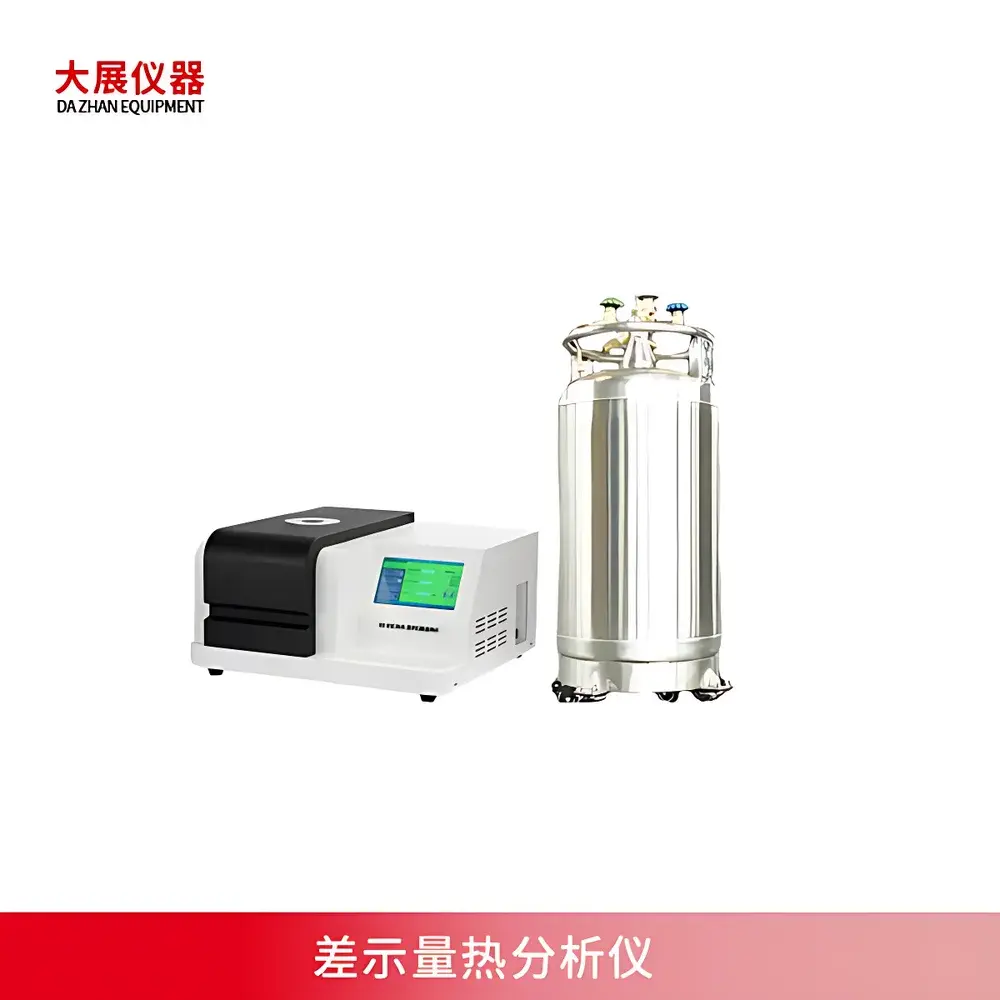
Nanjing Dazhan DZ-DSC300L Differential Scanning Calorimeter
| Brand | Nanjing Dazhan |
|---|---|
| Origin | Jiangsu, China |
| Manufacturer Type | Direct Manufacturer |
| Instrument Type | DSC |
| Model | DZ-DSC300L |
| Sample Capacity | Single-sample |
| Temperature Range | −170 °C to 600 °C |
| Heating/Cooling Rate | 0.1–100 K/min (heating), 0.1–40 K/min (cooling) |
| DSC Signal Range | 0 to ±600 mW |
| DSC Resolution | 0.01 µW |
| DSC Sensitivity | 0.001 mW |
| Temperature Stability | ±0.01 °C |
| Temperature Resolution | 0.001 °C |
| Atmosphere Control | Dual-gas auto-switching (N₂, Ar, O₂, or custom), flow rate 0–300 mL/min, max pressure ≤5 MPa |
| Thermal Program | Up to six segments (ramp/hold/cool), fully programmable |
| Display | 7-inch 24-bit color LCD touchscreen |
| Data Interface | Standard USB |
| Calibration Standards Included | Indium, Tin, Lead |
Overview
The Nanjing Dazhan DZ-DSC300L Differential Scanning Calorimeter is a high-precision thermal analysis instrument engineered for quantitative measurement of heat flow differences between a sample and inert reference as a function of temperature or time. It operates on the principle of power-compensated DSC, where independent heaters maintain equal temperatures in sample and reference crucibles while continuously adjusting differential power input to sustain thermal equilibrium. This architecture enables accurate determination of endothermic and exothermic transitions—including glass transition (Tg), melting (Tm), crystallization (Tc), solid-solid phase changes, oxidative induction time (OIT), and crosslinking enthalpies—with high baseline stability and reproducibility across wide thermal ranges.
Key Features
- Extended low-temperature capability down to −170 °C enabled by integrated mechanical cryocooler—eliminating reliance on liquid nitrogen while ensuring rapid, repeatable cooling cycles.
- Optimized furnace design with symmetrical thermal mass distribution and high-emissivity ceramic heating elements, delivering superior temperature homogeneity (<±0.01 °C drift over 30 min at isothermal conditions) and enhanced signal-to-noise ratio.
- True bidirectional control architecture: real-time operation via intuitive 7-inch 24-bit color LCD touchscreen interface or remote command through PC-based software—both supporting identical parameter sets and event logging.
- Programmable multi-segment thermal protocols (up to six ramp/hold/cool steps) with user-defined dwell times, rate limits, and gas-switch triggers synchronized to thermal events.
- Dual-gas atmosphere management system with automatic switching between two pre-configured gases (e.g., N₂ for inert analysis, O₂ for oxidation studies), precise mass-flow control (0–300 mL/min), and pressure-rated inlet up to 5 MPa for high-pressure applications.
- Onboard calibration verification using certified reference materials (Indium, Tin, Lead) traceable to NIST SRMs; supports user-initiated temperature and enthalpy calibration with audit-trail logging compliant with GLP requirements.
Sample Compatibility & Compliance
The DZ-DSC300L accommodates standard hermetic or vented aluminum, gold-plated, or high-purity graphite crucibles (6.7 mm OD, 40 µL volume), compatible with solids, powders, films, gels, and small-volume liquids (≤20 mg typical). Its sealed furnace chamber and gas-purged sensor head minimize moisture ingress and oxidative artifacts during low-T measurements. The instrument meets essential functional requirements outlined in ASTM E794 (melting and crystallization temperatures), ASTM E1356 (glass transition), ISO 11357 series (polymer characterization), and USP for thermal stability assessment of pharmaceutical excipients and APIs. Full electronic records—including method parameters, raw heat flow curves, metadata timestamps, and operator ID—are stored in vendor-neutral CSV and proprietary binary formats, supporting FDA 21 CFR Part 11 readiness when deployed with validated software and access controls.
Software & Data Management
Bundled Windows-compatible acquisition and analysis software provides real-time visualization of heat flow, temperature, and furnace power signals with adjustable scaling and overlay capabilities. Built-in algorithms support baseline correction (tangent, polynomial, or spline), peak integration (onset, peak, endset), kinetic modeling (Ozawa-Flynn-Wall, Kissinger), and Tg determination via midpoint or inflection methods. All data files include embedded instrument configuration logs, calibration history, and environmental metadata (ambient T/RH, gas composition). Export options include PDF reports with customizable templates, Excel-ready tabular outputs, and image exports (PNG, SVG) suitable for regulatory submissions. Audit trail functionality records all user actions—including method edits, data reprocessing, and calibration events—with immutable timestamps and operator attribution.
Applications
- Materials Science: Quantification of phase transformation enthalpies in shape-memory alloys, thermal hysteresis in ferroelectrics, and decomposition kinetics of metal-organic frameworks (MOFs).
- Polymers & Composites: Determination of cure onset temperature and degree of cure in epoxy resins; evaluation of thermal aging effects on polyolefin mechanical integrity via successive OIT measurements.
- Pharmaceutical Development: Solid-state characterization of polymorphs and amorphous dispersions; detection of residual solvent desorption events; stability-indicating assay for lyophilized biologics formulations.
- Food Science: Measurement of starch gelatinization enthalpy and retrogradation kinetics; lipid crystallization profiling in cocoa butter analogs; shelf-life prediction via accelerated oxidation testing under controlled O₂ partial pressures.
- Electrochemical Materials: Assessment of thermal runaway onset in cathode materials (e.g., NMC, LFP) and solid electrolytes; quantification of SEI formation enthalpy on lithiated anodes.
FAQ
What cooling method does the DZ-DSC300L use, and how does it compare to LN₂-cooled systems?
The instrument employs a closed-cycle mechanical cryocooler, enabling reliable sub-ambient operation to −170 °C without cryogen handling. Unlike LN₂ systems, it offers consistent cooling rates across repeated runs and eliminates consumable cost and logistical constraints—though maximum cooling rate (40 K/min) is lower than forced-LN₂ configurations.
Can the DZ-DSC300L perform simultaneous DSC-TGA coupling?
No—this is a standalone DSC platform. For hyphenated analysis, Nanjing Dazhan offers separate TGA and DSC instruments with synchronized start triggers and co-registered temperature bases, but true simultaneous measurement requires third-party modular coupling solutions.
Is the software compliant with 21 CFR Part 11 for regulated environments?
The base software supports electronic signatures, audit trails, and role-based access control. Full Part 11 compliance requires site-specific validation documentation, server-based deployment, and integration with enterprise identity management—services available through Nanjing Dazhan’s GxP Support Package.
How is temperature calibration verified, and what standards are supplied?
Three certified reference metals—Indium (156.6 °C), Tin (231.9 °C), and Lead (327.5 °C)—are included with each unit. Calibration routines follow ASTM E794 procedures, generating traceable reports with uncertainty estimates per ISO/IEC 17025 guidelines.
What maintenance intervals are recommended for long-term baseline stability?
Sensor cleaning and furnace inspection are advised every 1,000 operating hours or annually—whichever occurs first. Cryocooler oil replacement and refrigerant recharge are scheduled at 5,000-hour intervals by authorized service engineers.



