
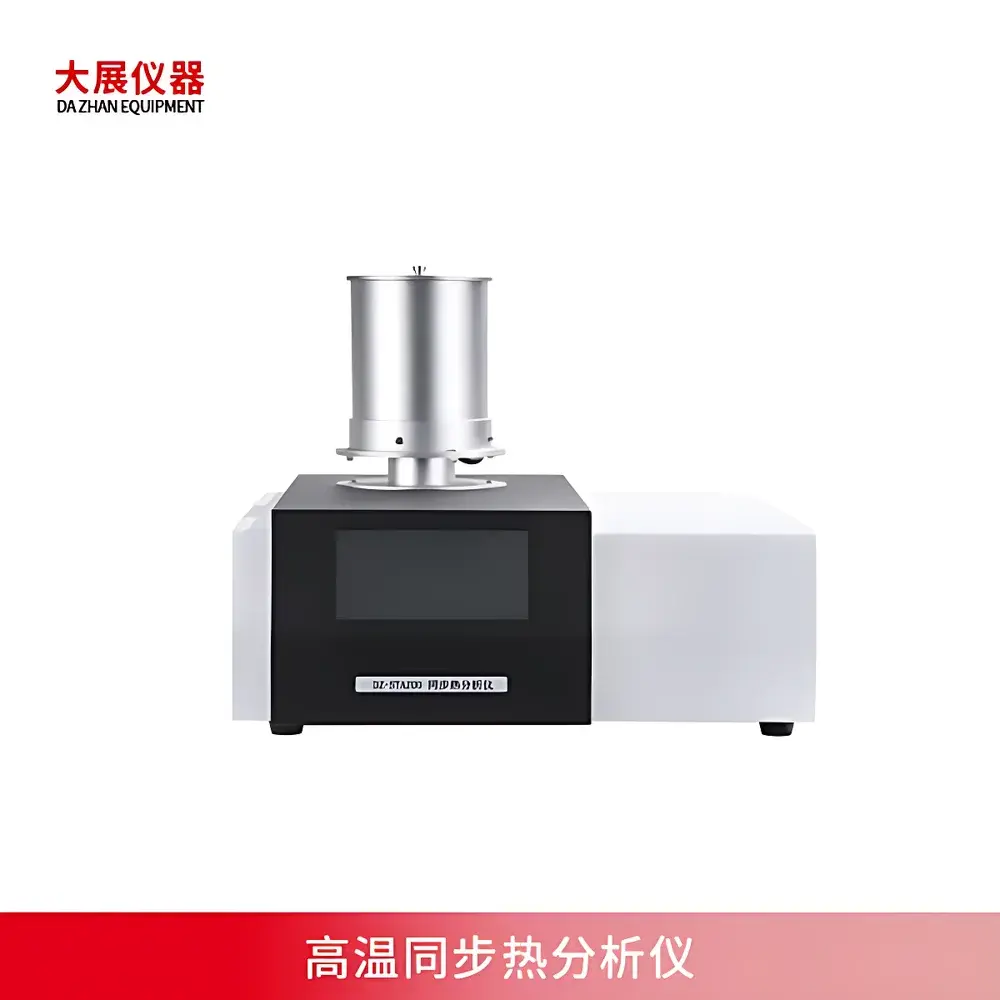
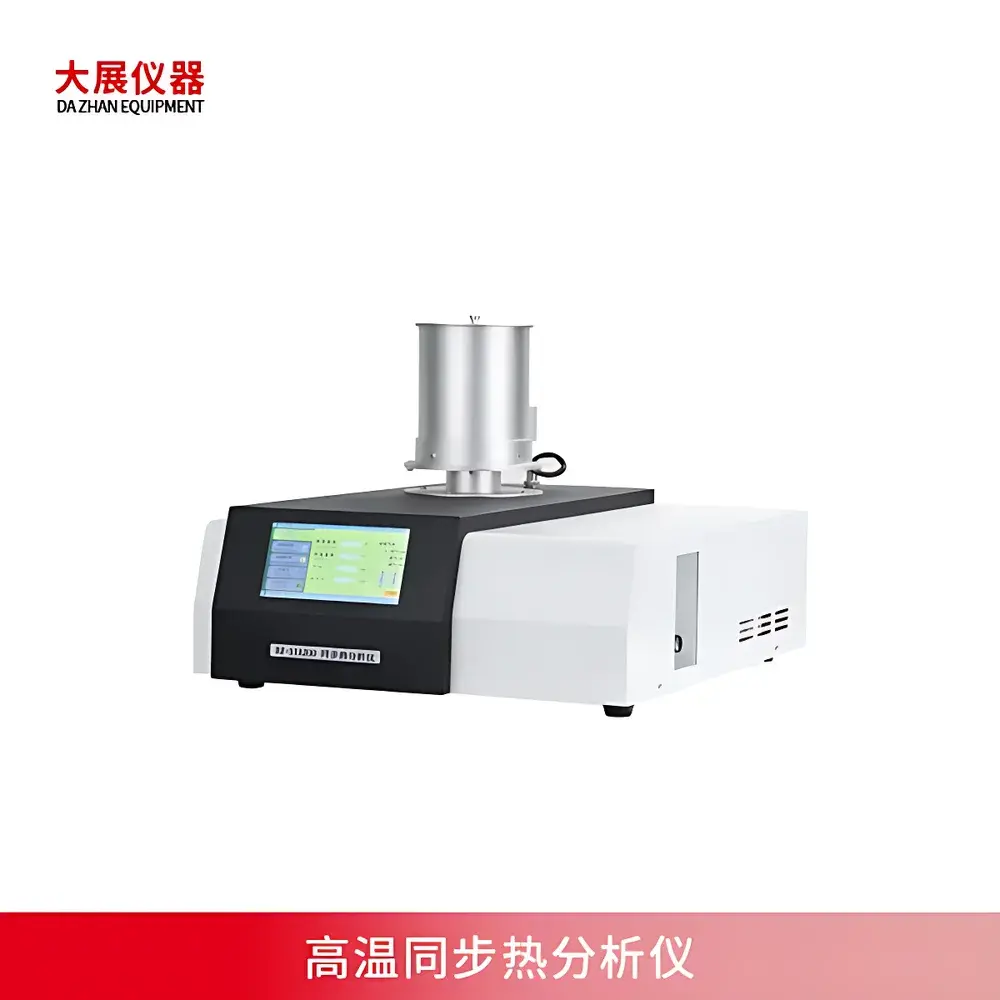
Nanjing Dazhan DZ-STA200 High-Temperature Simultaneous Thermal Analyzer (TG-DSC)
| Brand | Nanjing Dazhan |
|---|---|
| Origin | Jiangsu, China |
| Manufacturer Type | Direct Manufacturer |
| Region Classification | Domestic (China) |
| Model | DZ-STA200 |
| Coupling Technique | TG-DSC |
| Temperature Range | Ambient to 1200 °C |
| Heating Rate | 0.1–100 °C/min |
| Maximum Sample Mass | 5 g |
| Atmosphere Control | Inert, Oxidizing, Reducing |
Overview
The Nanjing Dazhan DZ-STA200 is a high-temperature simultaneous thermal analyzer engineered for precise, real-time coupling of thermogravimetric analysis (TGA) and differential scanning calorimetry (DSC) within a single furnace chamber. Based on the principle of concurrent mass loss measurement (via high-resolution microbalance) and heat flow differential detection (via symmetric thermocouple-based sensor), the instrument delivers synchronized, time-aligned TG and DSC signals under rigorously controlled thermal and atmospheric conditions. Designed for materials science laboratories requiring reproducible high-temperature characterization up to 1200 °C, the DZ-STA200 supports fundamental research and quality control workflows across metallurgy, polymer science, pharmaceutical development, inorganic chemistry, and advanced ceramics. Its dual-signal acquisition architecture eliminates inter-instrument calibration drift and enables direct correlation between enthalpic events (e.g., melting, crystallization, glass transition) and mass-change phenomena (e.g., decomposition, oxidation, volatilization).
Key Features
- High-stability dual-heating-element furnace using double-row wound noble-alloy (Ni-Cr) resistance wire, ensuring uniform temperature distribution and minimized electromagnetic interference.
- Precision-engineered platinum-rhodium alloy sample holder and sensor assembly, rated for continuous operation at ≥1200 °C with exceptional resistance to oxidation, corrosion, and thermal fatigue.
- Thermally decoupled mechanical design: power supply unit, cooling fan module, and main electronics chassis are physically isolated from the furnace and microbalance assembly to suppress thermal drift and mechanical vibration transmission.
- Top-opening furnace configuration with vertical sample insertion—reducing risk of sample rod misalignment or bending during loading and enabling rapid, tool-free access to the crucible.
- Integrated multi-layer thermal shielding system between the furnace zone and instrument housing, limiting heat conduction to the microbalance and control electronics to maintain baseline stability over extended runs.
- 24-bit color 7-inch capacitive touchscreen interface with intuitive icon-driven navigation, supporting multistep temperature programs (up to 32 segments), dwell time definition (0–300 min per step, extendable to 72 h), and real-time curve overlay.
Sample Compatibility & Compliance
The DZ-STA200 accommodates standard ceramic (Al2O3) and aluminum crucibles, with optional high-purity graphite or platinum variants available for aggressive atmospheres or elevated sensitivity requirements. The integrated dual-gas manifold features two independently controllable mass flow channels (0–200 mL/min each), supporting switching between inert (N2, Ar), oxidizing (air, O2), and reducing (H2/N2, CO) environments—either static or dynamic. All hardware and software components comply with general-purpose laboratory instrumentation safety standards (IEC 61010-1). While not pre-certified for regulated GxP environments, the system’s architecture supports audit-ready operation when configured with user-defined electronic signatures, full experimental metadata logging, and immutable data export (PDF, Excel) — aligning with GLP documentation practices and preparatory alignment with FDA 21 CFR Part 11 requirements.
Software & Data Management
The proprietary intelligent analysis software provides native support for raw TG, DTG, DSC, and combined TG-DSC data visualization and post-processing. Users may perform baseline correction, peak integration, onset/offset temperature identification, enthalpy quantification (with user-defined calibration factors), kinetic modeling (e.g., Kissinger, Ozawa-Flynn-Wall), and multi-curve comparison. Export formats include CSV, Excel (.xlsx), and print-ready PDF reports containing instrument parameters, atmosphere logs, calibration history, and annotated curves. Data integrity is reinforced via timestamped file generation, automatic backup directory management, and USB 2.0 port compatibility for external storage or network transfer. Software supports multi-point temperature and enthalpy calibration using certified reference materials (e.g., indium, zinc, alumina) across defined temperature intervals.
Applications
- Metallurgy: Oxidation kinetics of alloys, phase transformation temperatures in steel, sintering behavior of powder metallurgy compacts.
- Polymers & Composites: Quantification of filler content (e.g., CaCO3, SiO2), thermal degradation onset, char yield prediction, cure monitoring of thermosets.
- Pharmaceuticals: Polymorph screening, hydrate/dehydrate transitions, excipient compatibility studies, residual solvent quantification.
- Ceramics & Glass: Decomposition of precursors, crystallization exotherms, thermal expansion coefficient estimation via dilatometric correlation.
- Energy Materials: Thermal stability of battery cathode/anode materials, catalytic coke burn-off profiles, hydrogen storage material dehydrogenation steps.
- Food Science: Moisture loss kinetics, starch gelatinization, lipid oxidation induction periods, Maillard reaction onset.
FAQ
What is the maximum operating temperature and typical temperature stability specification?
The DZ-STA200 achieves a maximum furnace temperature of 1200 °C, with temperature fluctuation maintained at ±0.1 °C and resolution of 0.01 °C under isothermal conditions.
Can the system operate under reducing atmospheres such as hydrogen?
Yes—the built-in dual-channel gas controller supports programmable switching and flow regulation for H2/N2 mixtures and other reducing gases, provided appropriate safety interlocks and exhaust handling are implemented externally.
Is the microbalance sensitive enough for low-mass samples like thin films or nanoparticles?
With a resolution of 0.1 μg and measurable range from 0.1 mg to 5 g, the system is suitable for sub-milligram samples when using small-volume crucibles and optimized purge gas flow rates.
Does the software support kinetic analysis models for decomposition reactions?
Yes—integrated tools enable model-fitting using common solid-state kinetic equations (e.g., Arrhenius, Friedman, ASTM E698), with output of activation energy, pre-exponential factor, and reaction order.
Are calibration certificates traceable to national standards available?
Reference material calibration data (indium, zinc, alumina) can be documented internally; NIST-traceable calibration certificates are available upon request through authorized service partners.



