
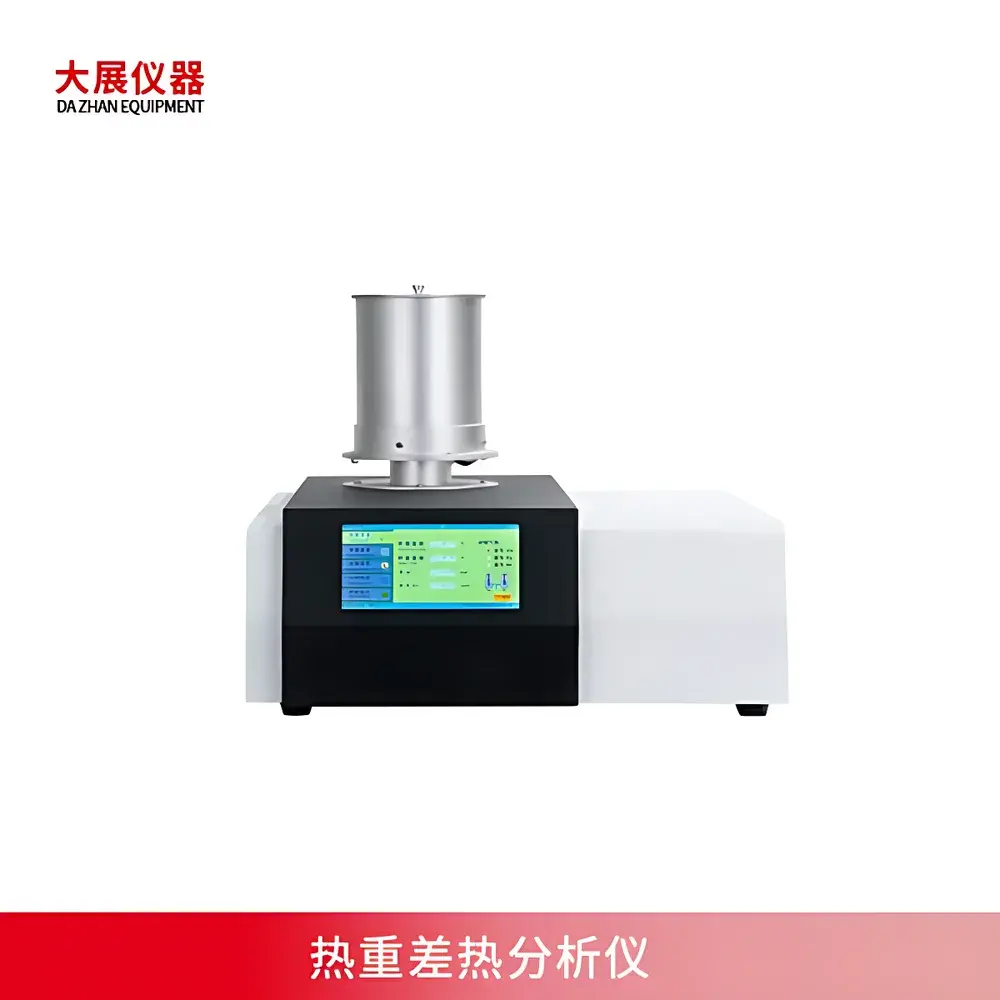
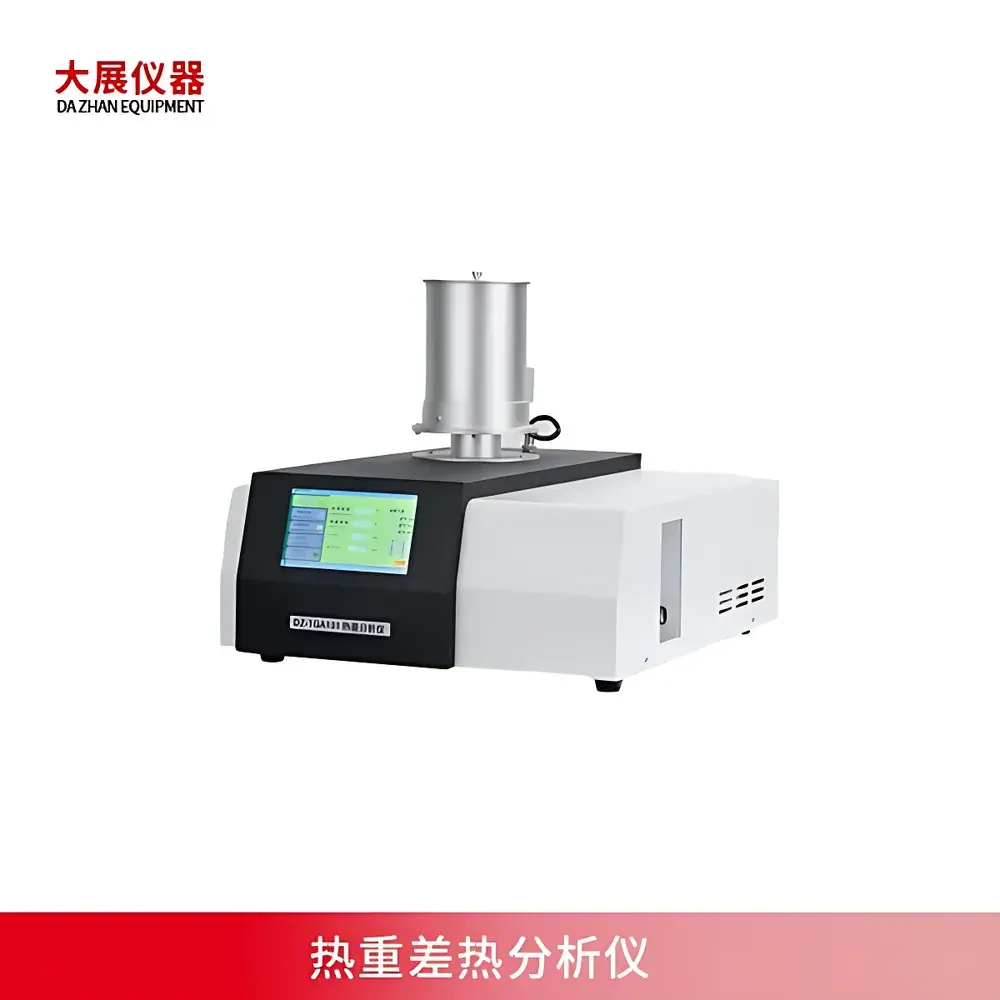
Nanjing Dazhan DZ-TGA101 Thermogravimetric Analyzer
| Brand | Nanjing Dazhan |
|---|---|
| Origin | Jiangsu, China |
| Manufacturer Type | Direct Manufacturer |
| Country of Origin | China |
| Model | DZ-TGA101 |
| Operating Environment | Ambient Pressure |
| Sample Capacity | Single Sample |
| Instrument Type | General-Purpose TGA |
| Temperature Range | Room Temperature to 1200 °C |
| Balance Sensitivity | 0.01 mg |
| Heating/Cooling Rate | 0.1–100 °C/min |
| Maximum Sample Mass | 30 g |
| Temperature Resolution | 0.01 °C |
| Temperature Stability | ±0.1 °C |
| Cooling Time (1000 °C → 100 °C) | ≤15 min |
| Balance Range | 0.1 mg–3 g (extendable to 30 g) |
| Isothermal Hold Duration | Up to 72 h (0–300 min programmable in 0.1 min increments) |
| Atmosphere Control | Dual-gas manifold with mass flow regulation (inert, oxidative, reductive, static, dynamic) |
| Data Acquisition | 48-bit quadruple-channel ADC for simultaneous TG, DTG, DSC (optional), and temperature signals |
| Interface | USB 2.0 (bidirectional) |
| Display | 7-inch 24-bit color touchscreen (Chinese/English UI) |
| Calibration | On-screen TG baseline and temperature multi-point calibration |
| Power Supply | AC 220 V, 50 Hz (customizable) |
Overview
The Nanjing Dazhan DZ-TGA101 Thermogravimetric Analyzer is a precision benchtop instrument engineered for quantitative measurement of mass change as a function of temperature or time under controlled atmospheric conditions. Based on the fundamental principle of thermogravimetry—monitoring sample mass variation during programmed thermal treatment—the DZ-TGA101 delivers high-fidelity data for decomposition kinetics, thermal stability assessment, volatilization behavior, oxidative degradation, and compositional quantification. Its robust furnace architecture, featuring optimized thermal insulation and rapid-response heating elements, enables stable operation across a wide temperature span (RT to 1200 °C) with exceptional temperature resolution (0.01 °C) and minimal drift (±0.1 °C). The system supports both dynamic heating/cooling ramps and extended isothermal holds (up to 72 hours), making it suitable for long-duration kinetic studies and quality assurance protocols in regulated environments.
Key Features
- High-stability microbalance with 0.01 mg sensitivity and extended capacity up to 30 g, utilizing corrosion-resistant Ni–Cr alloy sensor trays rated for continuous operation at ≥1200 °C.
- Top-opening furnace design with vertical lift mechanism—minimizes mechanical stress on the sample rod during loading/unloading and eliminates risk of sensor misalignment.
- 48-bit quadruple-channel analog-to-digital converter synchronously acquires TG, derivative thermogravimetric (DTG), optional DSC, and real-time temperature signals—ensuring temporal coherence and signal integrity.
- Integrated dual-gas atmosphere control system with calibrated mass flow meters, enabling precise switching and independent regulation of inert (e.g., N₂, Ar), oxidative (e.g., air, O₂), or reductive (e.g., H₂/N₂ mix) gas streams in static or dynamic modes.
- 7-inch 24-bit color capacitive touchscreen with intuitive bilingual (English/Chinese) interface—supports full instrument control, real-time curve visualization, on-device TG baseline correction, and multi-point temperature calibration without external PC.
- USB 2.0 bidirectional communication protocol allows remote parameter configuration, experiment initiation/termination, and live data streaming to Windows-based acquisition software with audit-trail-ready logging.
Sample Compatibility & Compliance
The DZ-TGA101 accommodates standard crucibles—including high-purity alumina, platinum, and quartz—enabling analysis of diverse materials such as polymers, pharmaceutical excipients, catalysts, metal oxides, carbon composites, and battery electrode formulations. Its operational envelope complies with key international test standards including ASTM E1131 (standard test method for compositional analysis by thermogravimetry), ISO 11358 (plastics—thermogravimetry of polymers), and USP <1225> (validation of compendial procedures). When operated with validated software and configured for electronic signature support, the system meets foundational requirements for GLP and GMP environments—including secure user access levels, immutable raw data storage, and timestamped audit trails per FDA 21 CFR Part 11 principles.
Software & Data Management
The included Windows-compatible software provides comprehensive post-acquisition processing: automatic peak detection on DTG curves, mass-loss step integration, kinetic modeling (e.g., Ozawa–Flynn–Wall, Kissinger), and comparative overlay of multiple runs. All datasets export natively to Excel (.xlsx) and PDF report formats with embedded metadata (operator ID, instrument serial number, calibration dates, gas flow logs). Raw binary files (.tdt) are stored with checksum verification and support version-controlled archiving. Software updates are delivered free-of-charge via secure HTTPS download and include backward compatibility for legacy experiment files.
Applications
- Quantitative determination of filler content (e.g., CaCO₃, SiO₂) and polymer matrix decomposition in composites.
- Residual solvent and moisture analysis in active pharmaceutical ingredients (APIs) per ICH Q5C guidelines.
- Oxidative induction time (OIT) evaluation of polyolefins and stabilizer efficacy screening.
- Thermal stability ranking of catalysts under simulated regeneration conditions (e.g., coke burn-off in FCC catalysts).
- Decomposition onset temperature (Td) and char yield prediction for flame-retardant polymer development.
- Inorganic residue quantification in ceramic precursors and ash content validation per ASTM D3174.
FAQ
What crucible types are supported, and what is the maximum operating temperature for each?
Standard alumina crucibles are rated to 1600 °C; platinum crucibles support ≤1400 °C in inert atmospheres; quartz crucibles are limited to ≤1100 °C and incompatible with alkaline or fluoride-containing samples.
Can the DZ-TGA101 perform simultaneous TGA-DSC measurements?
The base configuration includes dedicated TG/DTG channels; optional DSC sensor integration is available as a factory-installed upgrade with separate calibration and thermal compensation algorithms.
Is the software compliant with 21 CFR Part 11 for electronic records and signatures?
The current software version supports role-based user authentication, electronic signatures for report approval, and audit-trail generation—but full Part 11 compliance requires site-specific validation documentation and IT infrastructure alignment per organizational SOPs.
How is temperature calibration performed, and how often is it recommended?
Multi-point calibration uses certified reference materials (e.g., Ni, Cu, Al, KCl) at defined transition temperatures; annual calibration is recommended, with quarterly verification advised for GLP/GMP workflows.
Does the instrument support purge gas flow programming synchronized with temperature ramps?
Yes—gas flow rates and switching events can be scheduled as part of the method file, enabling automated transitions between inert and oxidative atmospheres at specified temperatures or time points.



