
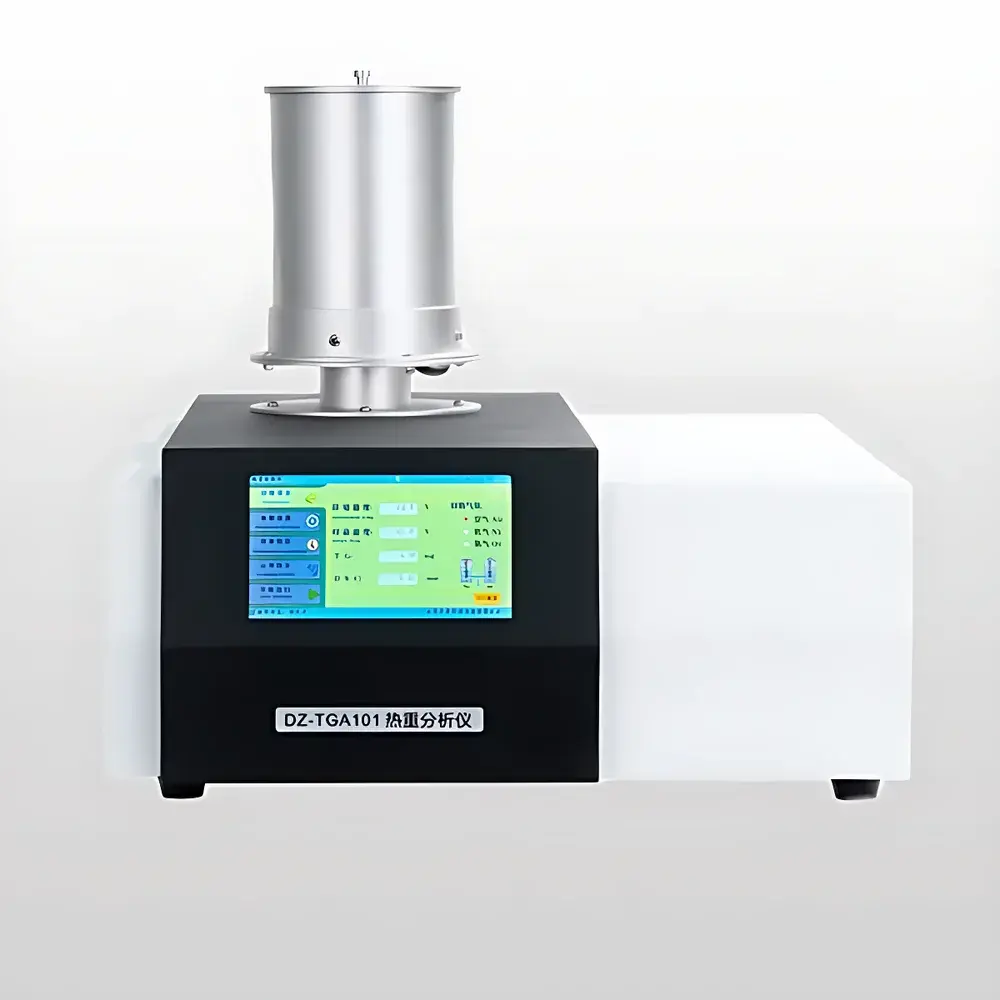
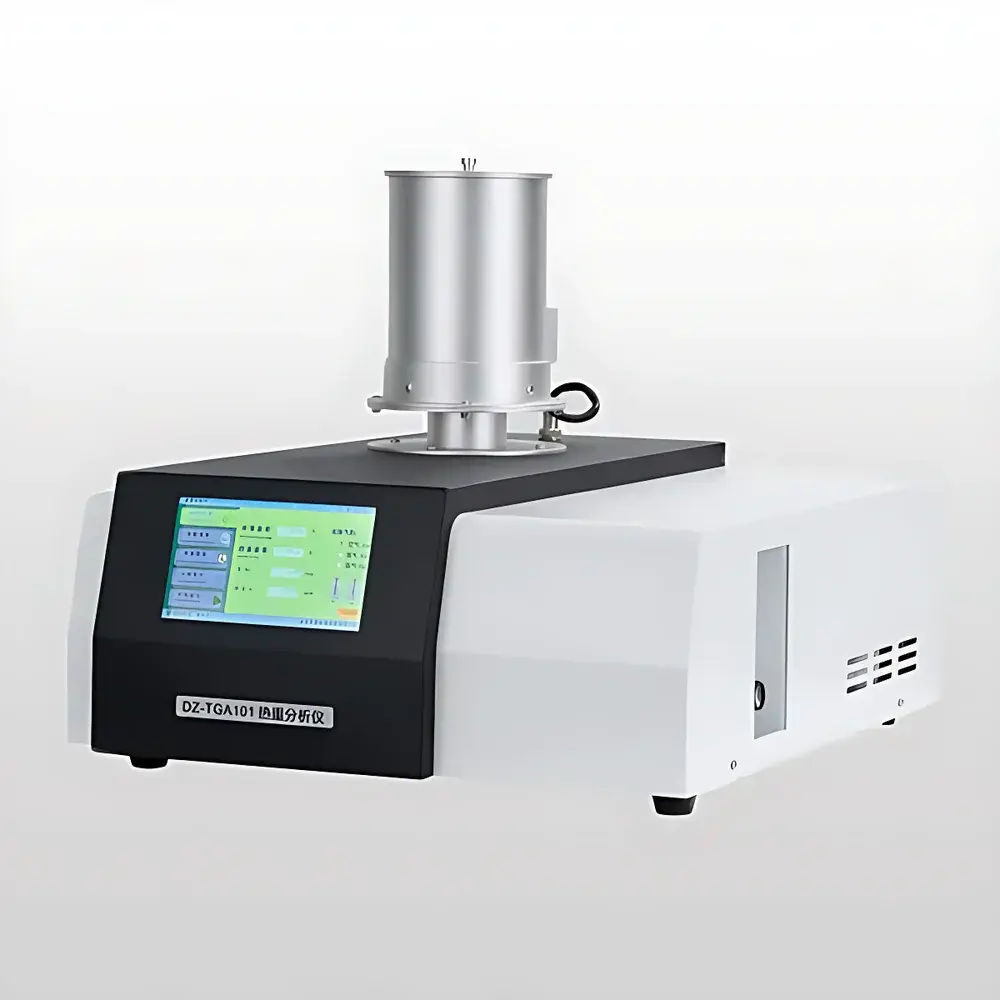
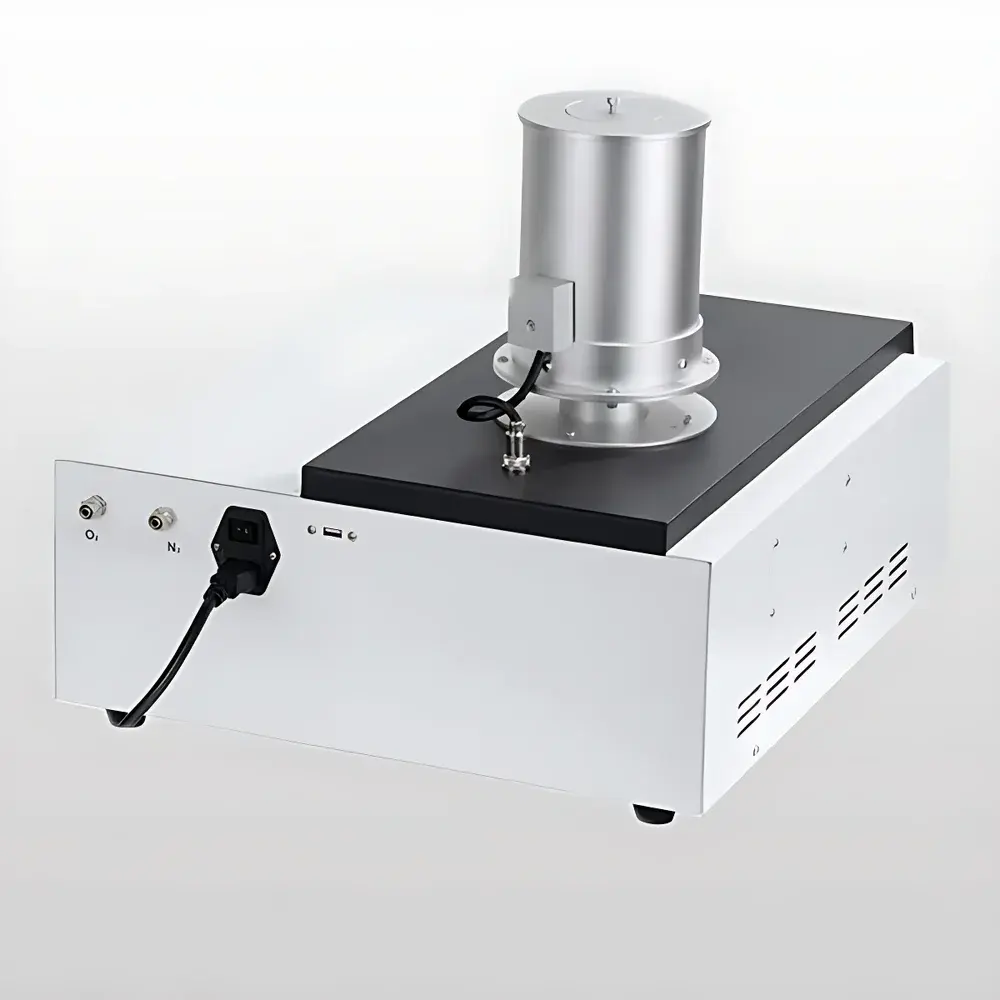
Nanjing Dazhan DZ-TGA101 Thermogravimetric Analyzer
| Brand | Nanjing Dazhan |
|---|---|
| Origin | Jiangsu, China |
| Manufacturer Type | Manufacturer |
| Country of Origin | China |
| Model | DZ-TGA101 |
| Operating Environment | Ambient Pressure |
| Sample Capacity | Single Sample |
| Instrument Type | General-Purpose |
| Temperature Range | Room Temperature to 1200 °C |
| Heating/Cooling Rate | 0.1–100 °C/min |
| Maximum Sample Mass | 30 g |
| Temperature Resolution | 0.01 °C |
| Temperature Stability | ±0.1 °C |
| Balance Range | 0.01 mg–2 g (extendable to 30 g) |
| Balance Resolution | 0.1 µg |
| Isothermal Hold Time | 0–500 min (expandable to 72 h) |
| Cooling Time (1000 °C → 100 °C) | ≤15 min |
| Atmosphere Control | Dual-gas flow regulation with inert/oxidizing/reducing/static/dynamic options |
| Data Interface | USB 2.0 |
| Power Supply | AC 220 V, 50 Hz |
Overview
The Nanjing Dazhan DZ-TGA101 Thermogravimetric Analyzer is a precision-controlled, general-purpose thermal analysis instrument engineered for quantitative measurement of mass change as a function of temperature or time under controlled atmospheric conditions. Based on the fundamental principle of thermogravimetry (TGA), it continuously monitors sample mass during programmed thermal cycles—ramping, isothermal holds, or cooling—enabling rigorous characterization of thermal stability, decomposition kinetics, moisture/volatile content, filler loading, oxidative induction time (OIT), and compositional heterogeneity. Designed for laboratory environments requiring reproducible, traceable, and auditable data, the DZ-TGA101 complies with core methodological standards referenced in ASTM E1131, ISO 11358, and USP , supporting both R&D and routine quality control workflows across polymer science, pharmaceutical development, catalysis, metallurgy, and advanced ceramics.
Key Features
- High-fidelity dual-signal acquisition system: 48-bit quad-channel analog-to-digital conversion simultaneously captures TG, DTG, and temperature (T) signals with sub-microgram resolution and minimal thermal lag.
- STM32-based embedded controller architecture ensures deterministic real-time sampling, adjustable scan rates, and robust signal integrity across full operational range (RT to 1200 °C).
- Integrated dual-gas manifold with calibrated mass flow controllers enables precise switching and independent regulation of two atmospheres—supporting inert (N₂, Ar), oxidizing (air, O₂), reducing (H₂, forming gas), static, or dynamic purge modes.
- 7-inch 24-bit color capacitive touchscreen with localized Chinese/English UI provides intuitive local operation, on-device calibration (TG zero/mass, temperature multi-point), and real-time curve visualization without PC dependency.
- Rapid thermal response: achieves cooling from 1000 °C to 100 °C in ≤15 minutes via optimized furnace geometry and active airflow management—reducing cycle time without compromising baseline stability.
- Modular balance design accommodates standard ceramic and aluminum crucibles; maximum load capacity extends to 30 g with maintained 0.1 µg resolution at low-mass ranges (0.01–2 g).
Sample Compatibility & Compliance
The DZ-TGA101 accepts solid powders, granules, thin films, fibers, and small metallic specimens—compatible with standard alumina, platinum, and aluminum crucibles (including hermetic and vented variants). Its temperature calibration protocol supports NIST-traceable reference materials (e.g., Ni, Cu, Al, CaC₂O₄·H₂O), and multi-point temperature correction ensures accuracy across the entire 0–1200 °C span. The instrument meets essential requirements for GLP-compliant environments: audit-trail-enabled software logging, electronic signature support, parameter lockout for validated methods, and raw-data immutability. While not pre-certified for FDA 21 CFR Part 11, its architecture supports integration into validated systems through configurable user access levels, timestamped event logs, and exportable metadata-rich .csv/.pdf reports.
Software & Data Management
The included Windows-based TGA Analysis Suite communicates bidirectionally via USB 2.0, enabling full remote control—including method definition, real-time monitoring, pause/resume, and emergency stop. It processes raw TG/DTG data using baseline subtraction, derivative smoothing (Savitzky-Golay), peak deconvolution, and kinetic modeling (e.g., Kissinger, Ozawa-Flynn-Wall). Export formats include Excel (.xlsx), CSV, and publication-ready PDFs with customizable annotations, scale markers, and multi-curve overlays. Software updates are delivered free-of-charge via secure vendor portal; all firmware and application binaries retain version-stamped changelogs compliant with internal QA documentation practices.
Applications
- Quantification of polymer degradation onset, char yield, and residual ash content per ISO 11358-1.
- Determination of solvent/water loss, plasticizer migration, and thermal oxidative stability in elastomers and coatings.
- Pharmaceutical excipient compatibility screening and active pharmaceutical ingredient (API) dehydration kinetics per USP .
- Catalyst support decomposition profiling and metal oxide reduction behavior under controlled H₂/N₂ gradients.
- Mineralogical phase transitions in clays, carbonates, and hydrated salts—correlated with DSC when coupled in hybrid configurations.
- Quality assurance of metal alloys and composites: oxidation resistance, intermetallic formation, and filler dispersion uniformity.
FAQ
What is the recommended calibration frequency for routine QC use?
For daily production testing, mass calibration should be performed at startup and after each major temperature excursion; temperature calibration using certified standards is advised weekly or per batch, aligned with internal SOPs.
Can the DZ-TGA101 operate under vacuum?
No—the system is designed for ambient-pressure operation with regulated gas purging only; vacuum compatibility requires external pumping infrastructure and is not supported by default hardware or firmware.
Is third-party software integration possible (e.g., LabArchives, Empower)?
Yes—raw data exports (.csv, .txt) and metadata headers conform to ASTM E1557 and ISO/IEC 17025 reporting conventions, facilitating ingestion into LIMS and ELN platforms via scripted import pipelines.
Does the instrument support automatic sample changing?
No—the DZ-TGA101 is a single-position manual-loading system; automated multi-sample handling is available in higher-tier models (e.g., DZ-TGA200 series) but not integrated here.
How is baseline drift compensated during long isothermal holds?
The software applies adaptive polynomial baseline correction over user-defined intervals, and the high-stability furnace design minimizes thermal buoyancy effects—typical drift remains below ±2 µg over 500-minute holds at 800 °C.



