
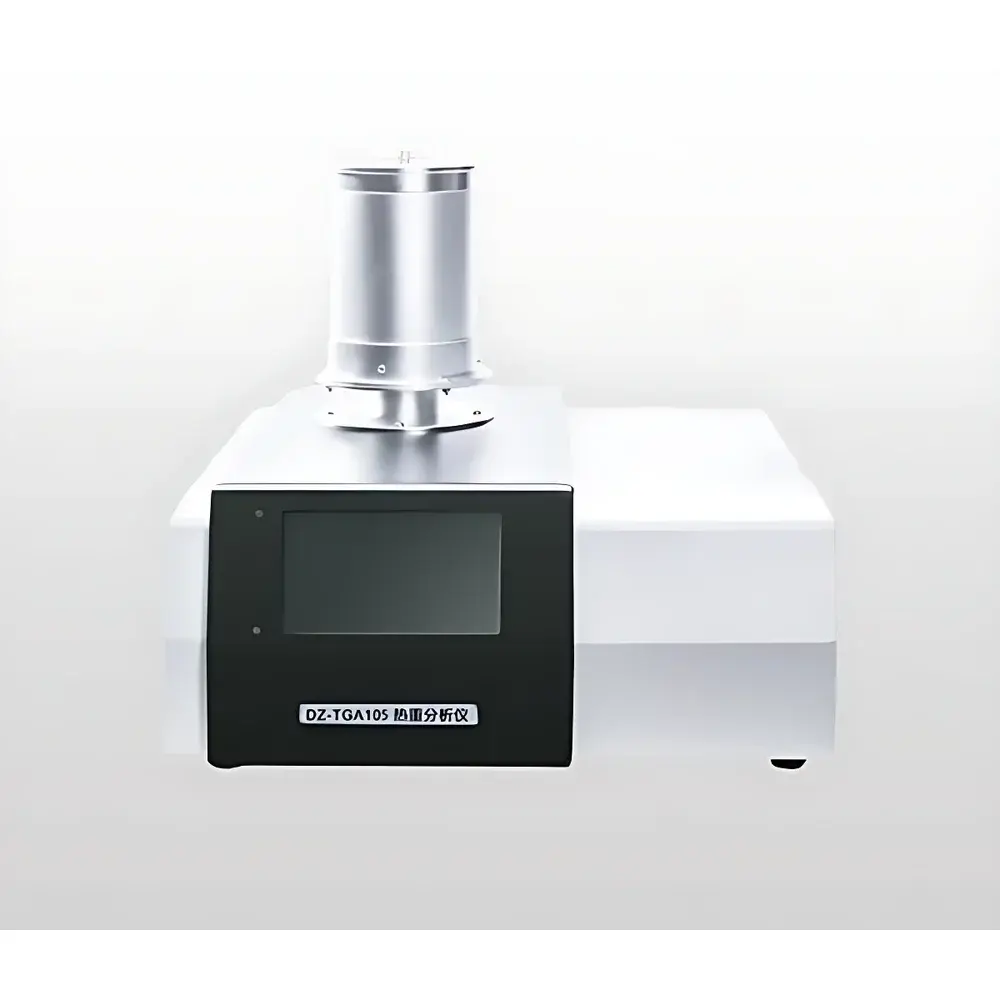
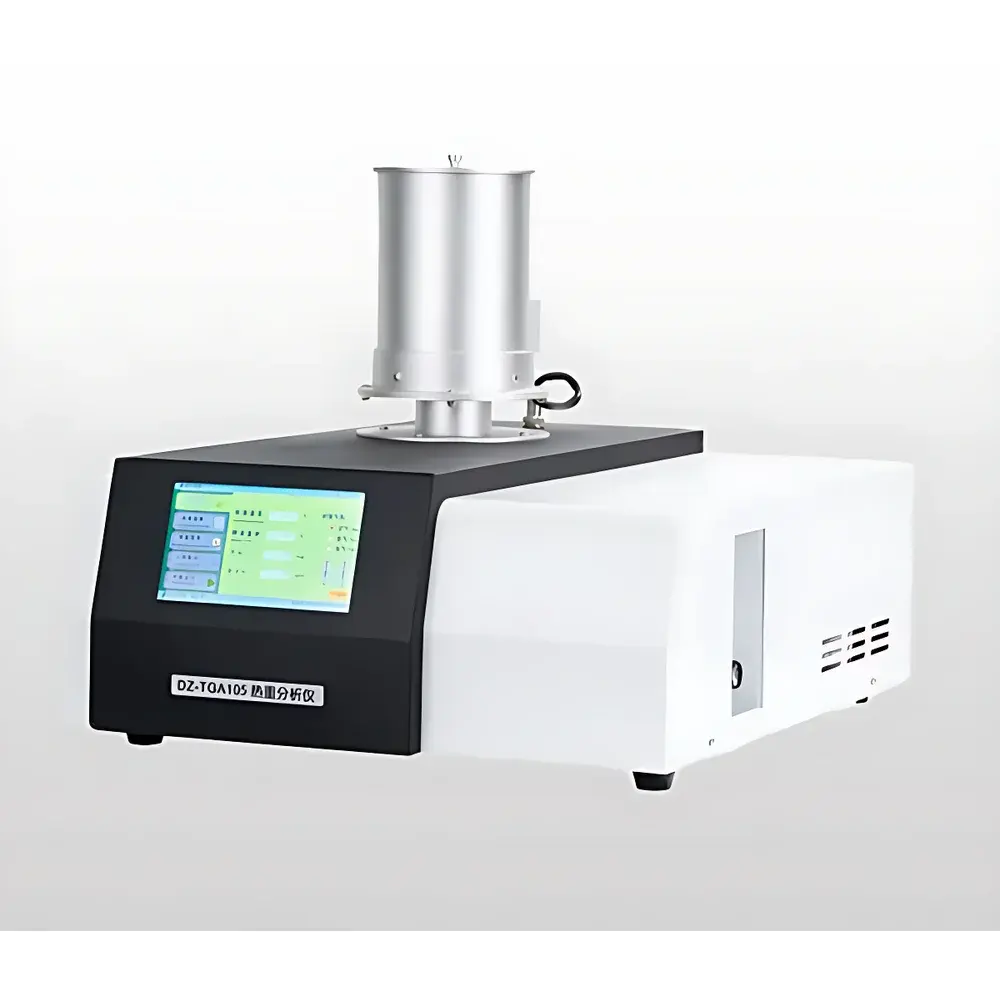
Nanjing Dazhan DZ-TGA105 High-Temperature Thermogravimetric Analyzer
| Brand | Nanjing Dazhan |
|---|---|
| Origin | Jiangsu, China |
| Manufacturer Type | Direct Manufacturer |
| Origin Category | Domestic |
| Model | DZ-TGA105 |
| Structure Type | Top-Loading (Upper-Positioned) |
| Test Environment | High-Temperature |
| Sample Capacity | Single Sample |
| Instrument Type | General-Purpose |
| Temperature Range | Ambient to 1450 °C |
| Temperature Accuracy | ±0.01 °C |
| Temperature Resolution | 0.1 °C |
| Temperature Stability | ±0.1 °C |
| Heating/Cooling Rate | 0.1–100 °C/min |
| Maximum Sample Mass | 30 g |
| Balance Range | 1 mg–2 g (expandable to 5 g) |
| Balance Resolution | 0.1 µg |
| Isothermal Hold Time | 0–300 min |
| Atmosphere Options | Inert, Oxidizing, Reducing, Static, Dynamic |
| Gas Control | Dual-channel integrated mass flow controllers with adjustable flow rates |
| Data Interface | RS-232 |
| Software | Proprietary TGA analysis suite with automated curve acquisition, kinetic modeling, derivative (DTG) calculation, report generation, and free periodic updates |
| Power Supply | AC 220 V, 50 Hz |
Overview
The Nanjing Dazhan DZ-TGA105 High-Temperature Thermogravimetric Analyzer is a precision-engineered instrument designed for quantitative measurement of mass change in solid or liquid samples as a function of temperature or time under controlled atmospheric conditions. Based on the fundamental principle of thermogravimetry—where sample mass is continuously monitored during programmed thermal cycles—the DZ-TGA105 enables rigorous characterization of thermal decomposition pathways, phase transitions, volatilization kinetics, oxidative stability, and compositional evolution. Its extended operational range up to 1450 °C supports high-temperature applications critical to metallurgy, advanced ceramics, refractory materials, and catalyst development. The top-loading furnace architecture ensures mechanical stability during rapid heating/cooling cycles while minimizing thermal lag and convection-induced buoyancy errors. All thermal and gravimetric subsystems are calibrated traceably to national standards, supporting compliance with ISO 11358, ASTM E1131, and USP <41> requirements for thermal analysis validation.
Key Features
- High-temperature capability: Continuous operation from ambient to 1450 °C with optimized ceramic insulation and dual-zone furnace control for uniform thermal distribution.
- Ultra-sensitive microbalance: Resolution of 0.1 µg over a 1 mg–2 g dynamic range (extendable to 5 g), integrated with active drift compensation and electromagnetic shielding.
- Precise thermal control: Programmable heating/cooling rates from 0.1 to 100 °C/min, with temperature accuracy ±0.01 °C and stability maintained within ±0.1 °C during isothermal holds (0–300 min).
- Integrated gas management system: Dual independent mass flow controllers (MFCs) support seamless switching between inert (N₂, Ar), oxidizing (air, O₂), and reducing (H₂, CO) atmospheres—each with real-time flow monitoring and digital setpoint adjustment.
- Rapid thermal cycling: Full cooldown from 1000 °C to 100 °C in ≤15 minutes, enabled by forced-air quenching and optimized thermal mass design.
- Robust mechanical architecture: Top-loading configuration minimizes sample handling errors and ensures consistent positioning relative to the thermocouple and balance sensor—critical for reproducibility across repeated runs.
Sample Compatibility & Compliance
The DZ-TGA105 accommodates standard platinum, alumina, or silica crucibles (up to 30 g gross load) and supports heterogeneous solids, powders, granules, thin films, and viscous liquids. It complies with GLP and GMP documentation requirements through audit-trail-enabled software, user-access logging, electronic signatures, and 21 CFR Part 11–compatible data integrity protocols. All calibration records—including temperature, mass, and gas flow verification—are stored with timestamps and operator metadata. The system meets essential safety standards per IEC 61010-1 and is CE-marked for laboratory use in EU-regulated environments.
Software & Data Management
The proprietary TGA analysis software provides full instrument control, real-time data acquisition, and post-run processing including derivative thermogravimetry (DTG), multi-step kinetic modeling (e.g., Kissinger, Ozawa-Flynn-Wall), residual mass quantification, and comparative overlay of multiple curves. Raw data are saved in ASCII-compatible .csv and vendor-neutral .tdf formats. Reporting templates conform to ISO/IEC 17025 documentation standards, with automatic inclusion of method parameters, calibration status, environmental logs, and uncertainty estimates. Remote diagnostics and firmware updates are supported via secure HTTPS channel; software upgrades are provided at no cost for the instrument’s service lifetime.
Applications
- Quantitative determination of filler content, moisture, solvent residue, and volatile organic compounds (VOCs) in polymers and composites.
- Thermal stability assessment of pharmaceutical APIs and excipients under accelerated aging protocols (ICH Q1A–Q1E).
- Kinetic analysis of metal oxide reduction, carbonate decomposition, and catalytic coke burn-off in petrochemical and energy storage materials.
- Composition profiling of multi-component ceramics, slag systems, and nuclear fuel matrices via stepwise mass loss correlation with known stoichiometries.
- Quality control of battery electrode materials—including LiCoO₂, NMC, and silicon anodes—for structural integrity, binder degradation, and SEI layer formation behavior.
- Validation of thermal protection performance in aerospace-grade ablative coatings and fire-retardant additives.
FAQ
What is the maximum recommended sample mass for optimal resolution and thermal homogeneity?
For highest sensitivity and minimal thermal gradient effects, we recommend loading ≤1 g for fine powders and ≤5 g for dense metallic or ceramic specimens. The 30 g upper limit refers to total crucible + sample weight—not analytical mass.
Does the system support simultaneous DTA or DSC functionality?
No—the DZ-TGA105 is a dedicated thermogravimetric platform. However, its RS-232 interface allows synchronized external data acquisition from compatible differential thermal analyzers or calorimeters via third-party DAQ hardware.
How is temperature calibration verified and documented?
Calibration uses certified reference materials (e.g., Ni, Cu, Al₂O₃) with known Curie points or phase transitions. Results are recorded in the instrument logbook with traceability to NIM (National Institute of Metrology, China) standards and exported as PDF reports upon request.
Can the software generate kinetic parameters compliant with ASTM E2550?
Yes—the built-in kinetic module implements ASTM E2550–22 methodology for activation energy calculation using isoconversional methods (Friedman, Kissinger-Akahira-Sunose), with confidence interval estimation and goodness-of-fit metrics.
Is remote instrument monitoring available?
While the base configuration does not include Ethernet/Wi-Fi connectivity, optional RS-232-to-Ethernet gateways enable networked access and integration into centralized lab information management systems (LIMS).



