
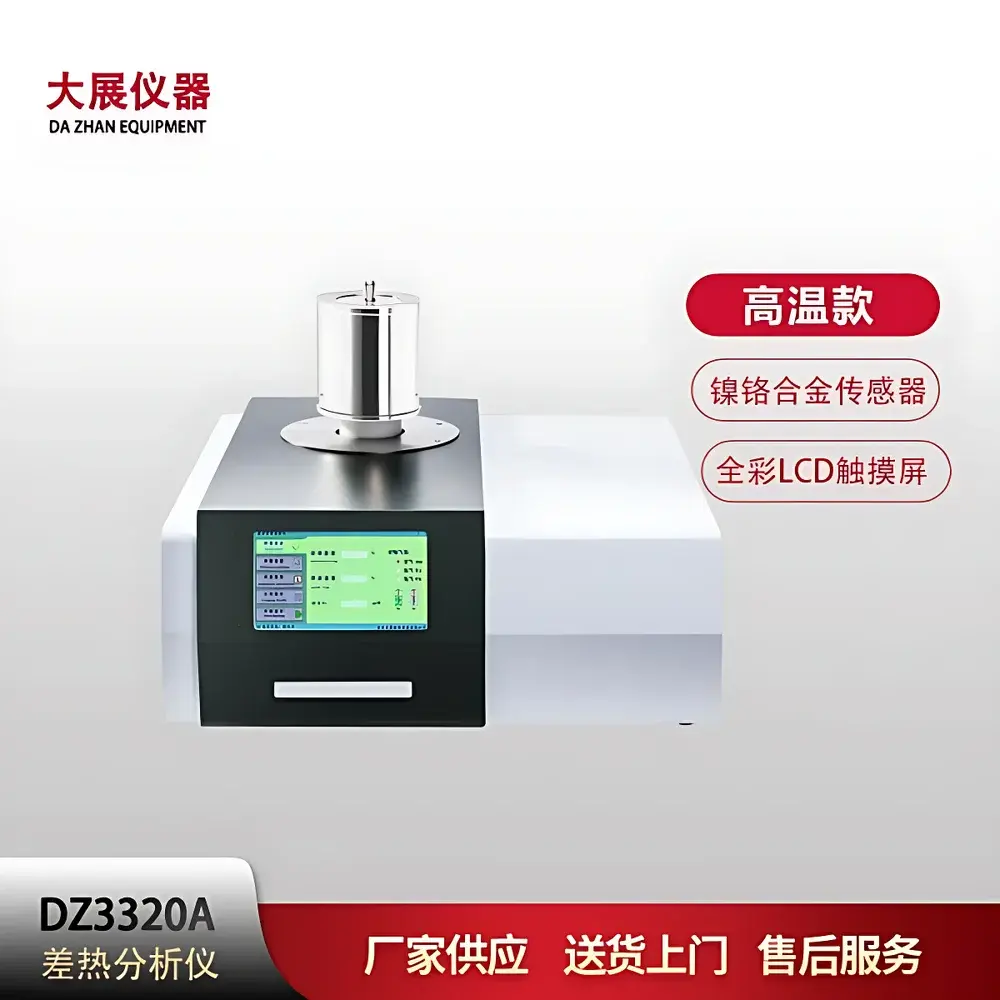
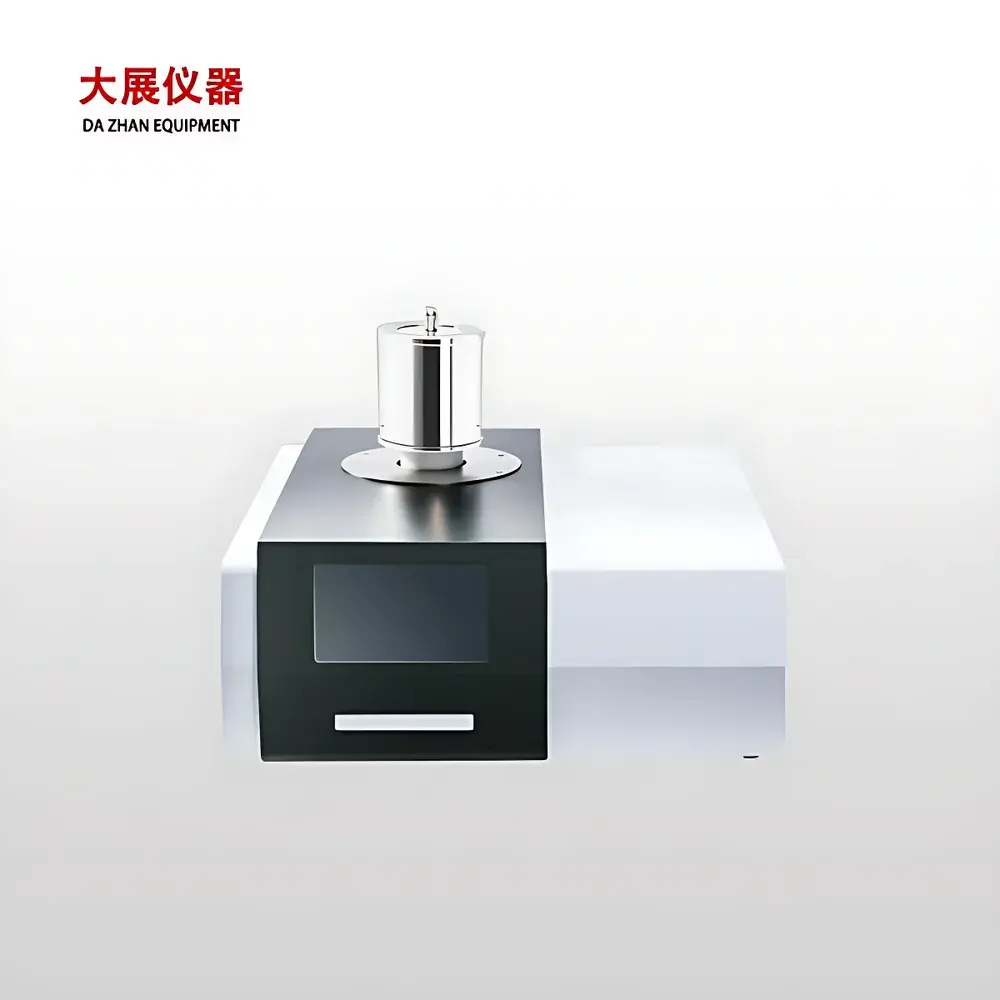
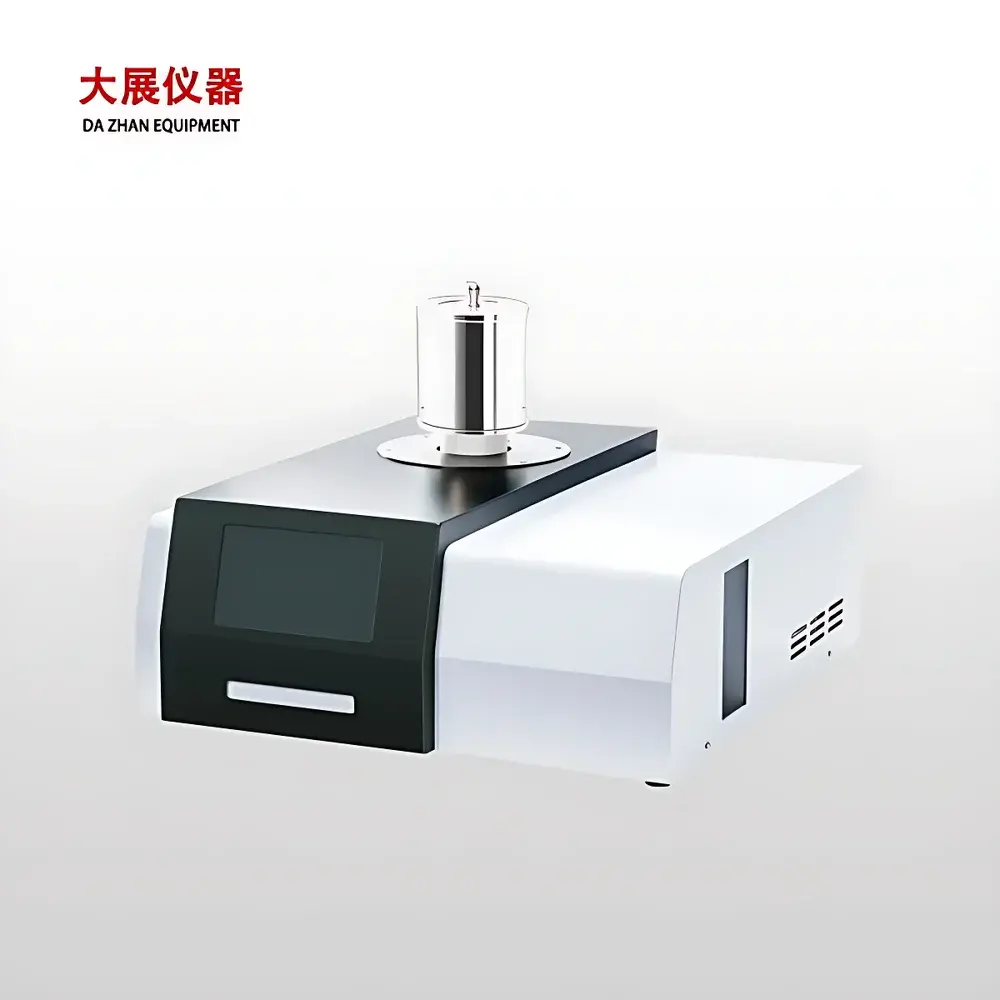
Nanjing Dazhan DZ3320A Differential Thermal Analyzer
| Brand | Nanjing Dazhan |
|---|---|
| Origin | Jiangsu, China |
| Manufacturer Type | Direct Manufacturer |
| Model | DZ3320A |
| Sample Capacity | Single |
| Instrument Type | Differential Thermal Analyzer (DTA) |
| Temperature Range | Ambient to 1150 °C |
| Temperature Accuracy | ±0.1 °C |
| Temperature Precision | ±0.1 °C |
| Heating/Cooling Rate | 0.1–100 °C/min |
| DTA Sensitivity | 0.01 µV |
| DTA Signal Range | 0–±2000 µV (expandable) |
| Temperature Resolution | 0.01 °C |
| Temperature Repeatability | ±0.1 °C |
| Control Method | PID Temperature Control |
| Furnace Design | Top-opening vertical furnace |
| Atmosphere Control | Programmable internal gas switching |
| Data Interface | Standard USB 2.0 |
| Display | 7-inch 24-bit color LCD touchscreen |
| Power Supply | AC 220 V / 50 Hz (customizable) |
| Baseline Adjustment | Adjustable slope and intercept via software |
Overview
The Nanjing Dazhan DZ3320A Differential Thermal Analyzer (DTA) is a precision benchtop thermal analysis instrument engineered for reliable detection of endothermic and exothermic transitions in solid and semi-crystalline materials. Unlike differential scanning calorimetry (DSC), which measures heat flow differences under controlled heating, the DZ3320A operates on the classical DTA principle: it records the temperature difference (ΔT) between a sample and an inert reference material as both are subjected to identical, programmable thermal profiles. This configuration enables high-sensitivity identification of phase transitions—including glass transitions (Tg), melting points (Tm), crystallization events, decomposition onset, and solid–solid transformations—across a broad operational range from ambient to 1150 °C. The instrument’s top-opening vertical furnace architecture ensures rapid thermal equilibration, minimal thermal lag, and unobstructed sample access—critical for routine QC testing and method development in polymer, ceramic, pharmaceutical, and metallurgical laboratories.
Key Features
- High-stability PID-controlled temperature regulation with ±0.1 °C accuracy and repeatability across the full 0.1–100 °C/min heating/cooling rate range
- Ultra-sensitive thermocouple-based detection system with 0.01 µV resolution and expandable signal range (0 to ±2000 µV)
- 7-inch high-resolution 24-bit color LCD touchscreen interface supporting intuitive real-time curve navigation, parameter entry, and baseline correction
- Programmable atmosphere control module enabling automated switching between inert (N2, Ar), oxidative (air, O2), or reducing (H2/N2) environments during a single run
- Open-furnace design facilitating fast sample loading/unloading, visual inspection of crucibles, and compatibility with standard alumina, platinum, and graphite crucibles (up to 100 µL capacity)
- USB 2.0 data export interface compliant with Windows-based acquisition software; supports CSV, TXT, and proprietary binary formats for traceable data archiving
- User-adjustable baseline compensation via linear slope and intercept parameters—essential for correcting instrumental drift during extended thermal cycles
Sample Compatibility & Compliance
The DZ3320A accommodates solid powders, granules, thin films, and small bulk specimens (≤50 mg typical). Its open furnace permits direct observation of sample behavior—including discoloration, swelling, or effervescence—during thermal events. The instrument meets fundamental requirements for ISO 11357-1 (Plastics — Differential Scanning Calorimetry), ASTM E794 (Standard Test Method for Melting and Crystallization Temperatures by Thermal Analysis), and ISO 11358 (Plastics — Thermogravimetry). While not certified for GMP/GLP-regulated environments out-of-the-box, its digital audit trail (timestamped runs, operator ID fields, and parameter logs), combined with optional password-protected user levels and electronic signature support in the companion software, enables alignment with FDA 21 CFR Part 11 readiness when deployed within validated workflows.
Software & Data Management
Acquisition and analysis are performed using Nanjing Dazhan’s proprietary ThermalLab Suite v3.x—a Windows 10/11-compatible application offering real-time DTA curve visualization, multi-run overlay, peak integration (onset, peak, endset), and derivative (dT/dt) calculation. Raw data files include embedded metadata: instrument ID, calibration date, operator name, atmospheric conditions, and full thermal program history. Export options include ASCII-delimited formats compatible with MATLAB, OriginLab, and JMP for advanced statistical modeling. All software modules undergo annual functional verification per ICH Q2(R2) guidelines for analytical instrument qualification (AIQ).
Applications
- Determination of glass transition temperatures (Tg) in thermoplastics and epoxy resins—e.g., identifying Tg = 61.7 °C in cured phenolic systems
- Characterization of thermal stability and decomposition kinetics in battery cathode materials (LiCoO2, NMC) under air or argon
- Quantification of eutectic melting points in metal alloys and solder pastes
- Assessment of curing behavior and residual exotherms in UV-curable acrylates and silicone elastomers
- Validation of thermal aging effects on packaging polymers per ASTM F1980 accelerated shelf-life protocols
- Supporting raw material release testing in API manufacturing where DTA serves as a complementary technique to DSC and TGA
FAQ
Is the DZ3320A compliant with GLP or GMP requirements?
The base system supports core GLP/GMP elements—including electronic signatures, audit trails, and user access control—when configured with ThermalLab Suite’s validation package and deployed on a qualified network infrastructure. Full compliance requires site-specific IQ/OQ/PQ documentation.
Can the instrument perform simultaneous DTA–TGA coupling?
No. The DZ3320A is a dedicated DTA platform. For combined thermal analysis, users should consider standalone TGA systems or integrated DTA–TGA instruments from other manufacturers.
What crucible types are supported?
Standard alumina crucibles (Ø6.7 × 5 mm) are supplied. Platinum, graphite, and gold crucibles are compatible upon request and subject to maximum temperature limits.
Does the system support custom heating rate profiles?
Yes. Multi-segment programs—including ramp-hold-ramp sequences, isothermal holds up to 999 minutes, and cooling-only segments—are fully programmable via the touchscreen interface or ThermalLab Suite.
How is temperature calibration verified?
Calibration is performed using high-purity reference materials (In, Sn, Pb, Zn, Al) traceable to NIST SRMs. A full calibration report—including deviation curves and uncertainty budgets—is generated during annual service or after sensor replacement.



