
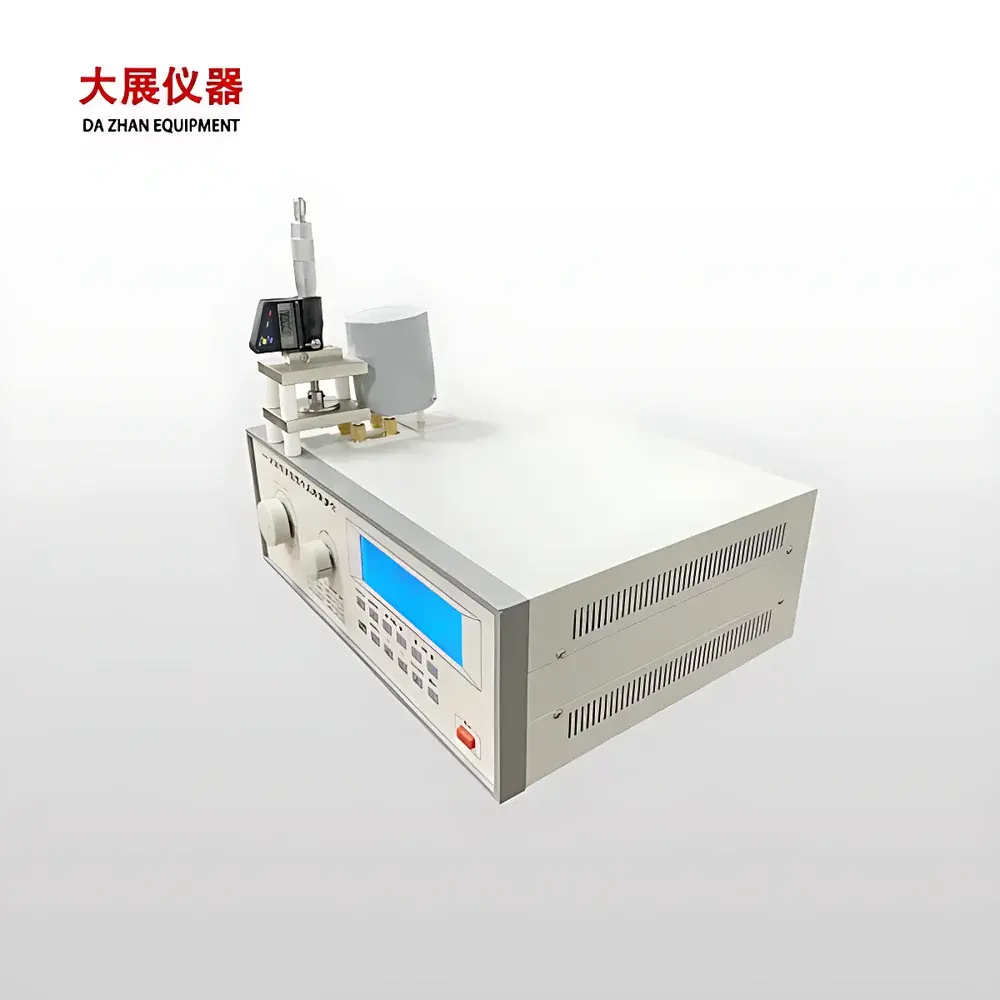
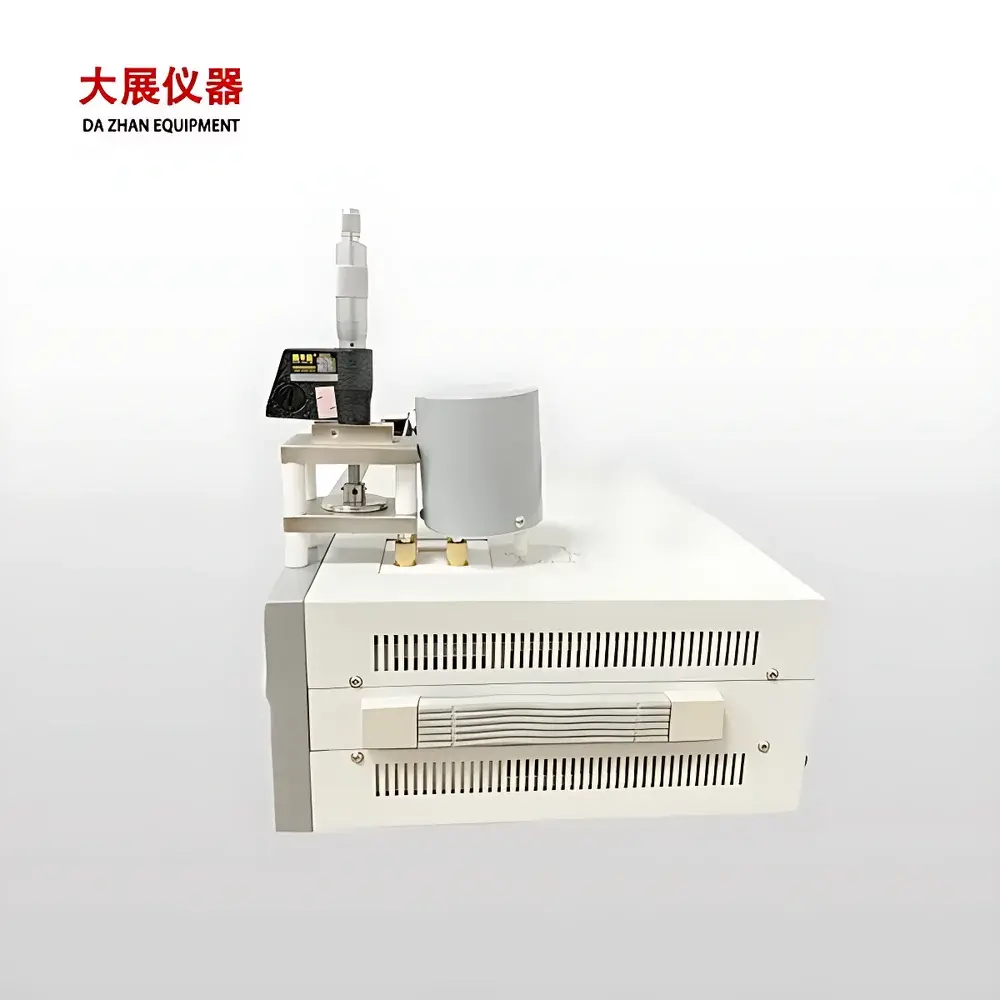
Nanjing Dazhan DZ5001 Dielectric Constant Meter
| Brand | Nanjing Dazhan |
|---|---|
| Origin | Jiangsu, China |
| Manufacturer Type | Direct Manufacturer |
| Model | DZ 5001 |
| Frequency Range | 10 kHz – 100 MHz |
| Frequency Accuracy | ±3×10⁻⁵ (6-digit resolution) |
| Sampling Resolution | 12-bit ADC |
| Q Factor Range | 1–1000 |
| Q Resolution | 0.1 (4-digit effective) |
| Q Measurement Error | <5% |
| Inductance Range | 1 nH – 140 mH |
| Inductance Resolution | 0.1 nH |
| Inductance Error | <3% |
| Main Tuning Capacitance | 17–240 pF (silver-plated monolithic) |
| Capacitance Direct Measurement Range | 1 pF – 25 nF |
| Capacitance Accuracy | ±1 pF or <1% |
| Capacitance Resolution | 0.1 pF |
| Automatic Resonance Search | Yes (stepper motor–driven) |
| Display Parameters | F, L, C, Q, Lt, Ct, Er, Tn, residual inductance, lead inductance correction |
Overview
The Nanjing Dazhan DZ5001 Dielectric Constant Meter is a precision impedance-resonance analyzer engineered for the quantitative determination of complex permittivity (εr′ and εr″) and loss tangent (tan δ) of solid and liquid dielectric materials. It operates on the principle of series/parallel resonance measurement using a high-stability DDS (Direct Digital Synthesis) signal source and a calibrated LC resonant cavity. By precisely measuring the resonant frequency shift and quality factor (Q) degradation induced by sample insertion into a defined electromagnetic field region, the instrument calculates relative permittivity (εr) and dissipation factor with traceable repeatability. Designed for laboratory-based R&D, quality control, and materials certification workflows, the DZ5001 supports standardized test methods aligned with ASTM D150, IEC 60250, and GB/T 1409—enabling consistent evaluation of insulating polymers, ceramics, composites, coatings, and electrolytes under controlled environmental conditions.
Key Features
- Wide-frequency DDS signal generation from 10 kHz to 100 MHz (7000:1 frequency coverage ratio), ensuring adaptability across low-loss and high-loss material regimes.
- High-resolution 12-bit analog-to-digital conversion system, delivering stable Q-factor readings essential for low-dielectric-loss materials (e.g., fused silica, polyimide films).
- Monolithic silver-plated tuning capacitor (17–240 pF) with ±1 pF absolute accuracy or <1% relative error, minimizing parasitic drift and thermal hysteresis.
- Stepper-motor–actuated automatic capacitance search and resonance tracking, eliminating manual nulling and reducing operator-induced variability.
- Integrated compensation for residual inductance and test-lead inductance—critical for maintaining measurement integrity at sub-nanohenry levels.
- Real-time LCD display of eight core parameters: resonant frequency (F), measured inductance (L), capacitance (C), Q factor, loaded inductance (Lt), tuned capacitance (Ct), relative permittivity (Er), and normalized temperature coefficient (Tn).
Sample Compatibility & Compliance
The DZ5001 accommodates standard parallel-plate, coaxial, and cavity-resonator sample fixtures (not included), supporting disk-shaped solids (diameter ≤25 mm, thickness 0.5–5 mm), thin films, powders (in dielectric holders), and low-conductivity liquids (e.g., transformer oil, silicone fluids). Its architecture enables compliance with ISO/IEC 17025–accredited testing procedures when used with certified reference materials (e.g., NIST SRM 1827). The instrument’s measurement uncertainty budget accounts for systematic contributions from frequency stability, ADC linearity, capacitor calibration traceability, and electromagnetic shielding integrity—making it suitable for internal QC documentation under GLP and pre-GMP environments.
Software & Data Management
While the DZ5001 operates as a stand-alone benchtop instrument, its RS-232 interface permits bidirectional communication with host PCs for automated data logging, batch reporting, and statistical process control (SPC) integration. Exported datasets include timestamped F, Q, L, C, and Er values per measurement cycle, formatted as CSV for compatibility with MATLAB, Python (NumPy/Pandas), and JMP. Audit trail functionality is implemented via firmware-level logging of calibration events, parameter changes, and user-initiated resonance sweeps—supporting basic FDA 21 CFR Part 11 readiness when paired with validated third-party data acquisition software.
Applications
- Quality assurance of high-frequency PCB substrates (e.g., Rogers RO4000®, Taconic RF-35) where εr consistency directly impacts impedance matching and signal integrity.
- Development of low-k dielectrics for semiconductor interlayer insulation, requiring tan δ < 0.002 at 1 MHz–1 GHz.
- Evaluation of moisture absorption in polymer encapsulants via time-dependent εr drift monitoring at fixed frequencies.
- Characterization of ferroelectric ceramics (e.g., BaTiO₃-based compositions) across temperature-controlled stages (external oven required).
- Verification of dielectric uniformity in multilayer ceramic capacitors (MLCCs) and piezoelectric transducers during incoming inspection.
FAQ
What sample geometries are supported without custom fixtures?
Standard measurements require flat, parallel-faced solid samples (diameter 10–25 mm, thickness 0.5–3 mm) placed between calibrated electrodes. Liquid samples must be contained in a shielded, temperature-stabilized cell with known electrode gap.
Is calibration traceable to national standards?
Yes—the main tuning capacitor and frequency synthesizer are factory-calibrated against NIM (National Institute of Metrology, China)–certified references; full calibration certificates (including uncertainty budgets) are available upon request.
Can the DZ5001 measure conductivity or resistivity?
No—it does not directly output DC resistivity. However, AC conductivity (σac) can be derived from εr″ and frequency using σac = ωε₀εr″, provided sample geometry and electrode configuration are precisely defined.
Does the instrument support temperature-dependent permittivity sweeps?
Not natively—the DZ5001 lacks integrated thermal control. For variable-temperature studies, users must integrate externally regulated hot/cold stages with compatible sample holders and manually log temperature alongside Er readings.
What maintenance is required to sustain measurement accuracy?
Annual verification of frequency accuracy and capacitor linearity is recommended. Cleaning of silver-plated capacitor surfaces with anhydrous ethanol and lint-free swabs prevents oxidation-related drift; no routine lubrication or alignment is needed due to stepper-motor–driven mechanics.



