
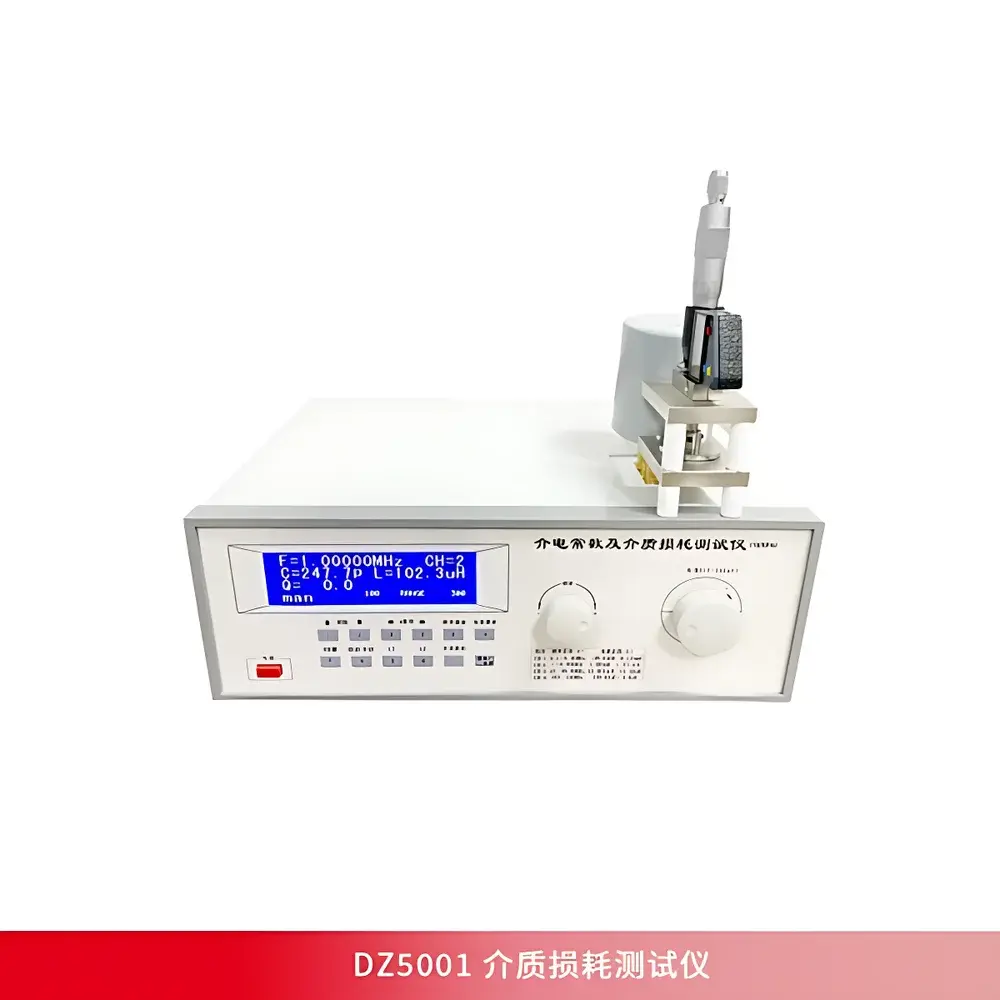
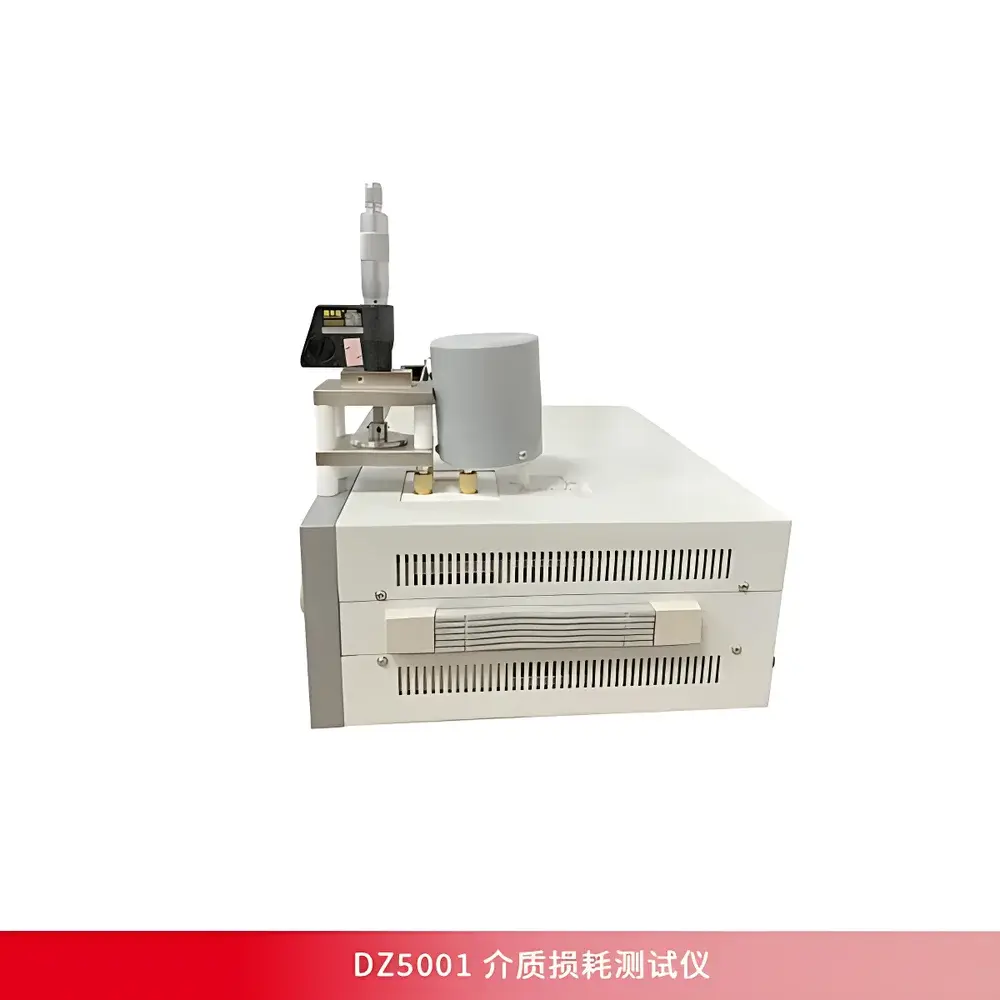
Nanjing Dazhan DZ5001 Dielectric Loss and Permittivity Analyzer
| Brand | Nanjing Dazhan |
|---|---|
| Origin | Jiangsu, China |
| Manufacturer Type | Direct Manufacturer |
| Country of Origin | China |
| Model | DZ5001 |
| Price Range | USD 1,400 – 4,200 |
| Measurement Principle | High-Frequency Resonance Method (Series/Parallel Resonant Circuit) |
| Frequency Range | 10 kHz – 100 MHz (DDS Synthesis, 7000:1 Sweep Ratio) |
| Frequency Accuracy | ±3×10⁻⁵ (6-digit resolution) |
| Capacitance Range | 1 pF – 25 nF (Direct Readout, ±1 pF or <1% error, 0.1 pF resolution) |
| Inductance Range | 1 nH – 140 mH (0.1 nH resolution, <3% error) |
| Q Factor Range | 1–1000 (4-digit display, 0.1 Q resolution, <5% measurement error) |
| Dielectric Constant (εᵣ) Accuracy | ±0.1% (3-digit LCD readout) |
| Dissipation Factor (tan δ) Accuracy | ±0.01% (4-digit LCD readout) |
| Sample Thickness Range | 0.1 mm – 10 mm |
| Auto-Nulling | Residual inductance & lead inductance compensation |
| Compliance | GB/T 1693–2007 |
Overview
The Nanjing Dazhan DZ5001 Dielectric Loss and Permittivity Analyzer is a precision high-frequency impedance measurement system engineered for the quantitative characterization of dielectric properties in solid insulating materials. It operates on the principle of series/parallel resonant circuit analysis using digitally synthesized sinusoidal excitation (DDS signal source), enabling stable, repeatable determination of complex permittivity (ε* = ε’ − jε”) across a broad frequency spectrum from 10 kHz to 100 MHz. The instrument directly computes relative permittivity (εᵣ) and dissipation factor (tan δ), two fundamental parameters governing energy storage and loss behavior in dielectrics under alternating electric fields. Its design adheres to the physical foundation of the resonance method—where sample capacitance and loss are extracted by measuring shifts in resonant frequency and bandwidth (Q-factor) of a calibrated LC tank circuit—ensuring traceability to SI-derived units and alignment with internationally recognized measurement paradigms for low-loss dielectrics.
Key Features
- High-stability DDS signal source with 6-digit frequency resolution (±3×10⁻⁵) and seamless 7000:1 frequency coverage (10 kHz–100 MHz), supporting broadband dispersion analysis.
- Integrated auto-tuning mechanism with stepper-motor-driven variable capacitor (17–240 pF, silver-plated monolithic construction) and real-time resonant point scanning.
- Simultaneous digital readout of multiple core parameters: resonant frequency (F), inductance (L), capacitance (C), Q-factor, effective capacitance (Ct), effective inductance (Lt), relative permittivity (εᵣ), and sample thickness (Tn).
- Onboard residual inductance and test-lead inductance compensation algorithm—eliminating systematic phase errors without manual nulling procedures.
- High-fidelity 12-bit ADC sampling architecture ensuring Q-factor stability (<5% error) even for ultra-low-loss materials (tan δ < 10⁻⁴).
- Dedicated micro-measurement stage with digital thickness gauge (0.1 mm–10 mm range, direct LCD readout) for standardized electrode gap control per GB/T 1693–2007.
Sample Compatibility & Compliance
The DZ5001 is optimized for flat, homogeneous, non-conductive solid specimens including ceramic substrates (alumina, zirconia), polymer films (polyimide, PET, PTFE), glass plates, mica sheets, and oxide-based thin-film composites. Sample geometry must conform to parallel-plate electrode configuration; minimum surface area ≥ 25 mm² and maximum lateral dimension ≤ 50 mm. The system supports both air-gap and guarded-electrode configurations per IEC 60250 and ASTM D150 guidelines. All measurements comply with GB/T 1693–2007 “Test Method for Dielectric Constant and Dissipation Factor of Solid Electrical Insulating Materials at Power, Audio and Radio Frequencies”, and its data structure is compatible with GLP/GMP documentation workflows requiring audit trails and parameter traceability.
Software & Data Management
While the DZ5001 operates as a stand-alone benchtop analyzer with full local LCD interface, it features RS-232 and optional USB-to-serial connectivity for external data logging. Raw measurement outputs—including time-stamped F, C, L, Q, εᵣ, and tan δ values—are exportable in CSV format for post-processing in MATLAB, Python (NumPy/SciPy), or Excel. The firmware implements internal calibration memory with factory-set reference standards (air, short-circuit, and NIST-traceable ceramic capacitor), supporting periodic verification per ISO/IEC 17025 requirements. No proprietary software installation is required; data acquisition can be integrated into LabVIEW or custom SCADA environments via standard ASCII command protocol.
Applications
This analyzer serves critical roles in materials R&D laboratories evaluating dielectric performance for high-frequency PCB substrates, RF/microwave packaging, capacitor dielectrics, piezoelectric ceramics, and aerospace-grade insulation systems. It supports quality control of batch-produced ceramic capacitors (MLCCs), validation of low-k polymer coatings in semiconductor interconnects, and comparative screening of bio-compatible polymer films for implantable sensors. In academic settings, it facilitates teaching of electromagnetic theory, complex impedance modeling, and frequency-dependent polarization mechanisms (dipolar, interfacial, ionic conduction). Its wide dynamic range enables characterization of both high-εᵣ ferroelectrics (εᵣ > 1000) and ultra-low-loss fluoropolymers (tan δ < 0.0002).
FAQ
What standards does the DZ5001 comply with?
It conforms to GB/T 1693–2007 and is functionally aligned with ASTM D150 and IEC 60250 for dielectric constant and dissipation factor measurement.
Can the instrument measure liquid or powder samples?
No—it is designed exclusively for solid, rigid, planar dielectrics with defined thickness and parallel surfaces.
Is calibration required before each use?
Factory calibration is retained in non-volatile memory; users perform daily verification using open/short/air standards per GB/T 1693–2007 Annex B.
Does the system support temperature-controlled measurements?
The base unit does not include environmental chamber integration, but it is compatible with third-party heated/cooled sample stages via external trigger and analog voltage input.
How is electrode contact resistance minimized during testing?
The instrument’s automatic lead inductance compensation and guarded measurement mode suppress parasitic effects; gold-plated spring-loaded electrodes are recommended for low-contact-resistance interfaces.
Related Products



